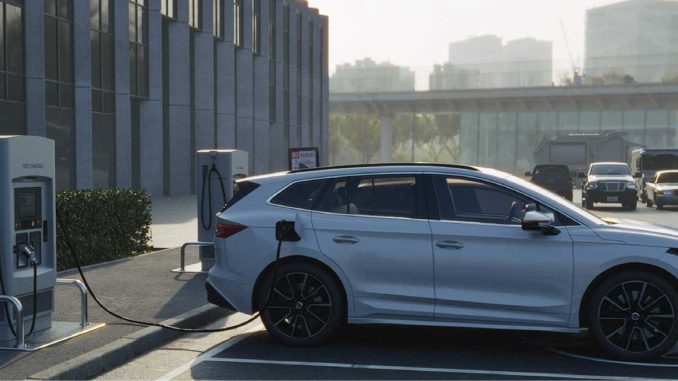
As part of its policy of decarbonisation, the government hopes that at least 30 per cent of private vehicles will be electric vehicles (EV) by 2030, along with 70 per cent of commercial cars, 40 per cent of buses and 80 per cent of two- and three-wheelers. If this comes to pass, 80 million EVs will be on the road by then.
One impediment to the “30 by 30” vision is a lack of charging infrastructure. Right now, with a much lower number of EVs, there is one public charging station for every 135 vehicles, and the distribution is uneven.
This presents an opportunity as well as significant challenges. Stringing together a charging network may require the equivalent of trillions of rupees in financing, as well as additional power capacity (on- and off-grid) to meet the rising EV demand.
The Ministry of Power has set minimum targets for charging infrastructure, mandating a charging station every 25 km on either side of highways, and at least one charging station in every 3 km by 3 km grid. Yet, by February 2024, India had only 12,146 operational EV charging stations, much less than stipulated.
The ideal ratio, going by global penetration, is somewhere between 6-20 EVs per charging station. Hitting the 20 EVs per charger ratio, assuming 80 million EVs, requires a network of 4 million public and semi-public charging stations. Even with less ambitious targets, a Confederation of Indian Industry report highlights the need for a minimum of 1.32 million charging stations by 2030.
It must be mentioned that there are massive variations in the estimates of EV charging costs and revenues, since traffic assumptions differ widely. The Centre for Energy Finance estimates a requirement of Rs 206 billion ($2.9 billion) in funding to meet public charging needs, with the assumption that 20 per cent of two-wheelers, 50 per cent of three-wheelers, 20 per cent of personal cars and 50 per cent of commercial cars will require charging at public stations.
But India Ratings and Research predicts that minimum investments of upwards of Rs 1 trillion will be required by 2032, assuming EV registrations will grow at a compound annual growth rate of 39 per cent. Even this estimate may be low if the ratio of 20 EVs per charging station is to be achieved, assuming the growth rate for EVs is realistic.
There has to be a return on investment for the charging point operator (CPO). Long payback periods, high upfront costs, and uncertainties regarding return on investment (RoI) make it hard to develop viable business models. Charging infrastructure could be privately owned at homes, or available for public use at locations such as malls, office complexes and petrol pumps.
There are policy incentives for charging infrastructure. The Bureau of Energy Efficiency is the central nodal agency that promotes charging. The Faster Adoption and Manufacturing of (Hybrid &) Electric Vehicles II scheme also provides incentives. There are subsidies and grants to support the setting up of charging stations through the PM E-DRIVE scheme, too. These subsidies cover some installation costs.
The EV Mitra initiative of 2025 offers subsidies for setting up charging infrastructure, to promote the creation of stations in public spaces and private properties, and along highways. The scheme also offers preferential interest rates and interest subsidies. CPOs are eligible for tax benefits, reduced registration fees, tax exemptions and other incentives that lower operational costs. Land allotted for stations may be available at subsidised rates, or on lease at favourable terms. In some states, reduced electricity tariffs are available.
But the successful development of a charging network will eventually depend on private sector investment even with the policy support. Several financing models are possible. Globally, public EV charging has evolved in four models: utility-led with franchises, automakers-led (“walled gardens” of chargers incompatible with each other), public sector undertaking-led and business-led. The walled model is unlikely, since India is standardising charging equipment.
Apart from franchise models, other innovative approaches to EV charging infrastructure financing will be needed to attract private sector investment, bridge the funding gap and support EV adoption.
When it comes to public-private partnerships (PPP), Delhi has rolled out a model. There are several companies setting up franchisee models, with Tata Power’s EZ Charge being the leader in this segment. Another option may be the utilisation of corporate social responsibility (CSR) funding, assuming this is acceptable on grounds of carbon reduction.
A charging station can offer some revenue streams beyond basic charging fees. Possibilities include advertising, promotions and revenue-sharing models where the franchisee collaborates with, say, a retail store or restaurant. As customers may shop while they wait, there may be extra traffic flowing to malls, restaurants or office complexes from contiguous charging stations. There are other tech-driven possibilities on the horizon, such as offering Wi-Fi hotspots and data analytics on user patterns.
According to an estimate by Tata Power, there is potential for high ROI for high-traffic areas. Profit margins can range upwards of 25 per cent, depending on location and usage. Projections suggest that investments for a charging station can be earned back within about four years in a high-traffic location. Scaling up, once the basic setup and land are there, is relatively easy, since adding more charging points is simple.
Investing in smart technology is key. As battery tech changes, smart systems optimising power usage and offering better load balancing will become important. Subscription-based models are worth exploring, whereby users pay a monthly fee to access charging networks – this offers assured cash flows. Battery swap models are catching on for two-wheelers.
A single charging station may cost between Rs 1 million-Rs 3 million to set up, which is roughly the same cost as a petrol pump. But compared to a pump, operating costs are much lower. To set up, a franchisee may require more initial investments, estimated at upwards of Rs 10 million by Tata Power, including setup costs, installation of charging equipment, land and necessary permissions.
Returns, for a CPO, come from direct charging revenue per kWh consumed, fleet partnerships, advertising, etc. Tata Power estimates that, subject to multiple factors, earnings could run between Rs 80,000-Rs 150,000 per month per charger.
One way could be PPPs, which allow for resource pooling, risk-sharing, and shared responsibilities. Delhi has implemented a PPP model, which is worth studying. It involved setting up 900 charging points at 100 locations in the PPP mode with a tariff as low as Rs 2 per unit.
There are several important aspects to the “Delhi Model”. The government, through its state nodal agency, Delhi Transco Limited, put together land parcels from different government agencies for renting out on a concessional basis to private bidders. The payment of land lease fees was deferred until revenue generation commenced, mitigating initial capital outlay.
This resolved one of the biggest constraints – land acquisition, as well as lowering costs. It also ensures good spatial planning for the network, in tune with feasibility analysis for each site. The government has also defrayed costs associated with upstream electrical infrastructure and linked lease rentals to revenues, addressing business viability.
The government has also encouraged the participation of stakeholders such as fleet operators, power distribution companies (discoms) and battery-swapping operators. Private sector operators were offered flexibility in determining charger combinations on 70 per cent of the space in each site. This enables them to keep up with evolving charging technology.
Bidding criteria for each site and each package of sites weighed lower service charges for end users as a positive criterion. Concessionaires pay a fixed rate of Re 0.70 per kWh of power sold to the site-owning agency. Competition among private bidders to acquire land led to negative service charge bids, resulting in EV charges of Rs 2 per unit.
This PPP model incentivises private sector involvement. This PPP structure reduces the need for initial capital investment and uncertain revenue streams, with the government offering subsidies and other forms of support. Transparency and fairness are essential to the success and long-term sustainability of such partnerships. So far, the Delhi PPP model has been successful and is being expanded for greater reach.
CSR funding, as mandated by the Companies Act, 2013, requires eligible companies to allocate at least 2 per cent of average net profits from the previous three financial years for CSR initiatives. CSR funding encourages investment in environmental causes. The annual CSR funding available exceeds Rs 260 billion, and at first glance, CSR can support EV infrastructure financing through investment in charging stations. Such investments can improve the environmental; and all lowercase score for the company and build a positive brand image.
Implementing innovative EV infrastructure financing approaches should not only be an imperative for the EV ecosystem, it will also have positive economic, environmental and social impacts, such as job creation, climate change mitigation, reduced pollution and increased energy security. The way the sector is developing indicates that a mix of several financial models will be required.