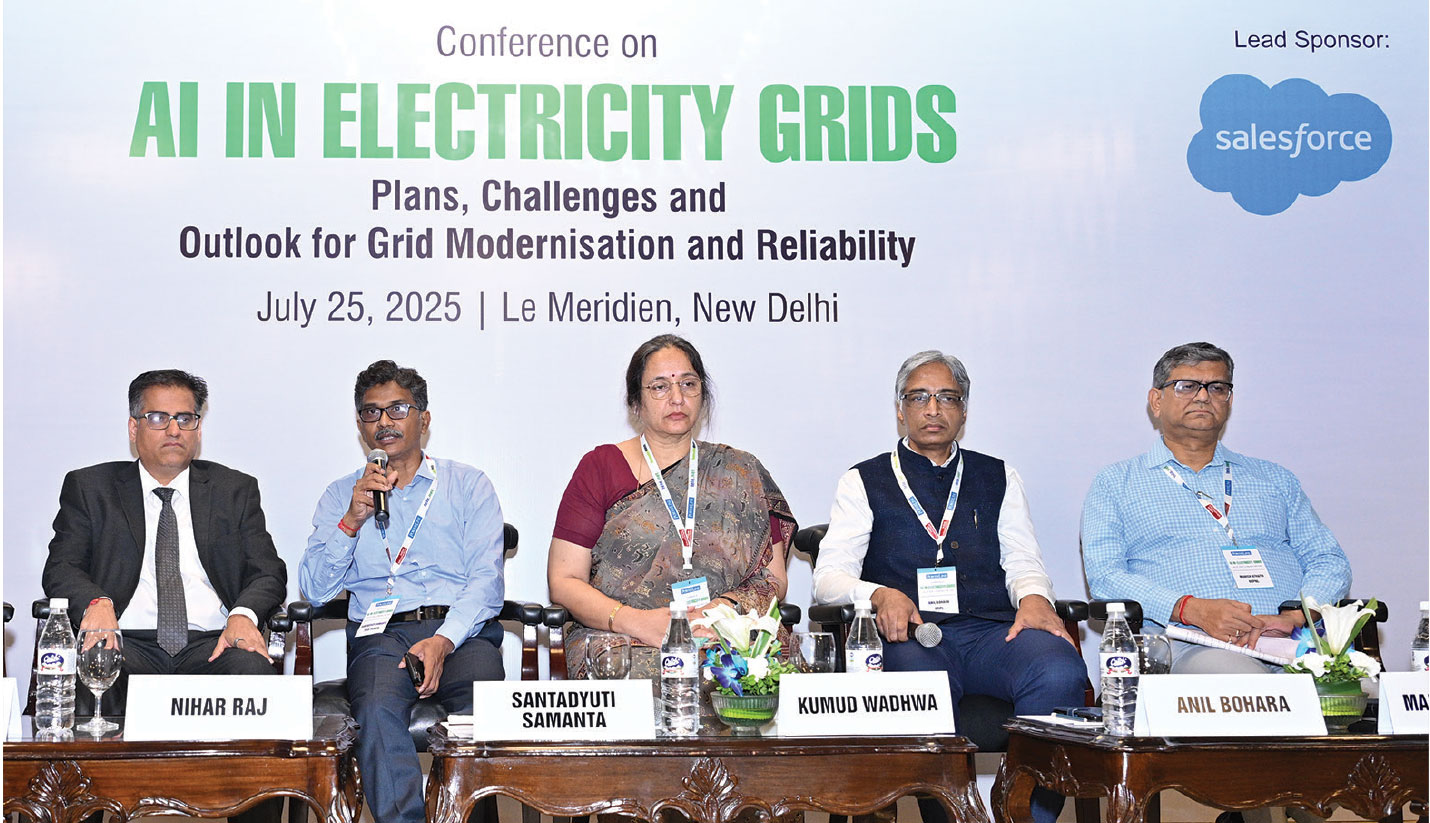
At a recent Power Line conference on “AI in Electricity Grid”, senior representatives from leading transmission and distribution utilities discussed the current status, challenges and future plans for artificial intelligence (AI) deployment in the power sector. The panellists were Kumud Wadhwa, Chief General Manager, Power Grid Corporation of India; Nihar Raj, Senior Vice President, Operations and Maintenance, Adani Energy Solutions; Santadyuti Samanta, Chief – D&IT (T&D), Tata Power Company; Manish Athaiya, Zonal Chief Engineer (T&C), Rajasthan Vidyut Prasaran Nigam Limited; and Anil Bohara, Head (System Operation, SCADA and Distribution Automation Projects), BSES Rajdhani Power Limited. Edited excerpts…
Current AI initiatives
Utilities across the transmission and distribution segments are actively exploring and implementing AI solutions to improve operational efficiency and service delivery. AI initiatives are being undertaken in areas such as asset management, project planning, consumer engagement and power scheduling.
Transco experience
Transcos have initiated their AI journey with a focus on improving business processes. AI is being applied in the design stage, in project management tools and through the creation of a maintenance GPT to assist ground-level workers with first-cut solutions and reduce outage times. Various solutions have been conceptualised with an AI-centric approach.
Transcos are using AI in asset management to scan images for model detection and are working on using AI for processing control documents, developing standard operating procedures and engineering drawings for intelligent knowledge management. To improve operations and maintenance (O&M) works, utilities are increasingly adopting drone-based image capture for line maintenance and preventive action. In addition, efforts are being made to develop areas such as intelligent knowledge management and cybersecurity mitigation using AI-based tools. Additionally, transcos are starting to adopt AI-based solutions from the engineering stage of the project itself. Utilities are focusing on developing database systems in order to improve data governance while maintaining data quality. They are also exploring AI applications to address business challenges in asset safety and O&M at the end-of-life stage.
For some state transmission utilities, advancements in the digitalisation of operations are being adopted, while AI-based solutions are yet to be explored. These utilities are focusing on the implementation of smart transmission networks and asset management systems for asset health management.
Discom experience
Discoms, especially private discoms, are deploying AI wherever opportunities arise to automate processes or assist operations. These solutions are being explored with the objective to ensure uninterrupted power supply for consumers. Moreover, operating in a regulated environment means that tariffs cannot be increased at will, so energy must be delivered at the minimum possible cost. Power quality must also be maintained while complying with all regulatory requirements.
Over the years, discoms have been integrating data from various climate agencies, Google services and other third-party sources with historical records to optimise power scheduling. This has helped minimise deviations and power purchase costs. In a particular area, historical feeder load data and detailed consumer usage patterns are combined with additional inputs, such as real-time weather conditions from private climate sensors, to estimate weather-and event-based consumption behaviour. This enables energy supply scheduling at the lowest possible cost. In AI applications, success depends on high-quality historical consumer data, professional third-party applications and strong internal data development capabilities. The availability of high quality granular data makes the applications of AI-based solutions easier to adopt.
A host of AI applications are being explored by discoms. Solutions are also being explored in the area of primary data creation. For example, in consumer onboarding, AI can be used to extract PAN details and streamline the journey. In services, optical character recognition is applied for meter reading, though complete automation is limited by current technology. The focus is on freeing up human effort by applying AI across functions such as customer onboarding, workforce management and work allocation, with targeted use cases in focus. For O&M, AI is being leveraged to automate the scheduling of orders, enable self-driven efficiency and reduce the need for manual data entry by extracting information from emails. Predictive models are used to identify and prioritise tasks, as well as detect theft during meter readings.
Implementation approach
To ensure smooth AI integration into the system, utilities are following a phased approach by starting with use cases that offer measurable operational benefits. One of the key focus areas is the use of AI for the predictive assessment of equipment health. Models are being developed to forecast asset failures, starting with pilot projects and retraining based on results before scaling deployment across the network. AI models for predictive assessment of equipment health are being used to forecast asset failures.
Given the importance of data protection, a hybrid approach is being followed to secure data and develop in-house solutions. AI-based solutions are being used for mapping optimised transmission line routes and engineering layouts. In the O&M phase, aged assets are a rich source of historical data, which can be used to enable AI to predict asset life. There are potential use cases of AI in inventory planning and management. Utilities are also undertaking business process re-engineering using AI-enabled applications to train the workforce
In state-owned companies, however, AI adoption can be challenging. Particularly, there are three key factors to address. First, the mindset and outlook of users must shift towards embracing IT and AI technologies. Second, with limited focus on IT and AI within utilities, it is important to identify employees genuinely interested in these technologies and equip them with the necessary skills. Third, AI technologies can be costly, which means that the management must be convinced of their long-term cost-saving potential.
Priority areas
With AI applications increasing progressively, utilities are mapping the top priority areas where AI can provide measurable gains in terms of improved planning and efficient operations. In the transmission segment, utilities have identified AI deployment in light detection and ranging-based services for vegetation data and line routing for cost estimation, which can help in the identification of vegetation growth along the route and undertake management.
On the distribution side, with increasing behind-the-meter loads, AI will be applied to manage this through primary data capture, which can be captured using customer forms. Additionally, AI can also be used for load segregation in the retail segment and theft detection in the industrial segment using signature analysis and industry mapping. Some demand response initiatives include smart switching, automated demand response and asset registration on the India Energy Stack to enable future business cases.
Future plans
Looking ahead, utilities have plans to focus on deploying AI use cases for project management and AI-based tools for skill management, with O&M as one of the priority areas. Private utilities also plan to focus on creating in-house GPTs, which they can use to meet cybersecurity goals and ensure safety and security in a protected environment. They also plan to adopt edge analytics, which will enable faster decision-making and capture data accurately to detect outliers. Future initiatives will revolve around digital self-service platforms and improving workforce efficiency. Additionally, with power scheduling now at a mature stage, the next priority is asset health management and predictive maintenance. This will cover lines, cables, drone surveys and both distribution and power transformers. The aim is to combine current and historical data, model it properly, and make informed decisions on shutdowns and maintenance. Additionally, 11 kV feeder automation has been undertaken on a large scale. In the coming years, the focus will be on maturing these systems, building field-level skills and leveraging the data these automated feeders generate to improve operational efficiency through AI.
As utilities look to advance further in their digital transformation journey, AI is a critical enabler for improving operational performance, predictive maintenance and smart grid planning.