Communication technologies are an integral component of an interconnected power system. Robust and interoperable communication technologies are vital to standardise head-end systems (HESs), meter data management systems (MDMS) and pluggable communication modules. At the heart of the communication system is a layered architecture, which comprises neighbourhood area networks (NANs) and wide area networks (WANs), backed by technologies such as radio frequency (RF) mesh, power line communications (PLCs), cellular internet of things (IoT) and fibre backbone.
Communication architecture
Two primary layers – NAN and WAN – serve as the basis of data transmission from devices situated in the field to utilities. They support functions such as metering, grid automation, outage detection and system control. Hence, the multilayered architecture enables utilities to transmit data seamlessly across the grid.
NAN forms the intermediate communication layer that connects smart meters to data concentrator units (DCUs) or gateways. For urban deployments, this includes RF mesh, which is a self-healing mesh topology that relays data through multiple nodes, thereby offering redundancy and decentralised communication. However, it suffers from interoperability limitations due to vendor-specific protocols. In rural areas, PLC transmits data over existing electrical wires using high frequency signals. Although it is a cost-effective solution, it is prone to electromagnetic interference and bandwidth constraints in load areas that are dense in nature. The Central Electricity Authority (CEA) has proposed the adoption of a unified HES and standardised interfaces based on the IEC 61968-9 protocol to ensure interoperability across vendors and technologies at the NAN level.
Meanwhile, WAN connects the DCUs and field gateways to the utility’s control centre platforms, including supervisory control and data acquisition (SCADA), MDMS and enterprise resource planning systems. It uses high-capacity technologies such as fibre optics, LTE/5G, narrowband IoT and satellite links to provide reliable, real-time communication across geographically dispersed infrastructure.
Technology selection
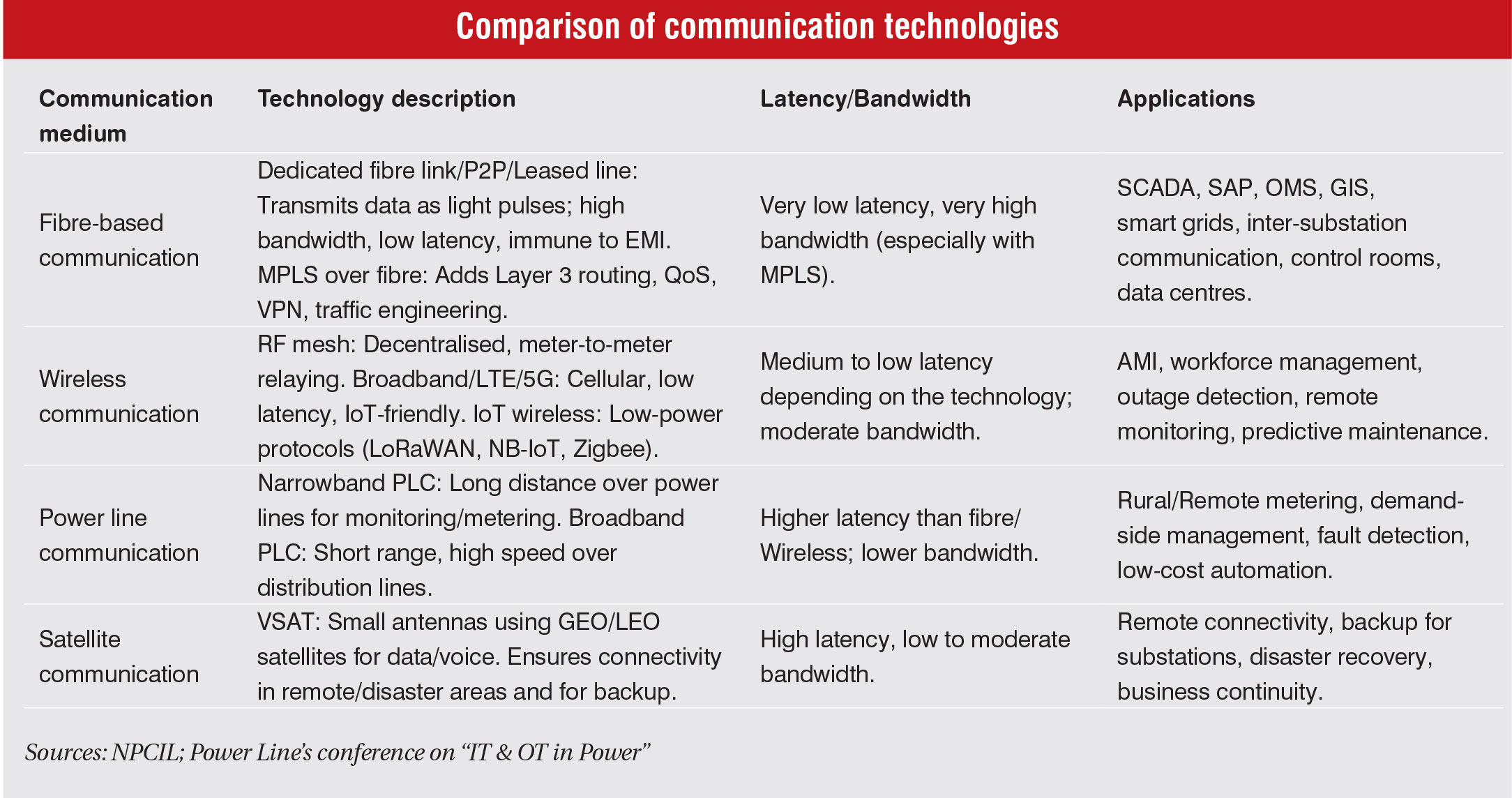
In India, utilities have adopted a diverse mix of communication technologies to support their deployments, depending on the medium. These include both non-cellular options such as PLC and RF wireless communication as well as satellite communication.
PLC has been favoured in rural and remote areas due to its ability to transmit data over existing electrical infrastructure and provide low-cost automated solutions. However, while discoms continue to experiment with PLC applications, there have been several limitations, including deployment challenges in difficult terrain, which have prompted a shift towards more suitable alternatives. For instance, in urban environments, wireless communication technologies such as RF mesh networks have seen wider deployments. They operate on a decentralised architecture where each meter acts as a relay node, forwarding data to concentrators through a self-healing, multi-hop route. This includes smart meters, SCADA instructions and IoT-based monitoring. However, they are likely to face challenges with interoperability and vendor-specific standards.
To address these concerns, the CEA released guidelines in 2024 to promote standardisation and interoperability of system architecture across AMI layers. The recommendations include a unified HES architecture, common communication interfaces and the introduction of pluggable modules that allow utilities to switch communication technologies without replacing entire meters. For high-bandwidth capacity, optic fibre communication remains the preferred medium. Utilities deploy dedicated fibre links to facilitate SCADA data transmission and substation-to-substation communication. Many utilities also overlay their fibre infrastructure with multiprotocol label switching (MPLS) to support secure routing and quality of service guarantees.
In remote areas, satellite communication technologies play a key role owing to their ability to serve as a backup link for isolated substations such as in the north-eastern states or near island territories, where there is lack of access to fibre or cellular coverage. This ensures a robust backbone infrastructure to ensure uninterrupted communication between field devices and control centres. Very small aperture terminal (VSAT) systems allow utilities to maintain connectivity in disaster-prone areas and ensure business continuity during extreme weather events. In such contexts, satellite links play a critical role in maintaining telemetry, enabling fault reporting and transmitting load despatch instructions.
 Key challenges
A common concern is the integration of modern communication platforms with ageing legacy infrastructure, which often lacks compatibility and requires substantial upgrades to support digitalisation and smart grid functionality. Interoperability issues arise due to the coexistence of multiple vendor ecosystems and proprietary protocols, complicating standardisation efforts and increasing long-term operational risk. Cybersecurity threats have also intensified with increased digital penetration, thus making critical grid assets prone to ransomware, data breaches and remote intrusion attempts. Utilities now face the dual burden of strengthening network defences and addressing a widening talent gap in specialised areas such as cybersecurity and IoT management.
Utilities often operate in complex environments that are characterised by harsh weather, challenging terrain and dispersed consumer bases, which make identification of suitable communication technology a challenge. Regulatory uncertainty and evolving compliance mandates add another layer of complexity, leading to delays in procurement cycles. Additionally, with growing customer expectations, there is demand for more transparent and personalised communication that relies on real-time energy data and seamless connectivity for billing and support services.
Future outlook
Looking ahead, several trends are set to shape the communication technology landscape in the power sector. The emergence of private 5G networks will give utilities greater control over their operating environment, particularly with the growing integration of distributed energy resources and the need for condition-based monitoring. To ensure long-term investment security, utilities must adopt technologies with robust development road maps and assured backward compatibility.
At the same time, the shift towards modular, vendor-neutral infrastructure will enable discoms to future-proof their systems. Integrating interoperable communication modules with smart meters can help reduce replacement costs, minimise downtime during upgrades and accelerate deployment. This approach also allows utilities to introduce new technologies over time without being locked into a single vendor ecosystem.