
For close to a decade, the UK has been considering introducing competitively appointed transmission owners (CATOs) in onshore electricity transmission, with the Office of Gas and Electricity Markets (Ofgem) initially discussing competitive tenders for onshore grid assets around 2016 after the success of the offshore transmission owner (OFTO) model. The CATO concept has gained significant momentum in recent years due to the urgent need to expand the grid to meet the net zero target. Recently, in July 2025, the UK’s energy regulator, Ofgem, published its final decision and updated policy position on the onshore electricity transmission early competition commercial framework. The latter will apply to CATOs, which will finance, build, operate and maintain assets in the electricity transmission network. This responsibility is currently held by three incumbent licensed transmission owners (TOs) – National Grid Electricity Transmission in England and Wales, SP Transmission in central and southern Scotland, and SSEN Transmission in northern Scotland.
The framework is being implemented in line with the Energy Act, 2023, and associated secondary legislation, which created the statutory basis for CATOs. As per Ofgem’s Tender Regulations, 2025, the National Energy System Operator (NESO) has been designated as the delivery body, responsible for running the competitive processes. The approach complements the government’s Clean Power 2030 Action Plan and wider net zero objectives, recognising the critical role of timely transmission build-out for integrating renewable generation.
Ofgem’s latest decision follows its earlier October 2024 consultation (which attracted 17 responses from TOs, potential new entrants, investors, suppliers and others) on NESO’s proposed commercial framework for onshore electricity transmission projects to be competitively tendered under the Early Competition regime. The latter model refers to opening up the development of large transmission reinforcements to competitive tendering before the detailed design stage. The commercial framework includes a range of mechanisms such as incentive structures, repricing model, payment arrangements and post-award obligations. The idea is to reduce costs, foster innovation, improve delivery and attract new sources of finance while safeguarding consumer interests.
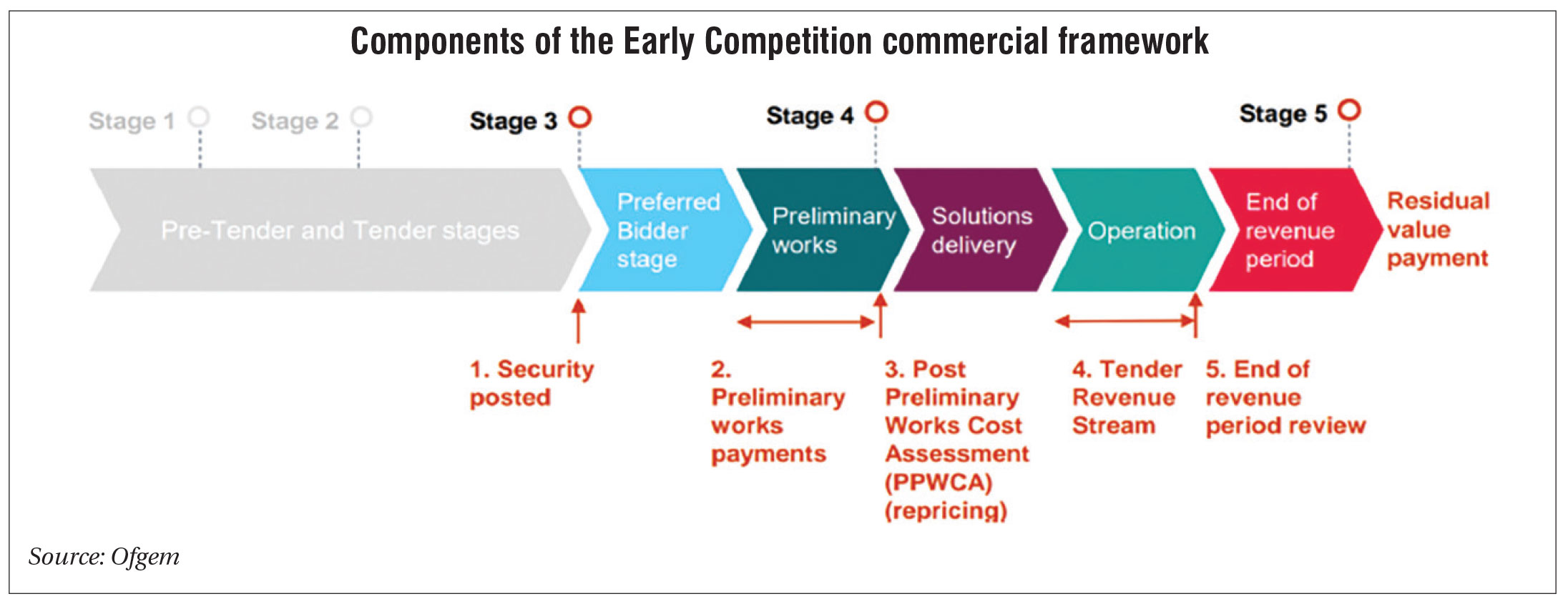 Ofgem’s latest policy will be implemented through the CATO electricity transmission licence, while the final decisions on the implementation mechanism of certain elements of the commercial framework will be made when it consults on the details of the CATO licence later in 2025.
The new framework will play a key role in opening investment opportunities in onshore networks for new entrants, which will be imperative if the GBP 58 billion of investment needs outlined in NESO’s “Beyond 2030” network design recommendations are to be met.
The key features of Ofgem’s framework are as follows:
- Post-award security obligation: CATOs must post security after being awarded a licence, equal to 10 per cent of forecast construction costs, capped at GBP 50 million for projects worth up to GBP 1 billion, with larger projects assessed on a case-by-case basis. Security will taper down to zero once the CATO has invested an equivalent amount in the project. Acceptable forms include performance bonds, letters of credit and parent company guarantees. This balances deterrence against non-delivery with bidder affordability. However, some respondents argued that the 10 per cent level was either too high (risking market entry) or too low (given potential cost overruns).
- Preliminary works payments: Ofgem has allowed payments for preliminary works (such as surveys, design, consents and stakeholder engagement), capped at 50 per cent of forecast preliminary costs, to reduce equity risk and encourage participation. Supply chain engagement will be encouraged through tender requirements, without customers having to fund down-payments to suppliers to avoid stranded costs. This whole approach mirrors elements of incumbent TO treatment and levels the playing field for new competitors.
- Post-preliminary works cost assessment: This mechanism allows cost adjustments for the time lag between bidding and construction, including indexation for inflation. Although NESO had proposed a 40 per cent cap on this adjustment and a reasonably foreseeable/unforeseeable test for eligible adjustments, Ofgem has decided that a cap higher than 40 per cent will apply for the first tender to ensure a strong level of bids. This balances investor financeability with consumer protection against runaway costs.
- Payment mechanism and performance incentives: NESO developed a tender revenue stream (TRS) model where CATOs recover revenues through a regulated stream linked to asset performance. TRS payments will begin once assets are commissioned. Performance standards will be enforced through financial penalties for under-delivery and potential rewards for exceeding benchmarks. Ofgem decided to align incentives closely with existing TO/OFTO regimes to ensure reliability while not overburdening new entrants. The intent is to maintain robust consumer protection while keeping the framework attractive to investors.
- Additional works obligation: Ofgem decided to accept NESO’s proposal to include an additional works obligation, emphasising documentation of scope/timing at the tender stage and allowing flexibility for larger or late-emerging needs. CATOs self-finance up to 20 per cent of original capex; between 20 and 50 per cent, CATOs can self-finance or receive regulated payments; and above 50 per cent, bespoke arrangements or retendering may occur. Unlike OFTOs, CATOs will not be capped at 20 per cent, given a greater likelihood of substantial onshore changes. This ensures CATOs contribute to wider network development while avoiding undue financial risk.
- Revenue period: Ofgem has agreed on a 35-year TRS from the point of asset commissioning, primarily availability-based and payable by NESO, with asset amortisation over 40 years, supported by residual value payments. Stakeholders highlighted the limited availability of long-term debt. Ofgem will therefore allocate refinancing risk partly to consumers and introduce gain-share mechanisms so consumers benefit if refinancing yields savings.
- Implementation and next steps: Ofgem has committed to consult on the CATO licence later in 2025. At the same time, NESO is currently assessing projects from the Holistic Network Design Follow Up Exercise (following ongoing impact assessments and network redesign) for their suitability for competition and will then assess projects submitted into the tCSNP 2 Refresh, expected to be published in 2026, with a view to identifying a first and subsequent pipeline of future projects for onshore competition. tCSNP 2 Refresh is an interim strategic energy planning process that assesses proposed network solutions developed by TOs and is a transitional phase in the development of the long-term centralised strategic network plan (CSNP), ensuring that intermediate steps are taken to address immediate network needs.
The Early Competition commercial framework represents a major reform of onshore electricity transmission in Great Britain. The framework balances risk allocation (between consumers and CATOs), financeability and long-term system needs. Ofgem has acknowledged the remaining challenges, especially around financing horizons and cost uncertainty, but has embedded flexibility to refine mechanisms as the regime matures. The framework is a cornerstone of the UK’s strategy to expand its transmission network rapidly and affordably to ensure the timely integration of renewables and achievement of net zero.