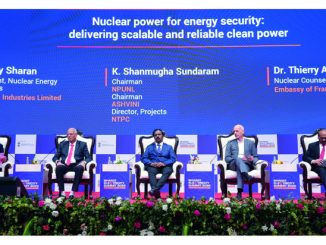
NTPC Parmanu Urja Nigam Limited (NPUNL), established in January 2025, marks the foray of NTPC Limited into the nuclear energy segment. This aligns with its strategy to expand its clean energy portfolio and support the country’s long-term energy transition goals.NPUNL will plan, develop, construct, operate and manage nuclear power projects and related facilities across India. Its mandate includes site identification, project design and construction, operations management, and research and development in nuclear technologies to build indigenous capability and ensure safe and efficient deployment of nuclear assets.
NTPC’s nuclear plans
India’s nuclear capacity currently accounts for less than 2 per cent of the country’s total installed base. With the government’s target of 100 GW of nuclear capacity by 2047, NTPC’s entry offers scope for scaling up capacity and accelerating project execution. NTPC currently operates an installed capacity of around 83 GW across the thermal, hydro and renewable segments. The creation of a dedicated subsidiary allows NTPC to pursue nuclear projects independently, while maintaining focus on the operational and regulatory requirements unique to this sector.
NPUNL has received necessary approvals from the Ministry of Power, the Department of Investment and Public Asset Management (DIPAM), and NITI Aayog.
Apart from NPUNL, NTPC has also set up Anushakti Vidhyut Nigam Limited (ASHVINI) – a joint venture company of NTPC and Nuclear Power Corporation of India Limited – for commissioning pressurised heavy water reactor (PHWR)nuclear projects. The Mahi Banswara Rajasthan Atomic Power Project, which will comprise four 700 MWe PHWRs, is being set up by ASHVINI. Recently, the prime minister laid the foundation stone for the project.
Early developments
NPUNL will be responsible for implementing nuclear projects and associated infrastructure. Initial activities include site studies and technology exploration. The company has obtained permission for site assessment at four potential locations in Madhya Pradesh. In parallel, it has invited global expressions of interest for pressurised water reactor technology and other advanced nuclear designs, with the aim of developing indigenous capability and local manufacturing partnerships.
On the fuel side, NTPC is exploring the acquisition of overseas uranium assets to ensure long-term supply security. An MoU has been drafted with the Uranium Corporation of India Limited for evaluating uranium mines abroad. These initiatives are intended to establish a stable and diversified fuel supply chain for future nuclear plants. Additionally, NTPC has partnered with the US-based Clean Core Thorium Energy to explore development/deployment of ANEEL (advanced nuclear energy for enriched life) fuel for PHWRs, subject to approval from the respective governments.
Industry challenges
Nuclear projects are inherently complex and capital intensive, with long gestation periods and stringent safety and regulatory requirements. Critical challenges include technology selection, financing, fuel procurement, waste management and the development of specialised technical and regulatory expertise distinct from NTPC’s conventional business segments.
Despite these challenges, policy support and growing demand for clean and firm power strengthen the business case for nuclear development. NTPC has indicated medium- to long-term plans to add up to 30 GW of nuclear capacity through NPUNL and other routes by the 2030s, positioning the subsidiary to play a central role in shaping the company’s future generation mix and supporting India’s transition to a low-carbon energy system.However, several measures need to be taken to address sector challenges and accelerate project implementation. Legal reforms, including amendments to the Atomic Energy Act and the Civil Liability for Nuclear Damage Act, will be necessary to gradually allow private and foreign investment. Financial incentives and government support, especially risk-sharing at early project stages, can help de-risk investments and attract new entrants.
Joint ventures and strategic partnerships will be important to fully leverage PHWR technology and ensure wider access to advanced nuclear capabilities. Collaboration on fuel and technology development can strengthen domestic capabilities, while reducing dependence on foreign technology. Regulatory streamlining, such as fast tracking approvals and adopting conditional review frameworks, will be key to accelerating project roll-out and ensuring timely deployment of new nuclear capacity.
Outlook
The formation of NPUNL creates a platform for NTPC to participate in India’s expanding nuclear power programme. The company will be able to leverage its project execution capabilities, financial strength and experience in large-scale generation to take up new nuclear projects independently and in partnership with other entities.
As India targets a substantial increase in non-fossil capacity, nuclear energy is expected to play a complementary role to renewables by providing reliable baseload generation. With policy support and a dedicated corporate structure, NPUNL could become a key participant in developing India’s next phase of low-carbon capacity.