India’s transmission network is witnessing rapid growth to cater to the country’s rising power demand and expanding generation capacity. In recent years, this growth has been marked by the physical expansion of the network and the deployment of higher transmission voltages and advanced technologies to enable large-scale power transfer. Transmission system planning and operations are also evolving to strengthen grid resilience and flexibility. Overall, a strong and reliable transmission system plays a key role in transmitting power efficiently across long distances, maintaining grid stability and ensuring uninterrupted power supply.
Size and growth
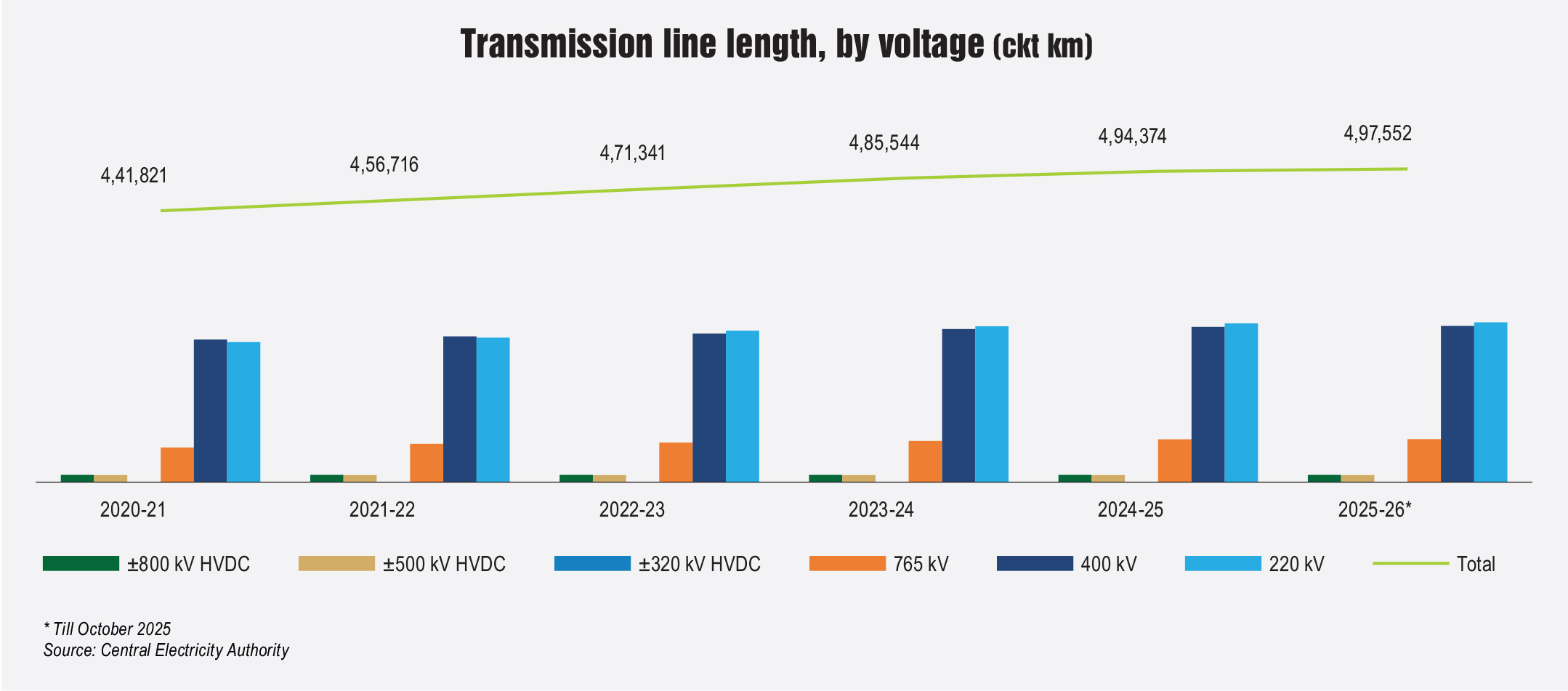
As of October 2025, the total length of transmission lines at the 220 kV level and above stood at 497,552 ckt km, comprising 57,323 ckt km (11.52 per cent) at the 765 kV level, 207,970 ckt km (41.8 per cent) at the 400 kV level and 212,884 ckt km (42.79 per cent) at the 230/220 kV level. At the high voltage direct current (HVDC) level, the line length stood at 9,655 ckt km at the ±800 kV level, 9,432 ckt km at the ±500 kV level and 288 ckt km at the ±320 kV level. In 2025-26 (up to October 2025), the total transmission line addition was 3,178 ckt km. Between 2019-20 and 2024-25, the transmission line length grew at a CAGR of 2.63 per cent.
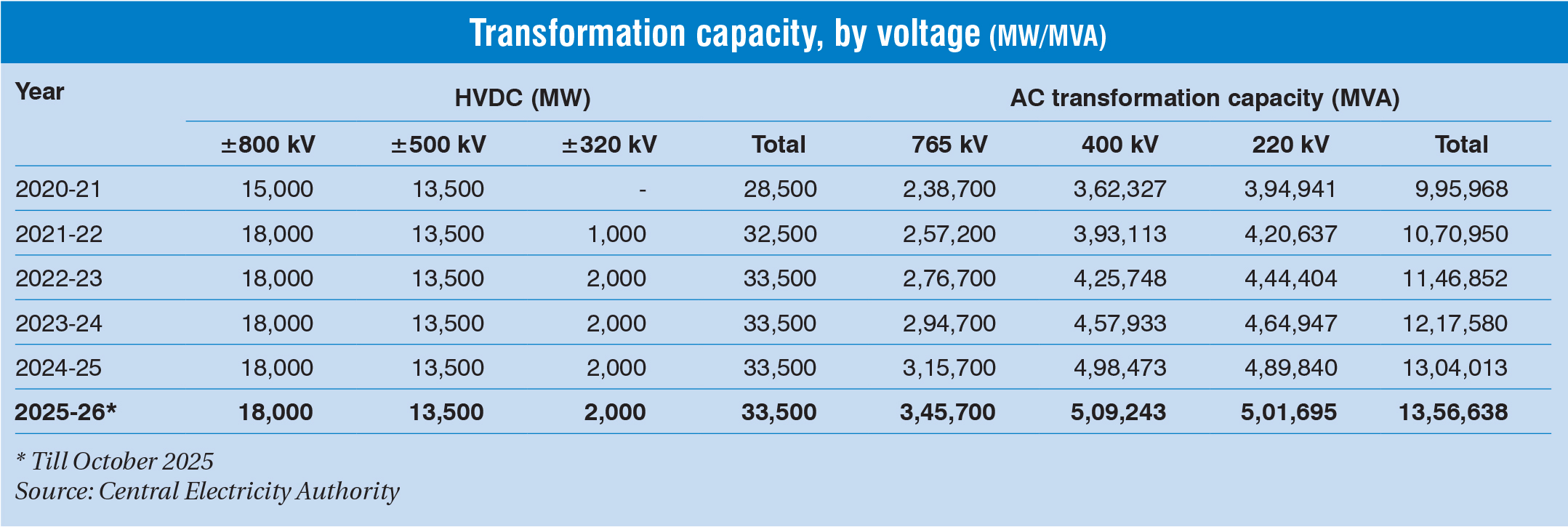
The transformation capacity across AC voltage levels stood at 1,356,638 MVA as of October 2025, comprising 345,700 MVA at the 765 kV level, 509,243 MVA at the 400 kV level and 501,695 MVA at the 230/220 kV level. Likewise, the aggregate HVDC capacity stood at 33,500 MW, comprising 18,000 MW at the ±800 kV level, 13,500 MW at the ±500 kV level and 2,000 MW at the ±320 kV level. Between 2019-20 and 2024-25, the AC transformation capacity grew at a CAGR of 6.7 per cent. Voltage-wise, the highest CAGR was recorded for the 765 kV and 400 kV levels, at around 6.4 per cent and 8 per cent respectively. HVDC transformation capacity grew at a CAGR of 5.6 per cent. The highest growth rate was witnessed for ±800 kV at a CAGR of 8.4 per cent.
During 2024-25, the total AC transformation capacity added was 86,433 MVA, while in 2025-26 (till October 2025), it was 52,625 MVA. As of September 2025, the interregional transmission capacity stood at 120,340 MW.
Key policy and regulatory developments
In March 2025, the Central Electricity Authority (CEA) notified guidelines for a unified philosophy for the placement of phasor measurement units (PMUs) in the electricity grid. These guidelines aim to improve grid monitoring and reliability by standardising PMU installation requirements across the power transmission network.
In June 2025, amendments were introduced to the standard bidding document (SBD) for tariff-based competitive bidding (TBCB), applicable to firm and despatchable renewable energy projects as well as competitive bidding processes for procuring power from solar, wind and solar-wind hybrid projects. The key changes are a reduction in the performance bank guarantee requirement from 5 per cent to 3 per cent of the expected project cost in order to ease the financial burden on project developers; permission for distribution licensees to approach the relevant electrical regulatory commission to avoid power sale agreement validation delays; and a stipulation that non-adherence to SBDs will require prior approval from the appropriate commission.
In January 2025, the CEA amended the Manual on Transmission Planning Criteria, 2023. The updated version introduces a uniform approach to inter/intra-state transmission system planning. It ensures that the system can manage multiple load generation scenarios and contingencies, coordinates transmission system expansion with power and load growth to avoid unnecessary expenditures, and highlights the need for customers and utilities to submit network access requirements with justification well in advance.
In March 2025, the Ministry of Power released supplementary guidelines for calculating compensation related to the right of way (RoW) for transmission lines. The supplementary guidelines address challenges related to land acquisition and compensation, ensuring that payments reflect the actual land value and providing transparency to stakeholders.
In September 2025, the Central Electricity Regulatory Commission notified the Connectivity and General Network Access to the Inter-State Transmission System (Third Amendment) Regulations, 2025, implementing comprehensive procedural and structural improvements. The amendments include key provisions such as the reallocation of unoccupied terminal bay capacities within interstate transmission system (ISTS) clusters, new rules for modifications in renewable sources for connectivity, and updated compliance requirements for land and financial closure. Further, the General Network Access amendment introduces new compliance monitoring frameworks, requiring regional load despatch centres to publish utilisation statistics; and strengthens control measures for transmission connection grantees from the application stage to the commercial operation date.
Green energy evacuation
Adequate evacuation for renewable energy sources is a must. To integrate wind/solar at scale, the Green Energy Corridors (GEC) scheme has been launched. GEC Phase I (which began in 2015), targets the evacuation of about 24 GW across eight states via 9,767 ckt km of lines and 22,689 MVA of substation capacity. Nearly 9,136 ckt km and 21,413 MVA have been commissioned so far under Phase I – completed in Madhya Pradesh, Rajasthan, Tamil Nadu and Karnataka; and delayed in other areas due to RoW/wildlife issues. GEC Phase II, which was approved in 2022, spans seven states, including Gujarat, Himachal Pradesh, Kerala, Uttar Pradesh and Tamil Nadu, with targets of approximately 7,574 ckt km and 29,737 MVA to evacuate about 20 GW of capacity. This is being implemented by state utilities, which receive central financial assistance of 33-40 per cent of the cost, and is slated for completion by 2025-26. Phase III of the scheme, with new proposals, is under consideration.
Beyond the GEC, India is developing transmission infrastructure from large renewable energy zones (REZs) across high-resource states to cluster multi-GW solar and wind development. These zones are tied to dedicated ISTS corridors to ensure timely, large-scale green power evacuation.
Other major green transmission projects are also underway. Dedicated ISTS lines for green hydrogen/ammonia hubs have been planned to serve 19-20 GW of green hydrogen by 2030, alongside offshore wind evacuation of about 10 GW envisaged off the Gujarat/Tamil Nadu coast. In 2024, the Ministry of New and Renewable Energy (MNRE) began planning coastal transmission for about 70 GW of anticipated green hydrogen demand by 2032. These corridors are being financed by mixed sources (central grants, loans from KfW/REC/PFC, and stakeholder contributions). Overall, GEC projects have received special funding (such as Rs 6 billion in Union Budget 2025) and are monitored by the CEA/MNRE to ensure timely completion.
 Growing private sector participation and PPP involvement
Tariff-based competitive bidding has grown significantly over the years, leading to reduced prices, faster project execution and greater private sector participation. As per the CEA, as of October 2025, a total of 91 transmission projects have been awarded through the TBCB mechanism. Of the total awarded projects, 46 projects, with a transmission line length of 20,662 ckt km and a transformation capacity of 185,100 MVA, were secured by Power Grid Corporation of India Limited (POWERGRID) and 45 projects were secured by private transmission service providers. As of October 2025, a total of 67 transmission projects have been commissioned through the TBCB route. Key private players in the transmission segment include Resonia (erstwhile Sterlite), Adani Energy Solutions Limited, Tata Power, IndiGrid and Apraava Energy.
Infrastructure investment trusts (InvITs) have become the flagship model for transmission monetisation, with POWERGRID and IndiGrid leading the market. The POWERGRID InvIT raised Rs 77 billion in 2021-22 by listing five lines. Notably, IndiGrid has since scaled rapidly, backed by global investors and a portfolio spanning both TBCB and brownfield acquisitions. The government is also mulling asset monetisation for state utilities, such as through acquire-operate-maintain-transfer (AOMT) models and InvITs to unlock private capital. The CEA has recently released a concept note outlining a structured framework for monetising intra-state transmission assets through the AOMT model, detailing the process, regulatory treatment and tax implications to help states operationalise monetisation effectively. This will unlock significant capital for investment in new projects and help meet the huge transmission capex requirement, estimated at over Rs 9 trillion by 2032.
Future outlook
As per the CEA’s National Electricity Plan (NEP)-Transmission, which outlines the transmission network requirements up to 2031-32, approximately 114,687 ckt km of transmission lines and about 776,330 MVA of transformation capacity at 220 kV and above will be added during 2022-27. The addition of about 1,000 MW of HVDC bipole capacity is also envisaged over the same period. Further, the NEP envisages the addition of about 76,787 ckt km of transmission lines and 497,855 MVA of transformation capacity at 220 kV and above during 2027-32. An additional 32,250 MW of HVDC bipole capacity is projected to be added during 2027-32. Overall, by 2031-32, transmission line length and transformation capacity are expected to reach 648,190 ckt km and 2,345,135 MVA respectively. HVDC bipole capacity is projected to be 34,500 MW by 2026-27 and 66,750 MW by 2027-32. Overall, the NEP estimates a total investment requirement of Rs 9 trillion up to 2031-32 for transmission network expansion and strengthening.
Notably, as per the CTUIL Rolling Plan (2030-31), 31,919 ckt km and 335,475 MVA of transmission line length and transformation capacity respectively are currently under construction and expected to be commissioned progressively up to 2030-31. This entails an investment of Rs 2.21 trillion. Additionally, transmission line and transformation capacity aggregating 35,343 ckt km and 294,122 MVA respectively, entailing a total cost of Rs 2.64 trillion, are under planning/approval/bidding.
 Challenges and the way forward
One of the key challenges facing the power transmission segment is keeping pace with renewable energy development. With the rapid increase in renewable capacity addition, there is a growing gap between clean power generation and the availability of evacuation infrastructure. This imbalance limits renewable integration and increases the risk of stranded assets and higher delivery costs. As per industry estimates, over 50 GW of renewable energy capacity remains stranded nationwide as of June 2025. The delays in the development of transmission infrastructure are owing to a host of structural and procedural bottlenecks, including RoW disputes, prolonged land acquisition processes, restrictions on equipment procurement and multi-agency approval requirements. One of the key affected states is Rajasthan, where, as per industry estimates, 8 GW of renewable energy capacity is stranded, with nearly half of this curtailed during peak solar hours on account of delayed completion of the associated transmission system.
RoW disputes remain one of the biggest obstacles to timely project completion. Delays in land acquisition, often triggered by compensation demands exceeding state-mandated rates, have not only pushed back construction timelines but also led to steep cost overruns across several states.
Institutional and regulatory complexities have further slowed progress. With electricity being a concurrent subject, both central and state authorities play key roles in planning and regulation. While this dual framework aims to promote decentralised decision-making, it has also resulted in multiple approval layers, causing uncertainty and long delays, from project conceptualisation to commissioning.
Adding to the strain are supply-side bottlenecks, including shortages of extra high voltage transformers, conductors and other components. Import restrictions and procurement constraints have made sourcing equipment more difficult, raising both costs and timelines for developers.
Additionally, lack of skilled manpower in the transmission segment hampers project execution, leading to delays in project commissioning. It also poses hurdles in the adoption of new technologies and solutions.