
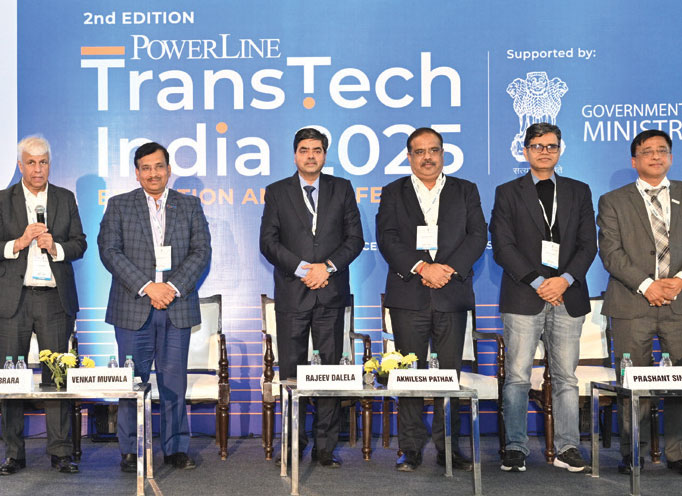
The “EPC Perspective” session at Power Line TransTech India 2025 featured a panel discussion among Rajeev Dalela, President (Domestic and SAARC), Kalpataru Projects International; Venkat Muvvala, President and Chief Business Officer, Infra and EPX Business, Jakson Group; Akhilesh Pathak, Executive Director, PMD, Power Grid Corporation of India (PowerGrid); Manish Shrivastav, Business Head, T&D Projects, APAR Industries; and Prashant Sinha, Chief Operating Officer, Resonia. The session focused on key industry challenges, the strategies required to address these issues, and the growing need for digital interventions and stronger project execution oversight. Edited excerpts…
The simultaneous floating of multiple transmission tenders is creating significant capacity constraints across the EPC ecosystem, particularly in terms of manpower availability and manufacturing capability for critical equipment such as transformers and switchgear. EPC players are also undertaking training and skills development initiatives. However, the development of specialised skill sets is a long-term process and continues to be geographically concentrated in a few states.
Project timelines have also become increasingly compressed, with most contracts requiring completion within 21-23 months, including the monsoon season. In states such as Gujarat, where the monsoon typically extends from mid-June to October, site accessibility is severely constrained, reducing the effective execution window to about 12 months. Within this period, EPC contractors are expected to complete the transmission lines, significantly intensifying execution pressures. The rapid expansion of renewable energy capacity has amplified these challenges further.
Right-of-way (RoW) remains one of the most significant challenges facing EPC players. The federal structure of the country has resulted in widely varying RoW policies across states, making transmission line construction relatively smooth in some regions and extremely difficult in others. The simultaneous development of multiple infrastructure projects has further intensified RoW constraints, often resulting in prolonged delays. Although states are expected to actively facilitate project execution, such support remains uneven across regions. Project delivery challenges were also noted for high-voltage substations, particularly 400 kV projects, due to certain contractual and technical requirements.
Rising material costs over the past 18 months have added to execution risks. The inclusion of price variation clauses in state-level contracts is essential to prevent undue financial exposure for EPC players. Supply chain constraints are another key challenge. To improve equipment availability and reduce lead times, there is a need to leverage production-linked incentive frameworks more actively for the transmission sector.
Solutions
The adoption of digital tools and mechanisation are widely recognised as critical to achieving the speed and scale required for future transmission build-out. Integrated programme management systems with digital visualisation capabilities are enabling better coordination, faster decision-making and improved execution monitoring. Significant progress has been made in the adoption of mechanised construction practices, with contractual mandates increasingly requiring the use of cranes and modern equipment. However, India’s varied terrain and geography necessitate customised solutions, and resistance among traditional labour groups remains a challenge.
Faceless digital billing and payment systems have emerged as a major enabler, allowing contractors to upload bills online, track their status in real time and receive payments without manual intervention. This has significantly improved turnaround times and reduced disputes.
The way forward
Looking ahead, the development of greenfield transmission corridors is becoming increasingly difficult due to land constraints, environmental clearances and RoW challenges. Above all, there is a strong need to focus on safety, quality and skilled project management. Project managers are increasingly required to function not only as engineers but also as effective coordinators capable of managing local stakeholders and navigating RoW challenges. Strong collaboration between developers and EPC contractors, with shared ownership of outcomes, is essential to sustaining the pace of India’s transmission expansion and supporting its broader energy transition.


