
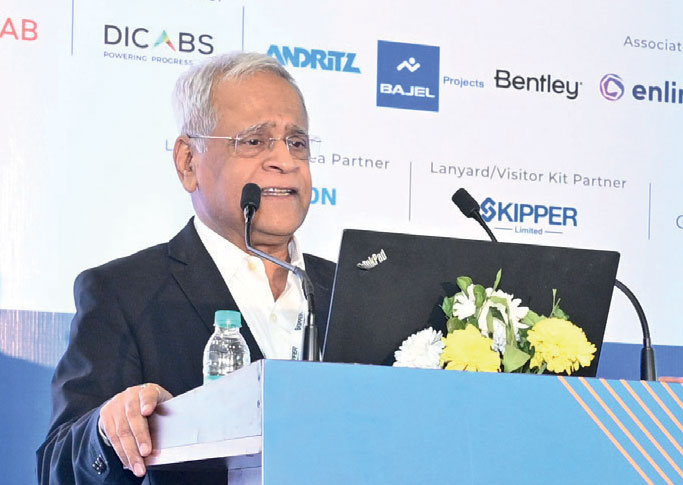
 S.K. Soonee, Former and Founding Chief Executive Officer of Power System Operation Corporation Limited (now Grid Controller of India Limited), delivered an address in the special session at the Power Line TransTech India 2025 Exhibition and Conference. He traced the milestones in transmission development, and highlighted the new role of optimisation techniques and future pathways for India’s transmission sector. Edited excerpts from his address…
India’s transmission network has evolved from largely linear, radial builds (132 kV, 220 kV to 400 kV in the 1960s–2000s) to highly meshed dynamic networks, with HVDC, 765 kV. Ambitious national objectives, such as 500 GW of renewable energy by 2030 and plans for offshore wind, electrolysers, data centres and cross-border links, are expected to exert unprecedented stress and strain on the transmission network, with a tangible risk of pushing transmission charges to double digit levels.
A well-planned electricity transmission system should be balanced in size and strength, underpinned by a robust recovery mechanism, with built-in provisions of safety and protection as well as effective maintenance. The deployment of new and innovative technology is indespensible for the integration of over 500 GW of renewable energy capacity by 2030. As inadequate transmission infrastructure poses high risks, the transmission planning needs to incorporate a short-term and long-term risk assessment, including uncertainties affecting power evacuation and, in turn, the power market.
Recent policy shifts, including initiatives such as general network access, PoC and pool-based transmission charge administration, have been transformative. Now that the transmission pool framework is in place for a multi-owner, multi-jurisdiction scenario, the next critical step is topology optimisation, ensuring that the physical network structure of the grid itself is economically and physically optimal in diurnal, seasonal scenarios, etc. The design of the market is being rapidly resolved in India; the next step is to optimise the structure of the network. Further, the integration of upcoming assets, such as green hydrogen projects, offshore wind projects and data centres, into the electricity grid will reflect unknown power demand patterns and evacuation requirements. Hence, the optimisation of existing transmission infrastructure becomes paramount.
The economic need for transmission comprises adding grid-enhancing technologies and is no longer confined to building new transmission infrastructure, but to minimising (not always eliminating) congestion and generation curtailments, upgrading ageing transmission lines (for example, with high-performance conductors, at higher voltage levels), which would need to be reconditioned now or in the future.
Topology optimisation
Transmission topology optimisation (TTO) is poised to become the next frontier for the Indian power transmission sector. The mechanism complements conventional congestion management by algorithmically finding reconfigurations to enhance the power network’s overall health. Typical actions include re-orienting lines of the identical voltage level at existing line crossings, construction of short small-line sections having a high-load angle difference per kilometre, substation topology re-arrangements by breaker/bus reconfiguration and evaluation of inter-utility coordination.
The objectives of TTO are multi-dimensional, including removal of overloads in transmission elements, minimisation of system losses, enhancement of renewable energy evacuation, stability improvement and better right-of-way visibility to planners and operators. The tangible benefits that TTO offers are reduced RoW requirement, savings in metal and labour costs, and improved utilisation of existing assets.
Future pathways
In transmission planning, there is now a compelling need to shift to TTO-topology optimisation. Besides, there is need for an emphasis on reliability and a more consolidated, comprehensive and proactive approach so as to get cost-effective optimal outcomes.


