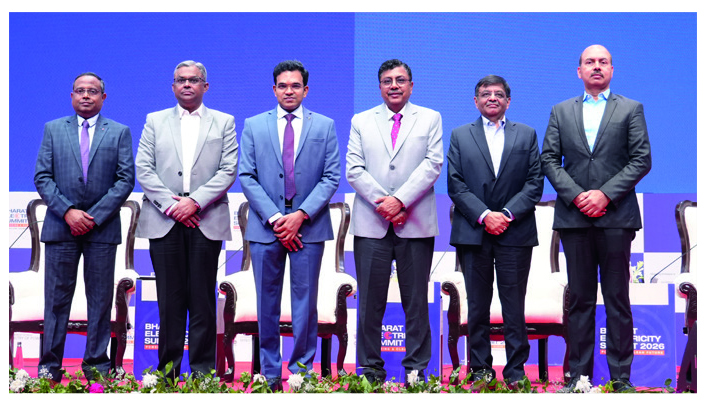
 The strategic session on “Next-generation Transmission Infrastructure and Operations: Real-time optimisation, automation and system-strength management” brought together key sector leaders to deliberate upon the evolving grid requirements amid rising renewable integration and system complexity. Moderated by Dr Subir Sen, Director (Technical), Tripura State Electricity Corporation Limited, the session featured insights from Samir Chandra Saxena, Chairman and Managing Director (MD), GRID-India; Naveen Srivastava, Director (Operations), Power Grid Corporation of India Limited (Powergrid); Dr Ram Prasath Manohar, IAS, MD, Karnataka Power Transmission Corporation Limited (KPTCL); Sandeep Zanzaria, Chief Executive Officer, GE Vernova T&D India Limited; and Akilur Rahman, Chief Technology Officer, India and Market Innovation Lead (South Asia), Hitachi Energy. Edited excerpts…
India’s power grid is at a defining crossroads. The power system that was established over decades – designed to cater to electricity generation from large thermal plants and predictable, unidirectional power flows – is now being developed to do manage a dynamic, multi-directional, renewable-rich network in real time. The traditional power system was built around a straightforward geography and for the unidirectional evacuation of power from source to sink.
The power infrastructure being under a lot of stress, owing to the rapid addition of renewable energy, particularly in the western and southern regions, has transformed power flow patterns from linear to dynamic and multi-directional. During solar hours, renewable-rich states such as Rajasthan export power to deficit regions across the grid. By evening, as solar generation tapers, those flows reverse. The grid now experiences more dynamic scenarios in power transmission depending on the time of day, the season and the weather – and the transmission system must respond according to these scenarios.
Congestion, once a problem primarily in importing regions, is now appearing in export conditions as well – particularly during periods of peak solar and wind generation. Increasing renewable penetration and distributed energy resources will necessitate enhanced reactive support through technologies such as statcoms and synchronous condensers, along with a robust system planning to manage variability and ensure grid stability.
In addition, next-generation transmission infrastructure is no longer optional but a necessity, driven by rapid growth in renewable integration and evolving grid dynamics. The transmission systems must not only support expansion but also ensure resilience, reliability and energy security in an increasingly complex operating environment. POWERGRID’s leadership in India’s successful transition to a “One Nation, One Grid, One Frequency” framework, has positioned the country among the world’s largest synchronised grids. As India prepares for generation capacities in the range of 780–800 GW, the transmission network must evolve to be robust, secure and future-ready at an entirely new order of magnitude.
The path forward for the transmission grid must involve digitally enabled, real-time monitoring platforms, backed by strong data infrastructure – moving away from periodic reporting toward continuous, granular situational awareness. Maintenance philosophy must shift decisively from preventive to predictive: leveraging sensor data, analytics and AI to anticipate failures across a vast physical network before they cascade into outages. Resilience must be built into both the physical and digital dimensions of the system – climate-resilient infrastructure design to withstand increasingly extreme weather events and robust cyber-security frameworks to protect a network that is becoming ever more digitally interconnected.
As India is moving toward a diversified energy portfolio to strengthen energy security, transforming the grid from a centralised, predictable system into a highly distributed, dynamic and interactive network that demands a fundamentally different approach to management and control becomes evident. The future grid will rely as much on intelligence, data and software as it does on towers, cables and substations. Technology domains, viz., distributed energy resource management systems, AI-driven transmission optimisation, and digital twins are expected to define the intelligence layer of this future grid.
India’s transmission challenge is not a future problem – it is a present-day operational reality. The solutions are known – statcoms, HVDC corridors, dynamic line rating, digital twins, DERMS platforms and predictive maintenance powered by AI.