 The finance minister has announced a set of measures in Union Budget 2026-27, spanning across higher customs duty reliefs, carbon capture support, transmission expansion for green corridors, public sector investments, and restructuring of non-banking financial institutions. A quick look at industry leaders’ views on this year’s budget announcement…
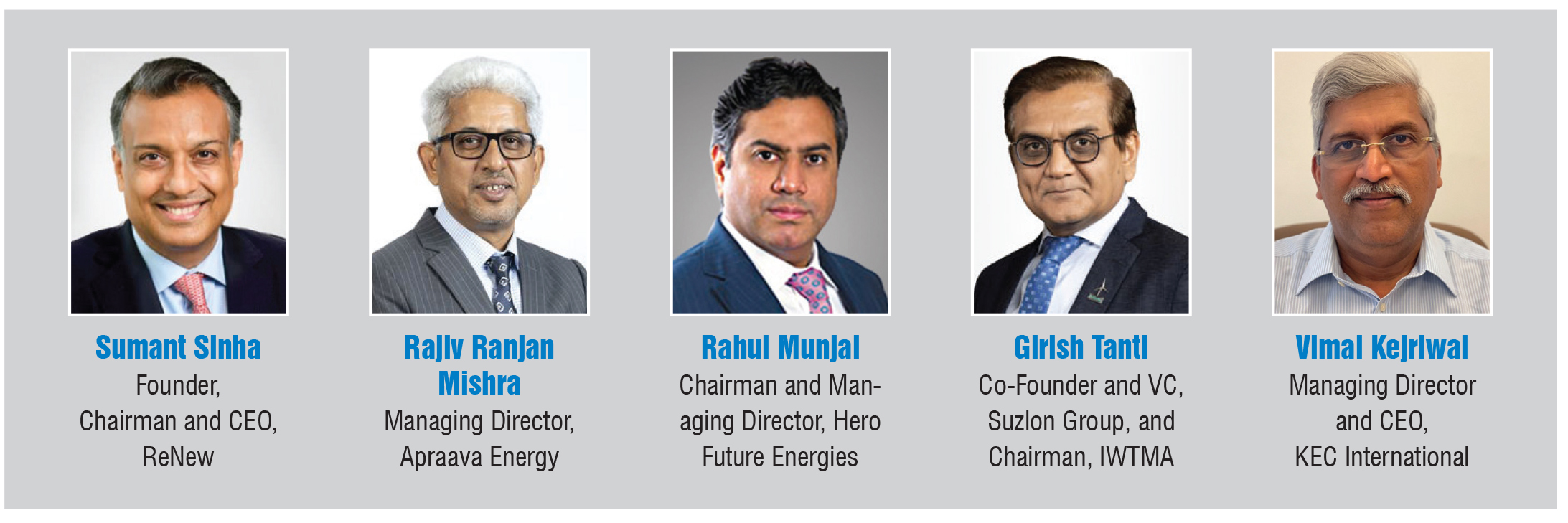
Sumant Sinha
Built like a road map designed for both sharp turns and long highways, Union budget 2026-27 gives clarity and confidence in a world defined by rapid shifts and long‑term challenges. It balances the immediate need for employment generation among the youth with disciplined fiscal consolidation, ensuring stability without slowing momentum.
By lowering or removing import duties on essential inputs and machinery, Union Budget 2026-27 makes it cheaper and easier for India to build strong domestic manufacturing capacity for strategic and export‑oriented products like batteries, semiconductor chips, garments and apparel. Its focus on critical minerals, carbon capture, utilisation, and storage (CCUS), and next‑generation nuclear technologies marks a decisive push towards the energy transition. Together, these measures signal a clear intent to build a resilient, competitive and opportunity‑ready economy to drive next‑generation clean energy sectors.
Rajiv Ranjan Mishra
Union Budget 2026-27 reflects a balanced and forward‑looking approach to strengthening India’s energy ecosystem, with a clear focus on reliability, sustainability and long‑term system resilience.
Policy support for battery energy storage directly addresses priority requirements of grid reliability and renewable integration. The extension of customs duty exemptions on capital goods used for lithium‑ion cells to include battery energy storage systems (BESSs), along with duty relief on key inputs such as sodium antimonate for solar glass, will help improve cost structures and support the scale‑up of grid‑level storage infrastructure that is essential for a flexible power system.
The proposed Rs 200 billion outlay over five years for CCUS further strengthens the transition pathway for emission‑intensive sectors such as power, steel, cement, refineries and chemicals. Enabling CCUS at scale allows critical infrastructure to decarbonise while continuing to meet growing energy and industrial demand.
Complementing these measures, the launch of the India Semiconductor Mission 2.0, with an outlay of Rs 400 billion, reinforces the development of enabling technologies and domestic manufacturing capabilities that underpin modern energy systems. Taken together, Union Budget 2026-27 provides a coherent and investment‑ready framework for building reliable, future‑ready and competitive energy infrastructure.
Rahul Munjal
I would like to congratulate the Hon’ble Finance Minister for rolling out a pragmatic yet visionary union budget, aimed at building a developed and self-reliant India. It sets a road map for inclusive, sustainable and accelerated economic growth, with a clear focus on robust infrastructure and connectivity, domestic manufacturing excellence, balanced regional growth and creation of a future-ready workforce. The government’s reform agenda marks a decisive shift from improving the “ease of doing business” to accelerating the “speed of doing business” through simplified regulations and technology-enabled approvals.
Targeted customs duty exemptions for Li-ion cells, BESSs and key clean energy manufacturing inputs will help scale domestic capacity and improve project viability. The commitment to CCUS acknowledges the need for credible transition pathways for sectors such as power, steel, cement and refining, while long-term support for nuclear energy creates a stable framework for capital-intensive energy investments.
Girish Tanti
Union Budget 2026-27 is a testament to our nation’s resilience and commitment to growth, even amid global uncertainty. With a significant increase in capex to Rs 12.2 trillion and energy spending to Rs 1 trillion, we are laying the foundation for a sustainable future. The focus on renewable energy growth, grid modernisation and energy security will accelerate India’s energy transition. The push towards Atmanirbhar Bharat by rationalising policies and incentivising innovation through production-linked incentives and tax benefits for domestic research and development and manufacturing are welcome moves. Bond market reforms will further boost our economic momentum. This inclusive and comprehensive budget ensures that we are on course for continued growth and prosperity.
Vimal Kejriwal
India’s Union Budget 2026-27 reinforces the government’s strong commitment to infrastructure-led growth. The scale-up of capex to Rs 12.2 trillion, along with the announcement of 20 new waterways and 7 high-speed rail corridors, underlines a clear focus on building nationally integrated transport and connectivity networks. For the engineering, procurement and construction (EPC) sector, this creates a positive and sustained demand environment across transmission, highways, railways and water infrastructure. KEC International is well aligned with these priorities, with deep execution capabilities across these segments. We welcome the continued emphasis on infrastructure, which will support long-term private investment, strengthen domestic supply chains and drive inclusive economic growth.
 Sharan Bansal
Union Budget 2026-27 highlights the government’s continued focus on achieving capital-led growth and developing long-term national infrastructure. The Budget raises capex to Rs 12.2 trillion for FY 2026-27, up from Rs 11.2 trillion in the previous year, reinforcing infrastructure investment as a key growth driver. The unambiguous difference between revenue spending and capex, as well as long-term commitments to the development of assets, gives infrastructure developers and manufacturers long-term visibility.
The budget focuses on capital formation, monitoring of outcomes and medium-term fiscal planning, which provides a stable policy environment in the energy transition in India. The fiscal deficit is targeted at 4.3 per cent of GDP for FY 2026-27, underscoring continued fiscal stability alongside investment push. The emphasis on productive capital spending and accountability will facilitate grid modernisation, a field that is well aligned with the ability of Skipper to supply power equipment, grid enabling systems and advanced engineering solutions.
Rajesh Ganesh
Union Budget 2026-27 is a strong reflection of the government’s vision for building a “Viksit Bharat”. By scaling up public capex to a historic Rs 12.2 trillion, the finance minister has provided the necessary fuel to accelerate India’s infrastructure-led growth engine.
For the power sector, the budget is particularly visionary. The focus on power sector reforms, specifically the incentives for intra-state transmission augmentation, distribution returns and additional borrowing power, is the catalyst needed to bridge the last-mile connectivity gap in the national grid. As India marches towards its 500 GW renewable energy target by 2030, the robustness of transmission infrastructure becomes paramount.
We see this as a strong opportunity. The government’s emphasis on infrastructure risk guarantees and manufacturing self-reliance aligns well with our strategic pivot towards becoming a specialised power transmission EPC player. Our ongoing investments in manufacturing expansion and backward integration are designed to leverage this very momentum, ensuring we commission complex interstate transmission systems and green energy corridor projects with execution excellence.
Chandra Kishore Thakur
We feel that this budget has rightly prioritised India’s energy security, especially the increasing role of renewables towards fulfilling this objective over the long term.
The relief in customs duty for the import of sodium antimonate used in the manufacture of solar glass is a step in the right direction. This move will reduce input costs for solar panel manufacturers and thereby augment domestic solar equipment production, giving an impetus to the entire sector in terms of Atmanirbhar Bharat.
The extending of basic customs duty exemption for capital goods used for the manufacturing of lithium-ion (Li-ion) cells for batteries, and to those used for manufacturing Li-ion cells for BESSs, is also a welcome decision. We must remember that BESSs significantly enhance the viability of solar power by addressing its intermittency and enabling efficient energy management. BESSs store excess solar generation for use during low-production periods, thereby augmenting overall system reliability and economics in the solar industry.
With these new measures, we are certain that renewable energy will play a vital role in India’s sustainable development, powering economic growth while reducing dependence on imported fossil fuels.
Rajesh Kumar Singh
Union Budget 2026-27 provides a strong and sustained policy signal for the expansion and modernisation of India’s power transmission and infrastructure ecosystem. The continued thrust on public capex, development of new dedicated freight corridors, creation of city economic regions, and targeted investments to ensure long-term energy security are critical enablers for strengthening the national grid and supporting India’s growing power demand. Measures such as the proposed Infrastructure Risk Guarantee Fund and accelerated asset monetisation through real estate investment trusts are expected to improve financing confidence, reduce execution risks and facilitate the timely completion of large-scale EPC projects. For Jyoti Structures, with a proven track record in executing extra high voltage transmission lines, substations and turnkey grid projects across India and international markets, the budget creates a conducive environment to support grid expansion, renewable energy integration and cross-regional connectivity, while reinforcing India’s broader electrification and infrastructure development priorities.
Jitendra Kumar Agarwal
Union Budget 2026-27 reinforces India’s medium-term growth trajectory by combining fiscal consolidation with a sustained public capex outlay of Rs 12.2 trillion, providing long-term visibility for infrastructure and energy investments.
From an energy perspective, the budget’s focus on system resilience is particularly relevant. As renewable capacity scales rapidly, grid-scale BESSs will be essential to manage variability and ensure dependable power delivery. Extending basic customs duty exemption to capital goods used for manufacturing BESSs is a material step towards accelerating deployment and lowering system costs.
Energy diversification is further strengthened through customs relief for solar manufacturing inputs and a Rs 200 billion, five-year commitment for CCUS. At scale, this reinforces the need for reliable, technology-enabled power systems to anchor India’s evolving industrial base and energy ambitions.

Simarpreet Singh
Union Budget 2026-27 signals that India’s energy transition will be driven by stronger capabilities, not just added capacity. The focus on industry-linked skilling will help build a workforce ready for the expanding renewable and power infrastructure ecosystem. Measures to strengthen domestic solar manufacturing, including duty exemptions on critical inputs like solar glass and sodium antimonate, will reduce import dependence and improve supply chain resilience. Bringing customs duty to zero on capital goods for Li-ion cell manufacturing will further accelerate energy storage adoption, which is crucial for grid stability and renewable integration. Together, these steps provide long-term clarity and confidence for investments across power transmission, renewables and energy storage.
Benjamin Lin
This budget brings together multiple strands of India’s manufacturing and technology growth story in a balanced and forward-looking manner. The Rs 400 billion allocation for the India Semiconductor Mission 2.0 and the enhanced outlay for electronics components manufacturing point to a clear focus on scale, depth and ecosystem development. When seen alongside targeted support for MSMEs through a Rs 100 billion growth fund, the policy framework addresses both large-scale manufacturing and the strength of the supplier base. By aligning capital support with capability building and innovation, the budget creates a solid foundation for sustainable, technology-led growth and reinforces India’s ambition to emerge as a globally competitive electronics manufacturing hub.
Kurang Panchal
Union Budget 2026-27 reinforces the government’s commitment to strengthening India’s power sector through sustained public investment and a focus on long-term energy security. Continued emphasis on infrastructure creation and urban development will support ongoing upgrades in transmission and distribution networks. As power demand rises and renewable capacity expands, these measures provide an enabling backdrop for investments aimed at improving network resilience, reducing outages and ensuring reliable supply across regions.
Teymur Abasguliyev
Union Budget 2026-27 sends a strong signal of continuity and confidence for India’s industrial and energy future. The emphasis on logistics efficiency, policy stability and technology-led reforms will materially improve project execution across the energy value chain and provide greater certainty for long-term investments.
Clarity on energy transition pathways, support for refining-petrochemical integration, and incentives for export-oriented downstream manufacturing are particularly encouraging and will help accelerate private sector participation. Combined with sustained capex, long-term infrastructure financing and focused skilling initiatives, these measures will enhance global competitiveness, deepen industrial ecosystems and enable sustainable job creation.
We also welcome the continued focus on micro, small and medium enterprises (MSMEs) and emerging energy transition areas such as CCUS and critical mineral corridors, which are essential for strengthening energy security and building resilient supply chains in an increasingly volatile global environment. At Nayara Energy, we remain committed to partnering with the government to translate these policy priorities into tangible growth, responsible investments and meaningful societal impact, while supporting a balanced and resilient energy transition.
Raju Kumar
Energy transition is a question of industrial resilience and system reliability, not just capacity expansion, which seems to be the key focus areas of Union Budget 2026-27. The establishment of rare Earth corridors in Odisha, Andhra Pradesh, Kerala and Tamil Nadu, alongside customs duty exemptions for capital goods used in critical mineral processing, directly addresses input security for renewables, storage and electric mobility. The Rs 200 billion CCUS programme provides a credible pathway to decarbonise power, steel and cement, while extending customs duty exemptions for nuclear projects till 2035 strengthens long-term baseload stability. On the tax front, exemptions for BESSs, Li-ion cells, solar glass inputs and biogas-blended compressed natural gas materially improve project viability. Collectively, these measures are likely to compress project costs, unlock private capital and accelerate deployment of storage-backed renewables, while the restructuring of PFC and REC could improve credit flow and execution discipline across the power sector.
 Anujesh Dwivedi
Union Budget 2026-27’s proposals signal a sharper push to mobilise capital and localise supply chains for the energy transition. The proposed restructuring of PFC and REC Limited is aimed at readying them for the larger electricity sector investments needed to support GDP growth alongside transition goals. Basic customs duty exemptions on imported capital goods for manufacturing Li-ion cells for batteries and BESSs, for critical minerals processing, and on sodium antimonate for solar glass manufacturing reinforce the focus on scaling domestic cleantech equipment. Extending basic customs duty exemption on goods required for nuclear power plants until 2035 should improve near-to medium-term project competitiveness. The Rs 200 billion, five-year outlay for CCUS across power, steel, cement, refineries and chemicals will accelerate decarbonisation and help protect export competitiveness amid the carbon border adjustment mechanism. Support for mineral-rich states to build rare Earth corridors will reduce import dependence for solar cells and Li-ion batteries.