

 By Pankaj Kumar Gupta, Chief General Manager (Energy Transition and Policy Research); K. Nagesh, General Manager (Station Engg); and Samir Sharma, Additional General Manager (Station Engg), NTPC Limited
India stands at a pivotal point in its energy landscape, tackling the dual imperative of reaching net zero emissions and fulfilling the aspirations of a Viksit Bharat by 2047. While the nation strives for extensive non-fossil capacity expansion, renewable energy remains variable and requires substantial storage solutions. Consequently, coal-based power plants continue to supply most of the baseload electricity, a pattern expected to persist until at least 2040 as energy demands rise.
 R&M: A preferable solution
The country faces a choice: build new coal stations or extend and modernise the life of existing plants through renovation and modernisation (R&M). Owing to the influx of renewable energy, new power stations often operate at partial load, reaching maximum output only during peak hours, meaning their full capacity is underutilised. Moreover, constructing new thermal power plants is a resource-intensive process, requiring substantial capital investment, land acquisition and environmental clearances.
In contrast, R&M of power plants is a cost-effective strategy to improve efficiency, achieve lower emissions and extend the life expectancy of ageing units. R&M can further equip old subcritical coal units to meet present-era operational challenges with respect to flexibilisation, such as technical minimum load (TML) operations, faster ramping requirements and two-shift operations.
R&M potential
As of March 2026, India’s installed power capacity stood at 532 GW, with coal contributing around 221 GW.
Accounting for 41 per cent of all-India installed capacity, coal power plants contributed about 70 per cent to electricity generation in 2025-26. This shows the importance of performance improvements in coal stations. As per initial assessment, 63.4 GW (223 no.) coal-based thermal power units are slated for R&M out of 221 GW. This equates to nearly one-third of India’s coal capacity, indicating substantial room for upgrading and efficiency improvements in older plants through appropriate advanced technological interventions.
R&M success stories
NTPC Ramagundam Stage 1 (3×200 MW)
NTPC Ramagundam Stage 1 is a notable example of R&M, where R&M led to a significant improvement of more than 180 kcal/kWh in unit heat rate, that too at a very low cost of Rs 6.1 million per MW. Major upgrades included replacing HIP and LP turbines, turbine stop and control valves, CRH NRV, gland steam system, turbine governing system, lube oil system modification, complete TG control system upgrade, ATRS, turbo supervisory system, HP/LP bypass control system, generator H2 coolers, seal oil and gas system, excitation system and terminal bushing.
GSECL Wanakbori TPS Unit 3
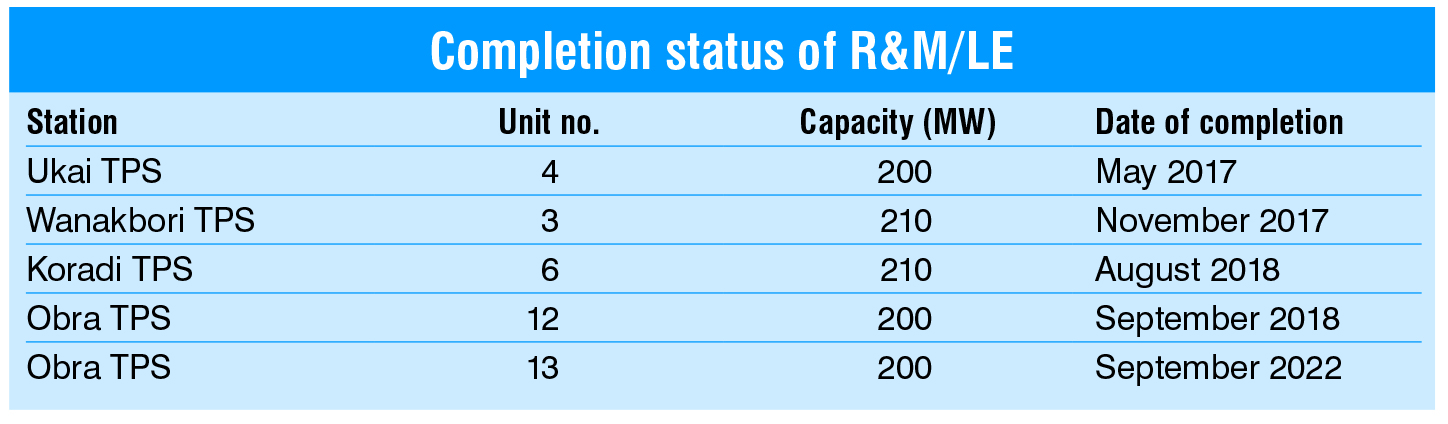
R&M of the 210 MW Unit 3 of the Wanakbori TPS is another example. Major works covered in R&M were:
- HP and IP module replacement
- LPT internals replaced
- Guaranteed turbine heat rate – 1,950 kcal per kWh
After R&M, the turbine cycle heat rate improved by 315.8 kcal per kWh. The R&M cost was Rs 4.5 million per MW with an awarded cost of Rs 940 million.
R&M possibilities: Improvement in net heat rate and flexibilisation (TML, fast ramping and two-shift operation)
An improvement of 50-100 kcal in net heat rate is very much possible in every old unit considering the unit vintage and its present operating condition. Based on performance gaps in actual operating conditions compared to design conditions, turbine replacement along with associated auxiliaries can be the most important R&M intervention.
Apart from performance deterioration, flexibilisation due to fast renewable energy integration is an another important factor necessitating R&M of coal stations.
Through R&M, subcritical units can be made ready for faster start/stops, TML operation, frequent ramping up/down and two-shift operation.
For R&M of subcritical units, a few suggestive interventions to achieve flexibility objectives are given below:
- Boiler tubes material upgrades that may include resizing of thick wall components.
- Improved water wall tube/fin system design and spray system resizing.
- Coal mills with dynamic classifiers for better response to throughput requirement during ramps and combustion stability with higher fineness at part loads.
- Advanced burner designs to ensure better combustion stability by maintaining appropriate velocities at all loads.
- Extensive use of variable frequency drives.
- Duct redesigning along with gates/dampers to avoid ash accumulation.
- Advanced turbines with bypass systems.
- Advanced governing and excitation systems.
- Adoption of condensing polishing units.
Apart from flexibility and efficiency improvements, appropriate interventions can be made to meet the latest stringent environmental norms.
Challenges in execution of R&M
Despite its numerous advantages, the execution of R&M projects is fraught with challenges. Renovating a coal station is rarely a straightforward task; in fact, it is sometimes considered more complex than establishing a new plant. While new plants are designed with modern equipment and layout requirement consideration, R&M projects are expected to reuse old foundations after due diligence and integrate new equipment into outdated piping and cabling routings. The following are the major challenges in execution of R&M:
- Engineering and structural constraints: The use of old foundations for new equipment necessitates careful engineering to ensure compatibility.
- Vendor availability: Often, after initial interest during the budgetary offer submission stage, only a handful of bidders participate in the tendering process, leading to restricted competition and potentially higher prices.
- Documentation and data gaps: A number of times, the required drawings and historical data are unavailable, which hinders the redesigning of new equipment and systems.
- Cost estimation uncertainties: Delays caused by the aforementioned issues, often lead to discrepancies between bid prices and quoted prices during the budgetary offer stage.
A lot of times, the obsolescence of certain components and the non-availability of spare parts make the replacements or upgrades difficult.
Suggestive road map for R&M
To navigate these challenges, a well-structured R&M road map is essential. Any R&M plan should commence with a thorough performance and data analysis of the station. For regulated sectors, two provisions exist for R&M in stations with units older than 25 years:
- Comprehensive R&M route: This approach involves a detailed work plan, including a shutdown programme, to address all aspects of renovation and modernisation.
- Special allowance route: Under this provision, Rs 1.075 million per MW is allocated for units eligible for R&M. The budget is calculated as a lump sum amount available for five years, aligned with the tariff period, and generally does not require R&M-specific unit shutdowns.
Selecting the appropriate route depends on the station’s condition, the regulatory framework and the financial viability of the project. The comprehensive route, with detailed planning and shutdown management, is suitable for stations to meet present operational challenges. The special allowance route, meanwhile, offers flexibility for minor replacement and upgrades without major disruptions.
Methodology for comprehensive R&M of coal stations
A systematic methodology is crucial for successful R&M execution. The following steps outline the recommended approach for comprehensive renovation and modernisation:
- Residual life assessment
- Performance analysis
- Breakdown and outage screening
- Obsolescence and spare parts availability
- Efficiency parameter analysis and performance evaluation test
- Operational parameter analysis
- Condition monitoring
- Addressing safety and environmental concerns
Based on due analysis, a detailed report should be prepared that may include all recommendations to achieve above-mentioned objectives of R&M along with techno commercial analysis and funding arrangements.
NTPC’s role in R&M of Indian power stations
Having successfully handled the R&M of nearly 15 GW in 200/210 MW and 500 MW coal units over the last 15 years, NTPC can play a major role in upgrading Indian power stations and advancing the Make in India initiative.
Recently, NTPC completed the detailed project report for R&M of the 3 x 210 MW DVC Mejia plant. NTPC provides consultancy services through its dedicated wing for R&M studies, preparation of technical specifications, etc.
Conclusion
R&M is not merely a technical exercise; it is a holistic process that demands careful planning, investment and collaboration. With the right roadmap and commitment, old thermal power stations can be transformed into efficient, reliable and environmentally responsible contributors to the energy landscape. Moreover, R&M may enable better flexibility for technical minimum loads, faster ramping and two shift operation requirements along with the possibility of achieving a 2-5 per cent reduction in emission intensity.