As thermal power plants (TPPs) operate under increasing pressure to improve efficiency, reliability and environmental compliance, automation is emerging as a key enabler of smarter plant operations. The integration of advanced technologies such as internet of things (IoT), artificial intelligence (AI), machine learning (ML), analytics and digital monitoring systems is transforming the way thermal plants are operated and maintained. These technologies are helping utilities optimise performance, reduce downtime, improve safety and enhance maintenance practices, while supporting sustainability and cost efficiency.
Role of IoT, AI and analytics in TPPs
The implementation of advanced digital technologies such as the IoT, AI and advanced analytics is playing a crucial role in enhancing the performance of TPPs. Equipment manufacturers, utility companies and consulting firms are increasingly deploying these technologies to address operational challenges and improve plant efficiency, reliability and sustainability.
TPPs involve multiple operational and business parameters, including revenue and costs, raw material management, equipment condition, process monitoring, emission compliance and safety requirements. These functions generate large volumes of data through systems such as enterprise resource planning, laboratory information management systems, distributed control systems, data lakes and manufacturing execution systems. At the same time, utilities face challenges such as large and critical equipment, dynamic processes, varying coal quality, equipment degradation, stringent emission norms and safety requirements.
Digitalisation is supporting business optimisation, operational efficiency and asset performance management. It helps maximise revenue, reduce costs and improve equipment availability while minimising maintenance expenditure and forced outages. Advanced digital tools are also enabling better process and equipment monitoring, including soft sensing of boiler furnace conditions, detection of changes in coal quality, prediction of catalyst degradation in selective catalytic reduction (SCR) systems, and monitoring of fouling in air preheaters (APHs).
In addition, digital technologies are supporting real-time operational optimisation by improving the efficiency of boilers, turbines, APHs, SCR systems and flue gas desulphurisation units. They also help reduce emissions, optimise chemical use, improve safety and streamline maintenance activities. Further, predictive analytics enables early fault detection and helps minimise unplanned shutdowns, thereby improving overall plant reliability and performance.
Digital technologies
Advanced combustion optimisation technologies: At the operational level, advanced combustion optimisation technologies are helping plants achieve better environmental and efficiency outcomes. These solutions monitor parameters such as SOx, NOx and particulate emissions in real time and optimise combustion conditions accordingly.
Digital twin: A digital twin is a cyber-physical system that replicates the behaviour of a real-life physical system while maintaining real-time communication with the actual plant system to support improved operational performance. It uses models trained on historical plant data along with advanced algorithms to predict plant behaviour under present operating conditions and provide prescriptive recommendations for optimising performance. In addition, physics-based predictive models are employed to improve the accuracy of complex process simulations. Digital twin technology enables the optimisation of key performance indicators that often involve conflicting objectives and operational constraints at the equipment, plant and site levels. Advanced industrial analytics integrated with optimisation and control capabilities support complex multi-objective decision-making through the use of the IoT and cloud technologies.
Drones: A wide range of digital interventions are currently being deployed in TPPs. Drones, for instance, are increasingly used for stockyard monitoring, hotspot detection and inspection activities. They enable plant operators to identify potential risks and equipment faults much earlier than traditional inspection methods. Drones are also being used to detect boiler tube leakages, which typically become visible only after the boiler is cooled down.
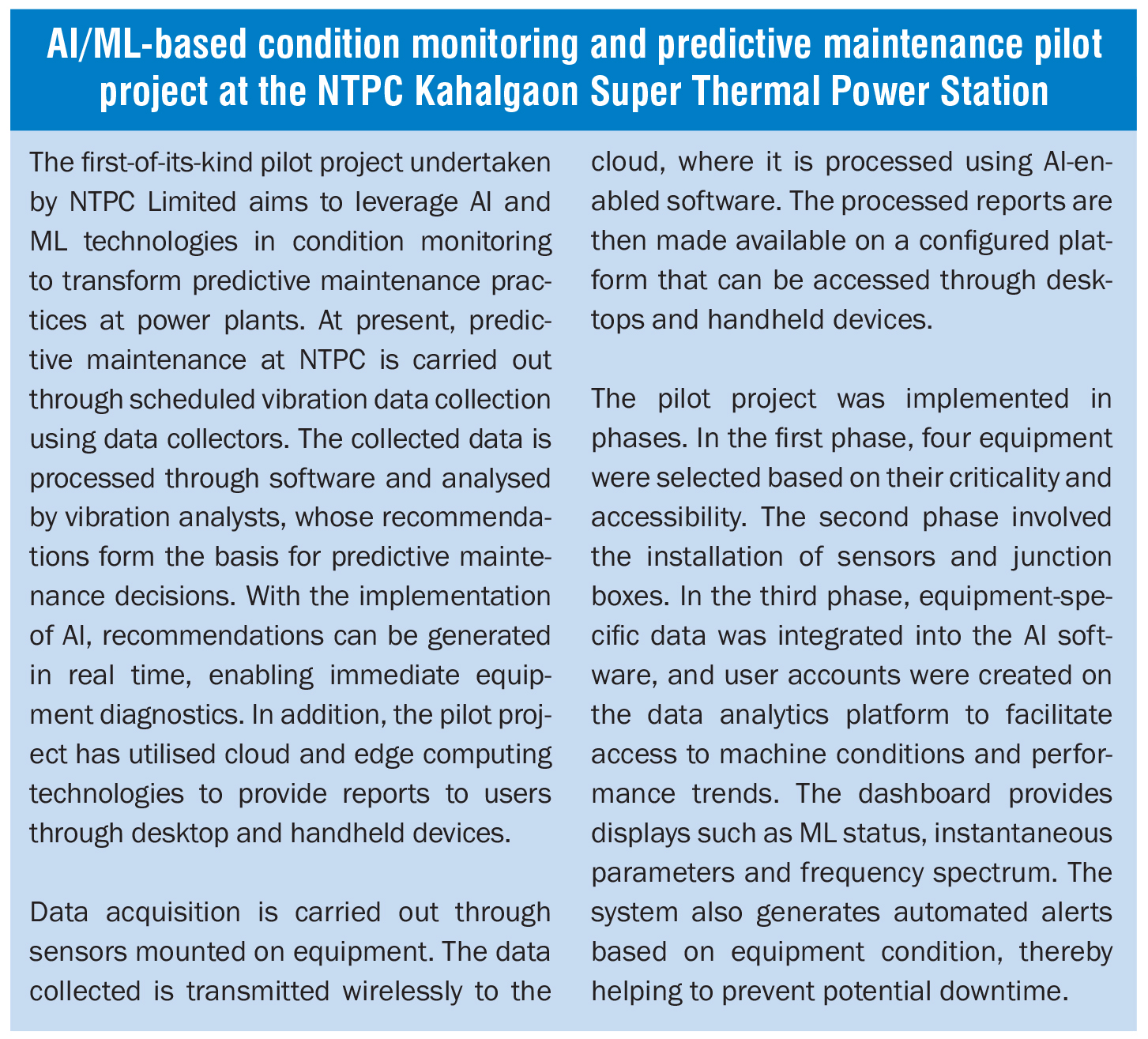
Analytics and ML: Predictive analytics and ML are also playing a growing role in plant operations. Advanced algorithms can analyse data from distributed control systems, vibration sensors and other monitoring equipment to predict equipment failures before they occur. This allows utilities to shift from reactive maintenance to predictive maintenance, thereby reducing forced outages and improving plant availability. Another emerging application is the use of automated predictive spare parts management systems. These tools analyse equipment performance data and operating conditions to estimate the likely consumption of spare parts. As a result, utilities can optimise inventory levels, avoid unnecessary stockpiling and ensure the timely procurement of critical components.
 AR and VR: Digital technologies are also improving plant training and safety management. Augmented reality (AR) and virtual reality (VR) solutions are increasingly being used for workforce training and safety simulations. These tools allow plant personnel to familiarise themselves with equipment and operational scenarios in a virtual environment, thereby enhancing preparedness and reducing the risk of operational errors.
Key issues and challenges
The adoption of automation technologies in TPPs presents several challenges that utilities must address to ensure effective implementation and long-term benefits. One of the key challenges is data management. Automated systems generate vast amounts of operational data from sensors, control systems and monitoring equipment, which must be efficiently collected, stored and analysed. Utilities need robust data management practices and digital platforms to ensure seamless integration and effective utilisation of this information. At the same time, concerns related to data privacy, security and interoperability between systems need to be addressed to safeguard sensitive operational information and enable smooth functioning.
Cybersecurity is another major concern as automation systems increasingly rely on digital communication networks and continuous data exchange. The growing use of remote monitoring, connected systems and digital platforms increases the vulnerability of TPPs to cyber threats and malicious attacks. To mitigate these risks, utilities must implement strong cybersecurity frameworks, including encryption protocols, authentication systems and intrusion detection mechanisms.
Another challenge lies in workforce readiness and skill development. Automation technologies require personnel with specialised technical expertise to operate, maintain and optimise advanced systems. Utilities must therefore invest in employee training and capacity-building programmes to equip their workforce with the necessary knowledge and skills.
Supportive regulatory and policy frameworks are equally important for the wider adoption of automation technologies. Regulatory mechanisms need to address key issues such as grid reliability, cybersecurity standards and data protection requirements to ensure safe and effective deployment. In addition, policy support in the form of incentives, funding mechanisms and government-backed initiatives can encourage utilities to undertake investments in automation technologies and accelerate digital transformation across the thermal power sector.
Further, the deployment of automation systems involves substantial upfront investments in digital infrastructure, advanced equipment, software solutions and workforce development. For many utilities, particularly those operating ageing plants, securing adequate financial resources can be challenging. However, despite the high initial costs, automation offers long-term benefits in the form of improved operational efficiency, enhanced reliability, reduced downtime and optimised maintenance practices. Utilities must therefore carefully assess the long-term gains and adopt phased implementation strategies to manage investment requirements effectively.
Conclusion
Automation is increasingly reshaping TPP operations by enabling real-time monitoring, predictive maintenance and data-driven decision-making. Technologies such as digital twins, AI/ML, drones, analytics, and AR/VR are helping utilities improve efficiency, reliability and safety while reducing emissions and maintenance costs. Although challenges related to data management, cybersecurity, workforce readiness and investment remain, the long-term benefits of automation are driving wider adoption across the sector. Going forward, sustained investments in digital technologies and supportive policy frameworks will play an important role in accelerating the digital transformation of TPPs.