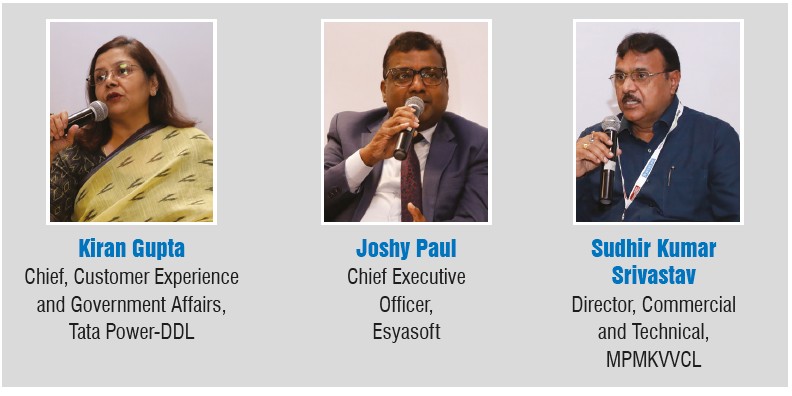
 At a recent Power Line conference on “Metering in India”, the session on “Utility Perspective” brought together industry leaders to discuss the progress of smart metering in India and its growing role in the power distribution sector. The panellists included Kiran Gupta, Chief – Customer Experience, Commercial, Government Affairs, EAC and Consumer Litigation, Tata Power-DDL; Joshy Paul, Chief Executive Officer, Esyasoft; and Sudhir Kumar Srivastav, Director – Commercial and Director (Technical), M.P. Madhya Kshetra Vidyut Vitaran Company Ltd. (MPMKVVCL). They discussed the evolution of smart metering, key applications and use cases, implementation challenges, and priorities and opportunities shaping the future of the smart metering ecosystem. Key takeaways from the session…
A matured segment
Over the past few years, smart metering has emerged as an integral component of the power distribution sector. What initially began with pilot deployments has gradually evolved into large-scale implementation, with utilities increasingly viewing smart meters as an essential element of their operational framework. While feeder-level smart metering has been largely completed, the focus has now shifted towards extending coverage to distribution transformers and end-consumers.
As deployments have expanded, utilities have started realising tangible operational benefits. Smart meters have enabled improvements in billing efficiency and revenue collection, strengthened energy accounting and supported efforts to reduce aggregate technical and commercial (AT&C) losses. Collectively, this has contributed to significant improvements in the overall financial performance.
Meanwhile, the transition to prepaid smart metering remains a work in progress. Although the existing hardware supports prepaid functionality, additional technological enhancements are still required for seamless implementation at scale. While prepaid smart metering has already been introduced for certain consumer categories, particularly government establishments, utilities and original equipment manufacturers will need to address the remaining technological gaps before wider deployment.
Key use cases
Over time, smart meters have evolved from being primarily billing devices to becoming key enablers of operational intelligence for distribution utilities.
One of the key applications of smart meters is in outage management. Equipped with “last gasp” communication capabilities, smart meters can transmit the final signal before a power interruption, enabling utilities to detect outages in near-real time. This allows operational teams to respond more quickly, facilitates predictive maintenance and helps minimise service interruptions.
In addition, the availability of real-time meter status information has improved consumer complaint management. Utilities can now determine whether a supply interruption is due to a network outage or an issue within a consumer’s premises. This has reduced unnecessary field visits and improved the efficiency of complaint resolution and customer service.
At the same time, smart metering is strengthening asset utilisation and asset health monitoring. With smart meters being deployed on distribution transformers, utilities can continuously monitor transformer loading and assess the load growth as new consumer connections are added. This enables them to optimise asset utilisation through load redistribution or transformer replacement where required, thereby reducing the need for additional capital expenditure. Further, real-time monitoring supports predictive maintenance of feeders and transformers, contributing to improved asset health and reliability.
Another important application is behavioural demand response. Enabled by near-real-time communication, smart meters allow utilities to inform consumers of periods of high system demand in advance, and encourage voluntary reduction in non-essential electricity consumption. While earlier demand response programmes relied mainly on financial incentives, the emphasis is increasingly shifting towards awareness-driven and participative approaches. Even partial consumer participation can help flatten peak demand, reduce the requirement for short-term power procurement and improve the overall grid management.
Meanwhile, remote disconnection and reconnection capabilities have led to major operational benefits. By eliminating a large number of field visits, these capabilities have enabled reductions in operating expenditure. Similarly, remote meter reading and billing have simplified billing operations, particularly for consumers who are often unavailable during physical meter reading visits.
An emerging area is the application of artificial intelligence (AI) in smart metering. The large volumes of data generated by smart meters are creating opportunities for advanced analytics. Going forward, the focus is expected to shift towards strengthening analytics capabilities and integrating AI into utility operations. AI-based applications can derive deeper operational insights, enhance work quality and provide more meaningful information and services to consumers.
Implementation challenges
Despite gains, several implementation challenges continue to persist. Among these, consumer engagement has emerged as the most significant issue for distribution utilities and advanced metering infrastructure service providers (AMISPs).
In the initial stages, consumer resistance was driven largely by concerns that smart meters would result in higher electricity bills. To address these concerns, utilities have increasingly undertaken awareness and outreach initiatives through newspapers, digital media and other communication channels. They have also worked with resident welfare associations and consumer forums to educate consumers about the benefits of smart meters to consumers rather than those accruing to the utility. In some cases, regulators have introduced rebates for domestic consumers receiving smart meters, which has helped improve consumer acceptance. In addition, consumers are being encouraged to use mobile applications to monitor daily electricity consumption and manage their energy usage more effectively.
It was also highlighted that consumer awareness should not begin only after the smart meter roll-out starts. Utilities need to lead engagement efforts well in advance, ideally at least a year before installations commence, to address misconceptions, build consumer confidence and make the roll-out process smoother. Apart from consumer engagement, communications and IT infrastructure remain key challenges. Traditional utility IT systems were designed to collect meter data once a day, whereas smart meters generate data every 15 minutes. This requires utilities to strengthen their communication networks and upgrade their IT systems to handle the much larger volumes of data. Meanwhile, availability of smart meters is no longer a major challenge. The focus has now shifted to the availability of skilled field personnel, as AMISPs continue to face challenges in deploying qualified manpower for installations.
The way forward
Overall, the experience with smart metering has been positive. The focus is now on expanding deployments and deriving greater value from the technology. Going forward, a key priority is to extend smart meter coverage and achieve saturation at both the distribution transformer and consumer levels. This is expected to enable comprehensive energy accounting as well as help identify consumers contributing to losses or operational disturbances within the distribution system.
At the same time, addressing communication-related challenges remains critical. Since utilities employ different communication technologies such as radio frequency, internet of things and 4G, ensuring reliable and uninterrupted communication across deployment areas becomes essential. The ability of smart meters to consistently transmit complete data is becoming increasingly important. This is required as utilities need not only billing information and remote disconnection capabilities but also interval consumption data and load profiles that support advanced analytics and future applications.
Attention is also being directed towards interoperability in the sector. In particular, replacing faulty network interface cards (NICs) can be challenging. Therefore, there is a need for more universal and interoperable NIC solutions to simplify maintenance and improve operational flexibility.
Meanwhile, AI is set to be the next major area in the smart metering ecosystem. As utilities accumulate large volumes of data, AI-based platforms are increasingly being used to generate operational insights, improve decision-making and enhance utility performance. Now that initial implementations have delivered encouraging results, the emphasis is shifting towards scaling these applications across larger utility networks. Broader AI initiatives are also being pursued at the industry level, with support from organisations such as the India Smart Grid Forum. Utilities are also expected to continue expanding smart meter use cases, while strengthening internal capabilities. In particular, developing the ability of utility personnel to analyse smart meter data and derive meaningful insights will become increasingly important.
In parallel, the growing adoption of rooftop solar, electric vehicles and distributed energy resources is creating new use cases for smart meters, including time-of-day tariffs and dynamic pricing. Going forward, smart meters will play a key role in providing the data and communication needed to manage a more decentralised and dynamic power distribution system.