Energy security has become a major concern across the world, amidst rising geopolitical tensions and disruptions in the global fuel markets. India imports a large part of its crude oil and natural gas requirements, making the country vulnerable to price volatility and supply disruptions. Meanwhile, India also has over 400 billion tonnes of coal reserves and around 47 billion tonnes of lignite reserves.
To make better use of these existing domestic resources, coal gasification has been gaining attention over the past few years. Instead of burning coal directly, the process converts coal into synthesis gas (syngas) by making it react with limited oxygen and steam. This gas, which mainly contains carbon monoxide and hydrogen, can then be used to produce methanol, ammonia, urea, synthetic natural gas and a range of other chemicals.
With this aim, the union cabinet approved a Rs 375 billion scheme in May 2026 to promote surface coal and lignite gasification projects. The initiative aims to better utilise domestic coal reserves, reduce dependence on imported feedstocks and support the development of a domestic coal-based chemicals and fuels ecosystem.
Key features of the scheme
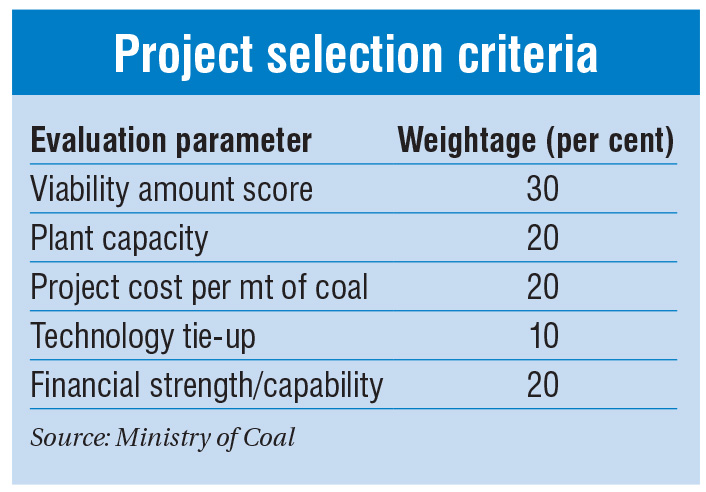
Under the scheme, around 75 million tonnes (mt) of coal and lignite is targeted to be gasified, contributing towards India’s overall goal of 100 mt of coal gasification by 2030. Project developers will be selected through a transparent and competitive bidding process, based on technical and financial evaluation parameters. Projects scoring a minimum of 40 out of 100 across all evaluation parameters will qualify and will be ranked on aggregate scores, with allocation subject to the overall scheme outlay.
To improve financial viability, the scheme offers incentives of up to 20 per cent of the plant and machinery cost, limited to new and unused equipment purchased after the scheme approval. These incentives are released in four equal instalments of 25 per cent each, linked to key project milestones. To ensure adequate safeguards, the incentive support is capped at Rs 50 billion for a single project, Rs 90 billion for a single product category (excluding synthetic natural gas and urea) and Rs 120 billion for a single-entity group across all projects.
Moreover, the scheme follows a technology-agnostic approach, while encouraging solutions suited to the country’s high-ash coal.
Participation is open to public sector undertakings, private companies, joint ventures and consortiums, provided they set up new projects with a minimum clean syngas capacity of 0.5 mt per annum and maintain a net worth of at least 20 per cent of the total project cost.
In addition, coal linkage tenure has been extended to 30 years under the non-regulated sector (NRS) framework to align with project life cycles. The scheme also allows coal gasification under commercial coal block auctions and promotes cluster-based development and pithead project siting to improve infrastructure efficiency.
Status of coal gasification in India
To promote coal gasification in India, the government launched the National Coal Gasification Mission in 2020, with a target of achieving 100 mt of coal gasification by 2030. In January 2024, it approved the Scheme for Promotion of Coal Gasification Projects of Indian Public Sector Enterprises and Private Sector, with an outlay of Rs 85 billion. Under the scheme, eight pilot projects worth Rs 62.33 billion are currently under implementation.
One of the earliest major projects was the coal gasification-based ammonia-urea plant announced at Talcher in 2018. While the project was initially scheduled for commissioning in 2023-24, the timeline has since been extended to 2027.
Over the years, several industry players have initiated pilot projects. Bharat Heavy Electricals Limited (BHEL) commissioned a 6.2 MW pilot plant in Tiruchirappalli in 2020. In the same year, Coal India announced three coal gasification projects for coal-to-methanol production. Thermax Limited has also set up a coal-to-methanol pilot plant in Pune.
More recently, companies such as New Era Cleantech and the Adani Group have announced new coal gasification projects, expanding the pipeline of commercial-scale developments.
The government has also introduced policy measures to encourage private sector participation. These include a dedicated coal linkage category under the NRS linkage auction policy and incentives in commercial coal block auctions for coal used in gasification.
 Expected benefits
India currently imports more than 50 per cent of its liquefied natural gas (LNG), around 20 per cent of urea, 100 per cent of ammonia and 80-90 per cent of methanol. In FY 2025, the import bill for these products stood at a whopping Rs 2.77 trillion. As a result, coal gasification is expected to reduce dependence on imported fuels and chemicals, while also insulating the economy from global price volatility and supply disruptions.
At the same time, the scheme is likely to attract investments of Rs 2.5 trillion-Rs 3 trillion and create around 50,000 direct and indirect jobs across coal-bearing regions. This will support industrial growth, strengthen domestic manufacturing and reduce reliance on imported engineering, procurement and construction (EPC) services by building indigenous coal gasification capabilities.
Environmentally, gasification allows easier removal of pollutants such as sulphur compounds and nitrogen oxides and offers higher efficiency than conventional coal combustion. This makes it a relatively cleaner option for utilising India’s coal reserves than direct coal combustion.
Challenges in coal gasification
Despite its potential, coal gasification continues to face several constraints that limit its large-scale commercial adoption.
A key issue is the high ash content and variable quality of Indian coal, which makes selecting the right gasifier technology critical. A mismatch between the technology and feedstock can directly affect plant performance and the overall project economics, potentially leading to delays and extensions. This increases the risk premiums for technology providers and EPC contractors, leading to higher project costs.
Another major constraint is the high capital intensity of these projects. Complex technologies, ash handling requirements and long gestation periods of five to seven years increase financial risks. In addition, high import and customs duties on key equipment add to overall costs, making financing a persistent bottleneck and increasing the need for greater participation from international investors. Gasification plants also require beneficiated coal, which raises raw material and processing costs.
At the same time, limited commercial-scale experience in India means that indigenous technologies are still largely restricted to pilot projects, increasing dependence on imported technologies and equipment.
Finally, while gasification helps reduce local pollutants, carbon dioxide emissions can only be addressed through carbon capture, utilisation and storage technologies, which are still at a nascent stage.
The way forward
Even as these challenges persist, implementation efforts have been gaining pace. In May 2026, Coal India Limited announced plans to set up coal-to-syngas facilities either at mine pitheads or close to large end-use industries such as fertiliser plants, direct reduced iron units and gas-based power stations. These facilities are expected to operate either as shared syngas hubs serving multiple consumers through pipelines or as dedicated units for a single large user. To take this forward, the company has also invited expressions of interest under build-own-operate and build-operate-maintain models.
Further, in June 2026, the foundation stone for the coal-to-ammonium nitrate project was laid at Lakhanpur in Odisha. Developed by Bharat Coal Gasification and Chemicals Limited, the project entails an investment of over Rs 250 billion and is scheduled for commissioning in September 2029. It will produce about 0.66 mt of technical-grade ammonium nitrate annually, using BHEL’s indigenously developed pressurised fluidised bed gasification technology. As India’s first commercial-scale coal-to-ammonium nitrate facility, it is expected to serve as a model for future coal-to-chemicals projects.
Meanwhile, policy attention is also turning towards underground coal gasification (UCG), although the technology remains largely at the pilot and early commercial stage globally. With nearly 40 per cent of India’s coal reserves located in deep seams, the government has introduced incentives to promote UCG, including exempting pilot projects from environmental clearance. Notably, the 14th round of commercial coal mine auctions launched in October 2025 offered 41 mines, including 21 with UCG potential for the first time. Subsequently, in April 2026, the Ministry of Coal executed agreements for four of these mines, marking the country’s first tranche of commercial coal blocks with embedded UCG provisions.
While the ecosystem for large-scale coal gasification is still evolving, coal is expected to remain the mainstay of India’s energy mix for the coming decades. Going forward, the timely execution of projects and sustained policy support will be critical for building a viable coal gasification ecosystem and strengthening long-term energy self-reliance.