
Nuclear energy is gaining prominence as a reliable source of round-the-clock, low-carbon power that complements India’s growing renewable energy capacity. Following the announcement of the government’s target of achieving 100 GW of nuclear power capacity by 2047, several developments have emerged, including new policy initiatives, increased budgetary support, progress in ongoing projects and efforts to encourage greater private sector participation. At the same time, emerging technologies such as small modular reactors (SMRs) are expanding the potential applications of nuclear energy beyond conventional power generation.
Current status
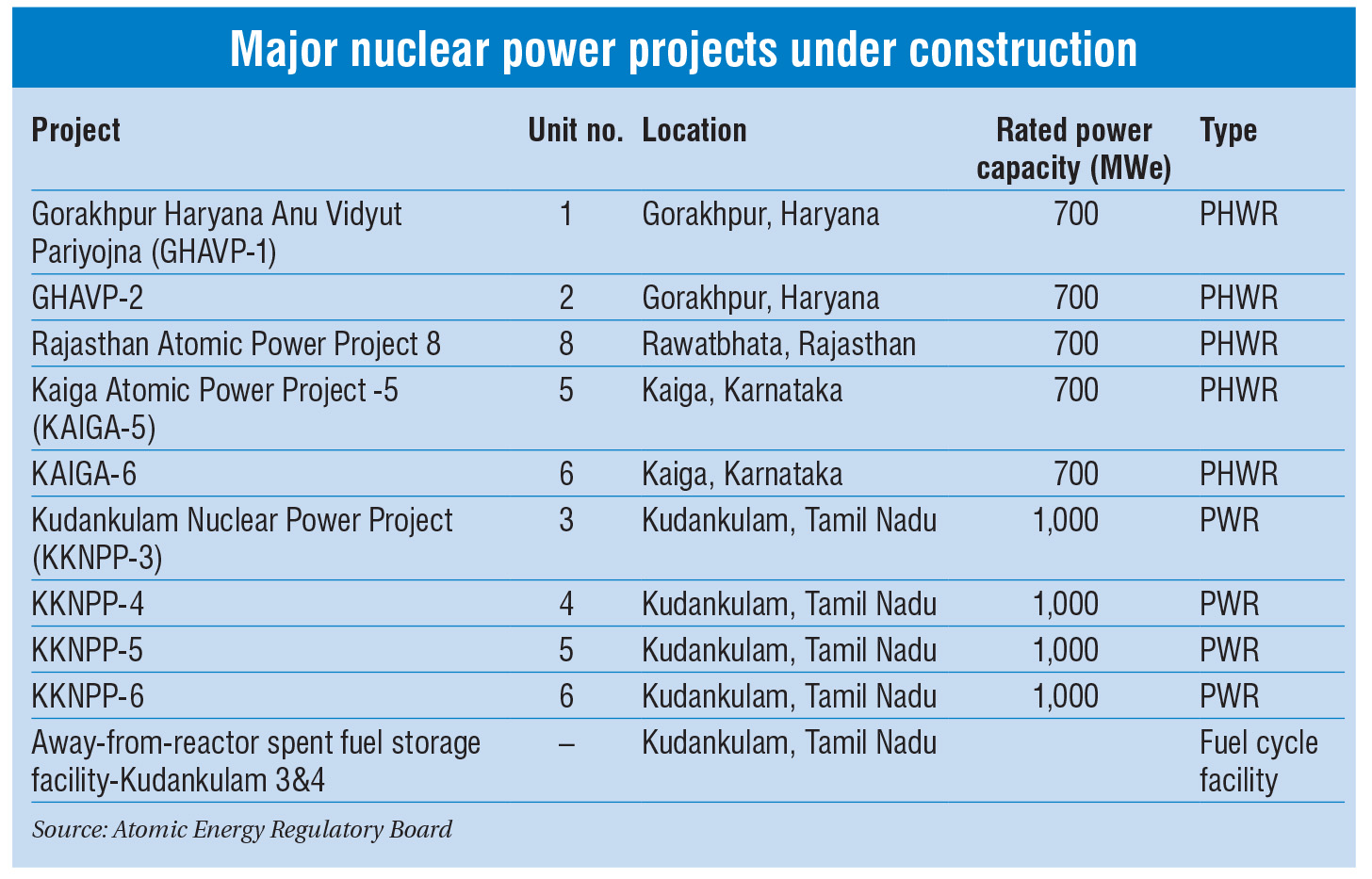
India currently has an installed nuclear capacity of 8.8 GW. At present, five pressurised heavy water reactors (PHWRs) with a combined capacity of 3,500 MW are under construction, while eight additional PHWRs with a capacity of 5,600 MW are in the pre-project stage. Further, four pressurised water reactors (PWRs) with a total capacity of 4,000 MW are under construction. These projects are at various stages of implementation and are expected to be commissioned progressively by 2031-32.
Nuclear Power Corporation of India Limited (NPCIL) has set a target to commission at least one reactor every year, reinforcing the steady expansion of the nuclear fleet. New greenfield sites such as Mahi Banswara in Rajasthan, proposed for four indigenously developed 700 MWe PHWR units, represent a significant step towards rapidly scaling up nuclear capacity while strengthening regional energy security.
NTPC Limited is planning to develop around 30 GW of nuclear power capacity across at least 14 states as part of its long-term growth strategy and to support the government’s 100 GW nuclear capacity target by 2047. The company has already commenced site selection studies in Gujarat, Andhra Pradesh, Odisha and Madhya Pradesh for its proposed nuclear projects.
Following extensive modernisation and refurbishment, Units 1 and 2 of the Tarapur Atomic Power Station have resumed power generation in June 2026. The two boiling water reactor units, commissioned in 1969 as India’s first commercial nuclear power plant, had been under long-term outage since 2020 for major refurbishment works. Originally built with a capacity of 200 MW each, the units currently operate at a reduced capacity of 160 MW.
SHANTI Act
The Sustainable Harnessing and Advancement of Nuclear Energy for Transforming India (SHANTI) Act, 2025, which received Presidential assent in December 2025, permits private sector participation to build, own, operate and decommission nuclear plants in nuclear energy activities under licenses issued by the central government and regulatory approvals. Participation is also enabled across parts of the nuclear value chain, including manufacturing, fuel transport, storage and approved imports and exports. Further, the act allows foreign equity in India-incorporated nuclear joint ventures, giving global players a formal route to participate while preserving Indian majority ownership. Russia has been India’s principal nuclear partner, supplying reactors for the Kudankulam Nuclear Power Project and supporting the construction of additional units. France is collaborating with India on the proposed Jaitapur Nuclear Power Project, which is expected to use European pressurised reactors. The US has partnered with India on civil nuclear cooperation, including discussions on advanced reactor technologies and SMRs. Meanwhile, countries such as Canada, Kazakhstan and Australia have contributed to India’s fuel security through uranium supply agreements.
 Private sector participation
The opening up of the nuclear sector has begun attracting significant private sector interest. In June 2026, the Adani Group announced plans to develop up to 10 GW of nuclear power capacity by 2035 and has incorporated dedicated subsidiaries for nuclear energy activities, indicating its intent to participate in the emerging nuclear market.
In May 2026, the Maharashtra government signed MoUs with NTPC Limited, Adani Power, Reliance Industries and Lalitpur Power Generation Company to facilitate investments worth Rs 6.5 trillion in the nuclear sector. The proposed projects are expected to add 25.4 GW of capacity. Reliance Industries alone has committed an investment of Rs 2 trillion to develop 7.2 GW of nuclear power capacity.
Tata Power is conducting feasibility studies for proposed nuclear projects in three states and is preparing detailed project reports in consultation with NPCIL. The company is also planning to develop a 440 MW Bharat Small Modular Reactor in collaboration with NPCIL.
Meanwhile, JSW Energy has announced plans to establish its first nuclear power plant by 2030 and is evaluating both large reactors and SMR technologies. The company plans to develop a pilot project and is currently undertaking site selection activities.
Bharat Modular Reactors
Bharat Small Reactors have emerged as a key pillar of India’s Nuclear Energy Mission, which aims to achieve 100 GW of nuclear power capacity by 2047. Under Union Budget 2025-26, the government allocated Rs 200 billion for the research, design, development and deployment of SMRs. The Department of Atomic Energy is currently developing three indigenous designs: the 220 MW Bharat Small Modular Reactor (BSMR-200), the 55 MW SMR-55, and a high-temperature gas-cooled reactor for hydrogen production. The BSMR-200, being jointly developed by Bhabha Atomic Research Centre and NPCIL, has received in-principle approval, while the proposal for administrative and financial sanction has been cleared by the Atomic Energy Commission. The reactor incorporates indigenously developed technologies, including the advanced purified reactor vessel alloy and reactor pressure vessel forging technologies developed in collaboration with the domestic industry. The lead units of these reactors will be established at the Department of Atomic Energy (DAE) sites for technology demonstration, with the BSMR-200 expected to require 60-72 months for construction after obtaining final approvals.
Nuclear-powered hydrogen production
India has achieved a significant milestone in clean energy by demonstrating hydrogen production using nuclear heat generated from its fast breeder reactor programme. At the Indira Gandhi Centre for Atomic Research, Kalpakkam, the DAE has commissioned a hydrogen production facility based on the copper-chlorine thermochemical process developed by Bhabha Atomic Research Centre. The technology utilises heat from the fast breeder test reactor instead of fossil fuels or electricity, enabling the simultaneous production of electricity and hydrogen from a single nuclear source. The development represents a new pathway for low-carbon hydrogen production and could support the decarbonisation of hard-to-abate sectors such as steel, chemicals and transport, while expanding the role of nuclear energy beyond power generation.
Challenges
Despite the growing momentum in the nuclear sector, several challenges continue to impede its large-scale expansion. The sector is characterised by a complex regulatory framework, lengthy approval processes and the dominant role of NPCIL, which has historically limited broader participation. In addition, stringent nuclear liability provisions and regulatory uncertainties have discouraged foreign technology suppliers and investors. Nuclear projects also face significant economic challenges due to high capital costs, limited financing options and competition from lower-cost renewable energy and coal-based generation. Long construction periods, complex safety requirements, fuel cycle management and radioactive waste disposal further add to project risks and costs. The sector remains dependent on imported uranium and foreign reactor technologies in certain segments, while export controls and changing geopolitical dynamics can affect long-term international partnerships. Social and environmental concerns related to nuclear safety, waste management, water consumption and security risks also continue to influence public acceptance. Further, the knowledge base and technical expertise in the nuclear sector remain largely concentrated within the DAE, resulting in a limited pool of skilled professionals and posing a challenge for the rapid expansion of India’s nuclear power programme.
The way forward
As India pursues its target of achieving 100 GW of nuclear capacity by 2047, a balanced and coordinated approach will be essential. Large nuclear reactors are expected to remain the backbone of the country’s nuclear programme, providing reliable baseload power to support grid stability. At the same time, SMRs and BMRs can address niche applications such as captive power supply, industrial decarbonisation and energy supply for sectors such as steel, cement, defense and data centres.
The regulatory framework will also need to evolve to support new technologies. Streamlined licensing procedures, design-based approvals and faster clearances can help accelerate the deployment of SMRs while maintaining high safety standards. Greater clarity on private sector participation, liability provisions and project development models will be important to attract investment. Improved coordination among various government agencies can also help reduce approval timelines. Further, achieving long-term nuclear targets will require investment in skilled manpower, research and domestic manufacturing capabilities. Training programmes focused on advanced reactor technologies, digital systems and nuclear safety will be essential. As India’s reactor fleet expands and diversifies, an integrated approach to fuel supply, waste management and the nuclear fuel cycle will be necessary to support the sustainable growth of the sector.
Aastha Sharma


