

The Central Electricity Regulatory Commission (CERC) has released a staff paper proposing generic renewable energy tariffs applicable for the third year of the control period under the Renewable Energy Tariff Regulations, 2024. The proposed tariffs will apply to eligible renewable energy projects commissioned between August 1, 2026 and March 31, 2027, and cover technologies envisaged under the regulations for generic tariff determination. These include small-hydro projects (SHPs), biomass power projects based on Rankine cycle technology, non-fossil-fuel-based cogeneration projects, biomass gasifier-based projects, biogas-based projects and refuse-derived fuel (RDF)-based municipal solid waste (MSW) projects.
The proposal has been issued under Regulation 8 of the Renewable Energy Tariff Regulations, 2024. It requires the commission to determine generic tariffs before the commencement of each year of the control period. Technologies such as solar PV, wind, hybrid renewable energy and renewable energy with storage continue to be governed through project-specific tariff determination under Regulation 7 and are therefore outside the scope of the present proposal.
The proposal continues to be based on the normative framework prescribed under the Renewable Energy Tariff Regulations, 2024. While the commission has retained the existing capital cost norms for the third year of the control period after reviewing prevailing market conditions, other financial and technical parameters have been applied in accordance with the provisions of the 2024 regulations, with annual updates wherever specified, such as operations and maintenance (O&M) expenses and fuel prices.
Tariff elements
Generic tariffs have been determined on a levellised basis over the useful life of each technology, with tariffs comprising return on equity (RoE), interest on loan, depreciation, interest on working capital and O&M expenses. For technologies involving fuel costs, including biomass, cogeneration, biomass gasifier and biogas projects, the tariff consists of separate fixed and variable cost components.
The useful life remains unchanged across technologies, at 40 years for SHPs, 25 years for biomass, cogeneration, biomass gasifier and biogas projects, and 20 years for RDF-based MSW projects. Tariffs determined during the control period will remain applicable throughout the tariff period corresponding to the useful life of the project.
One of the key features of the proposal is the commission’s decision to retain the existing capital cost norms notified under the Renewable Energy Tariff Regulations, 2024. After reviewing capital cost benchmarks adopted by various state electricity regulatory commissions and project-specific tariff orders, the CERC concluded that the existing norms remain broadly aligned with prevailing market conditions and therefore require no revision for 2026-27.
Accordingly, the normative capital cost has been retained at Rs 120 million per MW for SHPs in Himachal Pradesh, Uttarakhand, West Bengal, the Union Territories of Jammu & Kashmir and Ladakh, and the north-eastern states, while projects in other states continue to have lower normative capital costs depending on project size. For biomass power projects based on Rankine cycle technology, the normative capital cost ranges from Rs 63.8 million per MW to Rs 74.4 million per MW depending on fuel type and cooling system. The capital cost has been retained at Rs 56.2 million per MW for non-fossil-fuel-based cogeneration projects, Rs 67.7 million per MW for biomass gasifier projects, Rs 135.4 million per MW for biogas projects and Rs 220 million per MW for RDF-based MSW projects.
The commission has retained the normative debt-equity ratio at 70:30 and the loan tenor at 15 years. The interest rate on loans has been calculated at 10.71 per cent, based on the average one-year State Bank of India (SBI) MCLR for the preceding six months plus a spread of 200 basis points. The post-tax RoE has been maintained at 14 per cent for all technologies except SHPs, which continue to receive a normative RoE of 15 per cent. These assumptions result in discount factors of 9.08 per cent for most technologies and 9.38 per cent for SHPs, which have been used for tariff levellisation.
Depreciation continues to be calculated at 4.67 per cent annually during the first 15 years, with the balance depreciation spread over the remaining useful life. Interest on working capital has been computed at 11.96 per cent, corresponding to the SBI MCLR plus 325 basis points. Working capital norms include O&M expenses, maintenance spares, receivables equivalent to 45 days of tariff and fuel inventory wherever applicable.
The proposal also updates normative O&M expenses by escalating the first-year norms by 5.25 per cent annually, as prescribed in the regulations. Similarly, biomass fuel prices, bagasse prices and biogas feedstock prices have been escalated by 3.45 per cent over the previous year’s values for the determination of the variable tariff component.
 Proposed tariffs
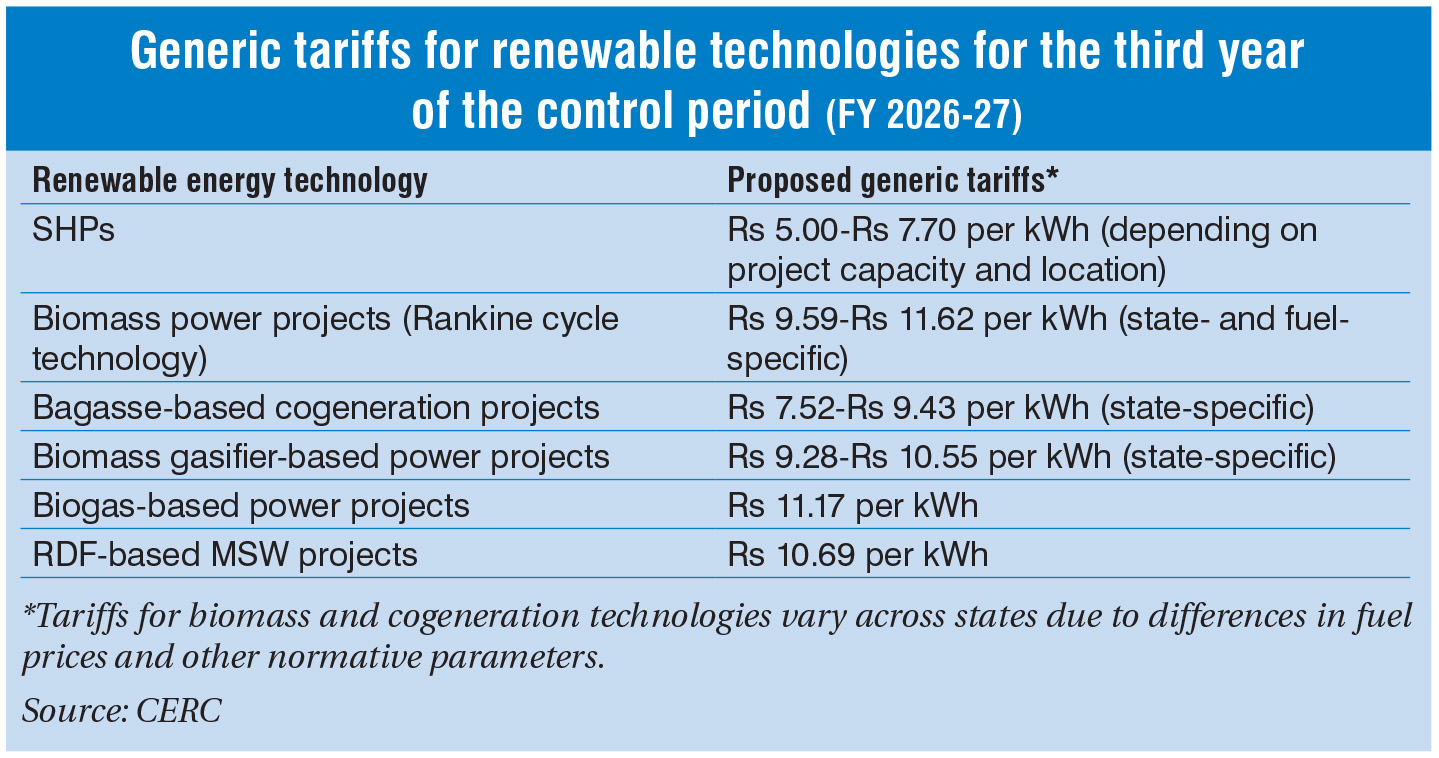
The commission has proposed levellised generic tariffs for all eligible renewable energy technologies while retaining the existing tariff framework. For SHPs, proposed tariffs range from Rs 5 per kWh to Rs 7.70 per kWh depending on project size and location. Projects in Himachal Pradesh, Uttarakhand, West Bengal, Jammu & Kashmir, Ladakh and the north-eastern states continue to receive differentiated tariffs due to higher capital costs, while projects in Punjab, Odisha and other states have separate tariff categories reflecting varying capacity utilisation factors and investment norms.
Biomass-based power projects continue to have state-specific tariffs owing to variations in biomass fuel prices. Depending on fuel type, boiler configuration and condenser technology, applicable tariffs typically range from about Rs 9.60 per kWh to over Rs 11.60 per kWh before adjustment for accelerated depreciation benefits. Biomass projects using air-cooled condensers and rice straw or juliflora fuel attract relatively higher tariffs because of their higher capital costs.
For non-fossil-fuel-based bagasse cogeneration projects, proposed tariffs range from about Rs 7.50 per kWh in Tamil Nadu to about Rs 9.40 per kWh in Haryana, primarily reflecting differences in state-wise bagasse prices. Biomass gasifier projects have proposed tariffs of Rs 9.30-Rs 10.60 per kWh across different states. Meanwhile, the commission has proposed generic tariffs of Rs 11.17 per kWh for biogas-based power projects and Rs 10.69 per kWh for RDF-based MSW projects before adjustment for accelerated depreciation benefits.
Across technologies, the proposal also computes separate tariff values after accounting for accelerated depreciation benefits for developers availing of such incentives. As in previous tariff orders, these benefits marginally reduce the effective levellised tariff payable by procuring entities.
The way forward
The proposed tariff order reflects regulatory continuity rather than a policy shift. By retaining the normative capital cost framework introduced in the Renewable Energy Tariff Regulations, 2024, the CERC has signalled that it considers the existing benchmarks to remain representative despite changing market conditions. Instead of revising the underlying cost assumptions, the commission has focused on updating financial and operational parameters, including financing costs, O&M expenses and fuel prices.
The proposal also reinforces the differentiated regulatory approach adopted under the 2024 regulations. While mature technologies such as small-hydro and biomass continue to be governed through generic tariffs, emerging technologies such as solar PV, wind, renewable hybrids and renewable energy storage systems remain subject to project-specific tariff determination. This provides greater flexibility for technologies characterised by rapidly evolving costs and business models while preserving a predictable tariff framework for conventional renewable technologies.
After reviewing stakeholder comments, the commission is expected to issue the final tariff order for 2026-27. Once notified, the tariffs will provide the benchmark for eligible renewable energy projects commissioned during the remaining period of the current control period, thereby providing continued investment certainty in renewable technologies for which generic tariff determination remains applicable.
Aastha Sharma


