 By Suraj Dhiman, General Manager (O&M), NHPC Limited
NHPC Limited operates one of the largest hydropower portfolios in the country, with 22 hydropower plants comprising 78 generating units. Most of these plants are located across the Himalayan foothills. The company has also been expanding into solar and wind power projects in western and southern India. In addition, several large hydropower projects are under development in Arunachal Pradesh.
Managing assets across multiple locations makes plant visibility essential. As NHPC’s portfolio has grown, digitalisation has become crucial for improving monitoring, operational efficiency and decision-making.
A key digital initiative has been the centralised real-time monitoring (RTM) system, which integrates supervisory control and data acquisition (SCADA) data from all operating power stations into a single, comprehensive view of generation and critical plant parameters. The RTM system enables the corporate office in Faridabad to monitor plant performance in real time, while the operations and maintenance team can track key performance indicators across stations.
This article highlights the digitalisation initiatives of NHPC Limited at its hydropower stations…
From traditional monitoring to RTM
Before the RTM system was introduced, each NHPC power station was monitored independently through its local SCADA system. At the corporate office, plant performance was tracked through telephone calls, manually prepared reports and data entered by operators at regular intervals. This made it difficult to obtain a consolidated view of operations across all stations. The process was time-consuming and dependent on manual reporting.
To overcome these limitations, NHPC integrated the SCADA systems at its 21 operating hydropower stations into a centralised monitoring platform using the AVEVA PI System. The platform brings operational data from all stations to the corporate office, making live plant information available through a single interface. This enables the company to monitor operations across its portfolio in real time, identify faults more quickly, analyse operational data faster, and take timely maintenance decisions.
Benefits of RTM
Automated MIS reporting
Before RTM, operators manually recorded parameters such as temperatures, water levels and generation values in registers or spreadsheets. These readings were then compiled to prepare management information system (MIS) reports, including daily and monthly generation reports. Since data had to be collected from multiple power stations, the process was time-consuming and susceptible to manual errors.
With RTM, live operational data is transferred directly to SAP, where calculations such as unit-wise generation, plant availability factor, and maximum and minimum values are performed automatically. Standardised MIS reports are generated without manual intervention. This has improved data reliability and reduced the time spent on data compilation, reconciliation and verification.
Continuous monitoring
Real-time monitoring has shifted plant monitoring from periodic data collection to continuous, real-time monitoring. Earlier, operators recorded operating parameters at fixed intervals, typically once every hour. Any abnormal event occurring between two readings could therefore go unnoticed.
With RTM, operational data is transmitted continuously from sensors at each power station to the corporate office. This eliminates the need to contact individual stations for the latest operating information, which may already have changed by the time it is reported. Continuous data updates provide a more accurate and up-to-date view of plant operations. This enables the operations and maintenance team to monitor equipment performance in real time and identify abnormalities more quickly.
Centralised dashboards
Using the continuous stream of data through the RTM platform, NHPC has developed station-wise and consolidated dashboards to improve operational visibility and support faster decision-making.
One of the dashboards compares scheduled generation with actual generation across all power stations, allowing management to quickly identify underperforming units. It also shows the number of units in operation, the total generation achieved during the day, and the generation required to meet the daily requirement.
Similar dashboards are available for individual generating units, turbines and transformers. Users can drill down from the enterprise level to a specific machine and view operating parameters such as turbine discharge, bearing temperatures, transformer temperatures, vibrations and breaker status. Since historical data is stored on the platform, trends for any parameter can be viewed over months or years without referring to physical logbooks.
Real-time alarms and trip detection
NHPC has also implemented real-time alarms and trip detection through its RTM platform to enable faster response to equipment abnormalities. Alarm thresholds have been defined for critical operating parameters. Whenever these limits are exceeded, the system automatically sends notifications through email or SMS, allowing timely corrective action.
During the initial implementation, alarms were configured for a large number of parameters and notifications were sent to many users. This resulted in excessive alerts, reducing their effectiveness. NHPC has since adopted a phased approach. Initially, only the most critical alarms are configured and notifications are sent to a limited group of users. Additional alarms are introduced gradually as confidence in the settings increases.
Health index of generators
NHPC has extended its digitalisation efforts beyond RTM to predictive maintenance by developing an artificial intelligence (AI)-based generator health index. Currently in the pilot stage, it is the company’s first practical application of AI for predictive maintenance. The tool combines real-time operating data with historical maintenance records to generate a single health score for each generator.
The model uses both dynamic operating data and static maintenance information. Dynamic data includes stator winding and core temperatures, cooling water and air temperatures, bearing temperatures, vibration levels, and excitation current and voltage.
Static information is drawn from annual maintenance activities, such as insulation resistance tests, polarisation index measurements, the dielectric dissipation factor (tan δ), partial discharge tests, winding resistance measurements, oil analysis, core flux tests, maintenance history, forced outages, previous repairs and outstanding defects. These parameters are assigned weightages based on applicable IEEE and IEC standards and original equipment manufacturer practices to calculate the overall health score.
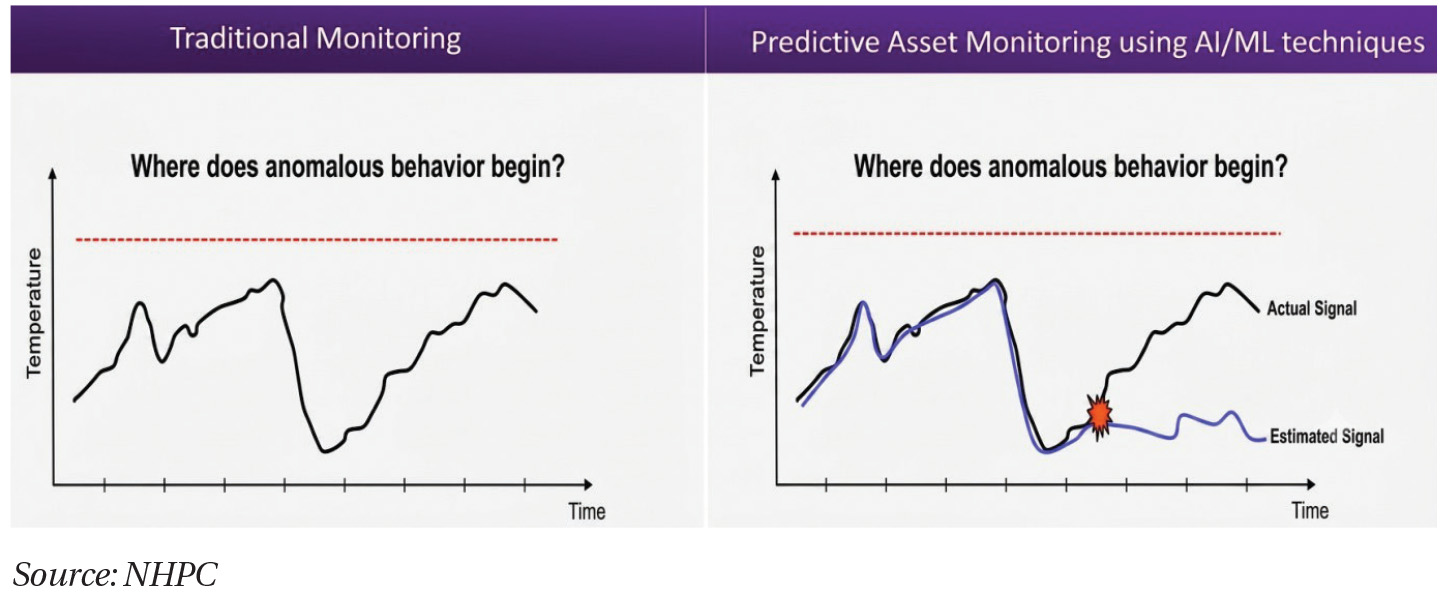
The tool has initially been implemented for generator stators. Using three years of operating data, it establishes the normal temperature behaviour of each stator. During operation, the model compares actual temperatures with the expected values. Any significant deviation is flagged, allowing maintenance teams to investigate potential issues at an early stage.
NHPC plans to extend the health index to all 78 generator stators. The scores will help rank generators based on their condition, allowing maintenance teams to prioritise equipment that requires attention. This can help avoid unnecessary maintenance on healthy generators, optimise maintenance costs, and support decisions on refurbishment, rewinding or replacement. The model can also support advanced applications such as estimating the remaining useful life of equipment and quantifying the probability of failure based on its condition. The company plans to apply the same approach to transformers, turbines, oil pressure units and other major equipment.
The way forward
NHPC’s next focus area is the use of AI and machine learning for predictive asset monitoring. While conventional alarms continue to play an important role in plant monitoring, they only indicate a problem after a parameter crosses a predefined limit. By then, equipment deterioration may already have begun.
Predictive monitoring aims to detect such issues much earlier. It analyses historical operating data to establish the normal behaviour of an asset. Around three to four years of operating data is required to develop a reliable baseline.
During operation, the AI model continuously compares live sensor data with this baseline. If the actual behaviour starts to deviate from the expected pattern, the system flags it as an anomaly, even before conventional alarm limits are reached. This gives maintenance teams an early indication that an asset may require inspection or corrective action.
NHPC is currently developing these capabilities through pilot projects. In the long term, it aims to move beyond condition monitoring to predicting failures before they occur. Future applications are expected to include failure mode prediction, estimation of the remaining useful life of equipment, prediction of the time available before failure, and AI-based maintenance recommendations. As these capabilities mature, they are expected to improve maintenance planning, optimise maintenance schedules, and support more reliable operation of generating stations.