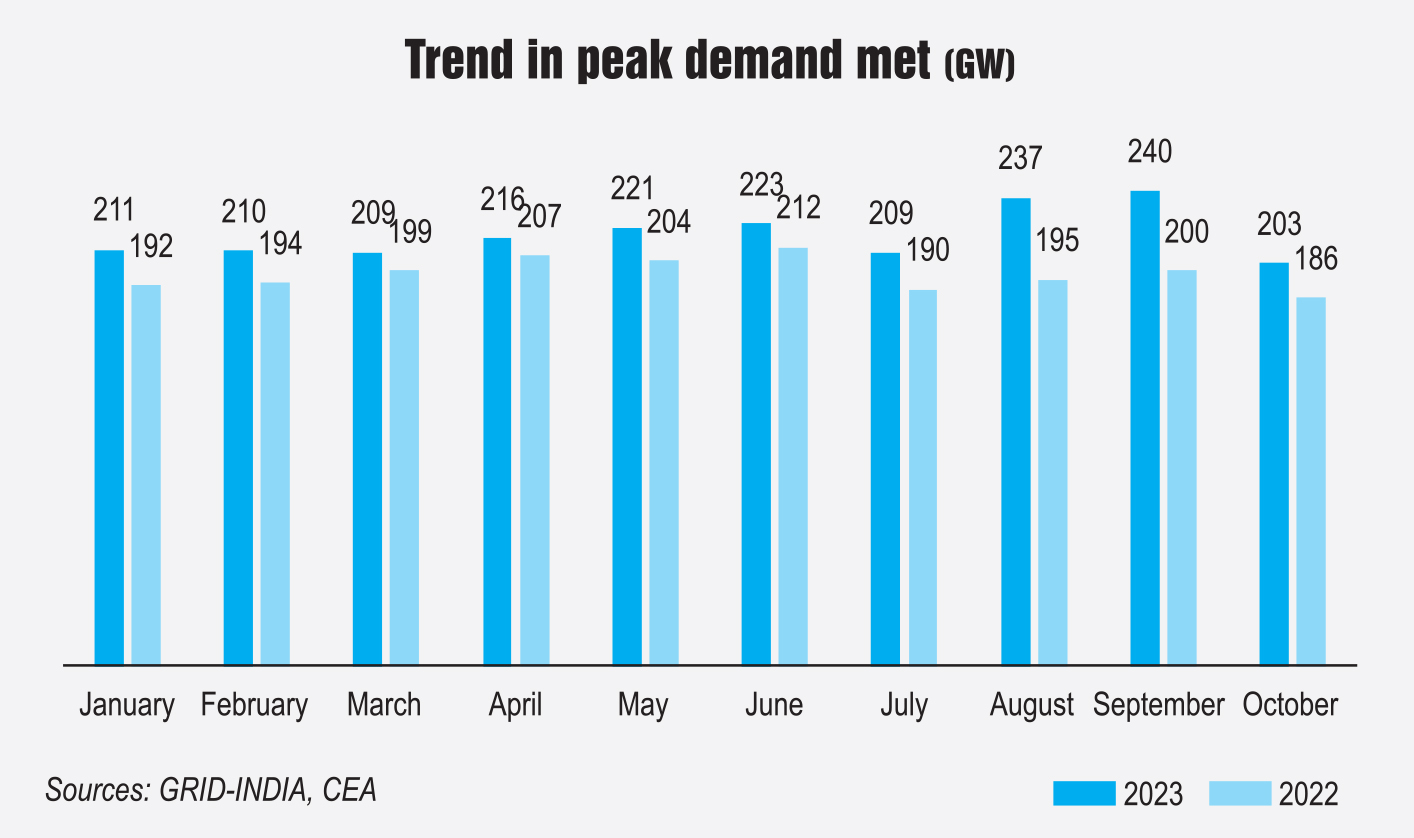
 Propelled by economic growth, India’s electricity demand is growing by leaps and bounds. In October 2023, power demand recorded an increase of 21 per cent over the corresponding period of the previous year, while in September 2023 and August 2023, it grew by 10 per cent and 16 per cent respectively. Peak demand recorded a new high of 239 GW in September 2023. Industry experts and policymakers see this trend continuing in the future and are gearing up to meet the increasing power demand. As per the Central Electricity Authority’s (CEA) forecast, the all-India peak power demand is expected to reach 256.53 GW (in September 2024) during 2024-25.
The Ministry of Power (MoP) has announced that various measures implemented over the last couple years will continue. These include mandatory blending of imported coal at 6 per cent and full operation of imported coal-based (ICB) power plants. What comes as a major shift, however, is the recent announcement to add 55-60 GW of new thermal capacity by 2031-32 (in addition to the 25 GW of under-construction capacity), as against the earlier target of 25 GW capacity addition during this period. To set the ball rolling, various central public sector undertakings (PSUs) – NTPC Limited, NLC India Limited and Coal India Limited (CIL) – have announced plans to award mega thermal power projects in the coming months.
Efforts to meet power demand
In October 2023, the MoP, via two separate notices, directed ICB power units to run till June 2024 and all power generating companies to import up to 6 per cent of their coal requirements till March 2024. This has been done to meet the power demand while addressing the issue of fuel shortage (during September 1, 2023 to October 9, 2023, the gap between receipt of domestic coal and consumption of coal was 12 mt) and to make up for the fall in hydropower generation (in the first half of FY2024, there was an 11 per cent decline in hydro generation over the corresponding period of FY2023 due to variable monsoons and around 2 GW of hydro capacity being out of operation because of the recent Sikkim floods).
Notably, the latest extensions in mandate follow a series of extensions in the past. The mandate invoking Section 11 of the Electricity Act, 2003, directing all ICB plants, aggregating 17 GW across 15 plants, to operate and generate power to their full capacity was originally issued in February 2023 and was later extended to June 2023 and then to October 2023, and has now been extended to June 2024 in view of the coal availability and power demand scenario in the country. With regard to the mandatory blending of imported coal, in 2022, gencos were mandated to blend 10 per cent of their coal requirement, which was later made voluntary for them. In January 2023, the mandate was restored, with 6 per cent blending. In September 2023, this was reduced to 4 per cent and then increased again to 6 per cent till the end of 2023-24.
Meanwhile, at the recently concluded National Conference of Power and Renewable Energy Ministers of States and UTs, the power ministry emphasised on the need to ensure 24×7 quality electricity supply by operating all power plants at full capacity and adding generation capacity. The ministry urged the states to expedite the commissioning of conventional and renewable energy projects, and plan for future capacity addition. The ministry also stressed on ensuring that there is no load shedding and that a high level of plant availability is maintained to do so. The state gencos were asked to endeavour to run their power plants at full capacity, complete plant maintenance/overhaul before February 2024 (so that all plants are available during the period March to June) and prepare the generating units for a minimum PLF of 85 per cent before March 2024. On the fuel front, the states were advised to maintain adequate coal stocks to meet the growing power demand, especially during the period April-June 2024.
With regard to stressed thermal assets pending resolution, the power ministry, via a notice dated November 1, 2023, has advised the state gencos to acquire stressed assets under the Insolvency and Bankruptcy Code through the National Company Law Tribunal route. The four major projects listed for takeover are Rattan India Power Limited’s 5×270 MW TPP; Coastal Energen Private Limited’s 2×600 MW ICB TPP; KSK Mahanadi Power Company Limited’s 6×600 MW TPP; and Shri Maheshwar Hydel Power Corporation Limited’s 10×40 MW hydroelectric project. These projects face challenges such as inadequate capital investment, fuel unavailability and inadequate working capital. The acquisition of these projects by the state gencos is expected to lead to their quick turnaround while helping the state meet the growing power demand.
80 GW of thermal additions by 2031-32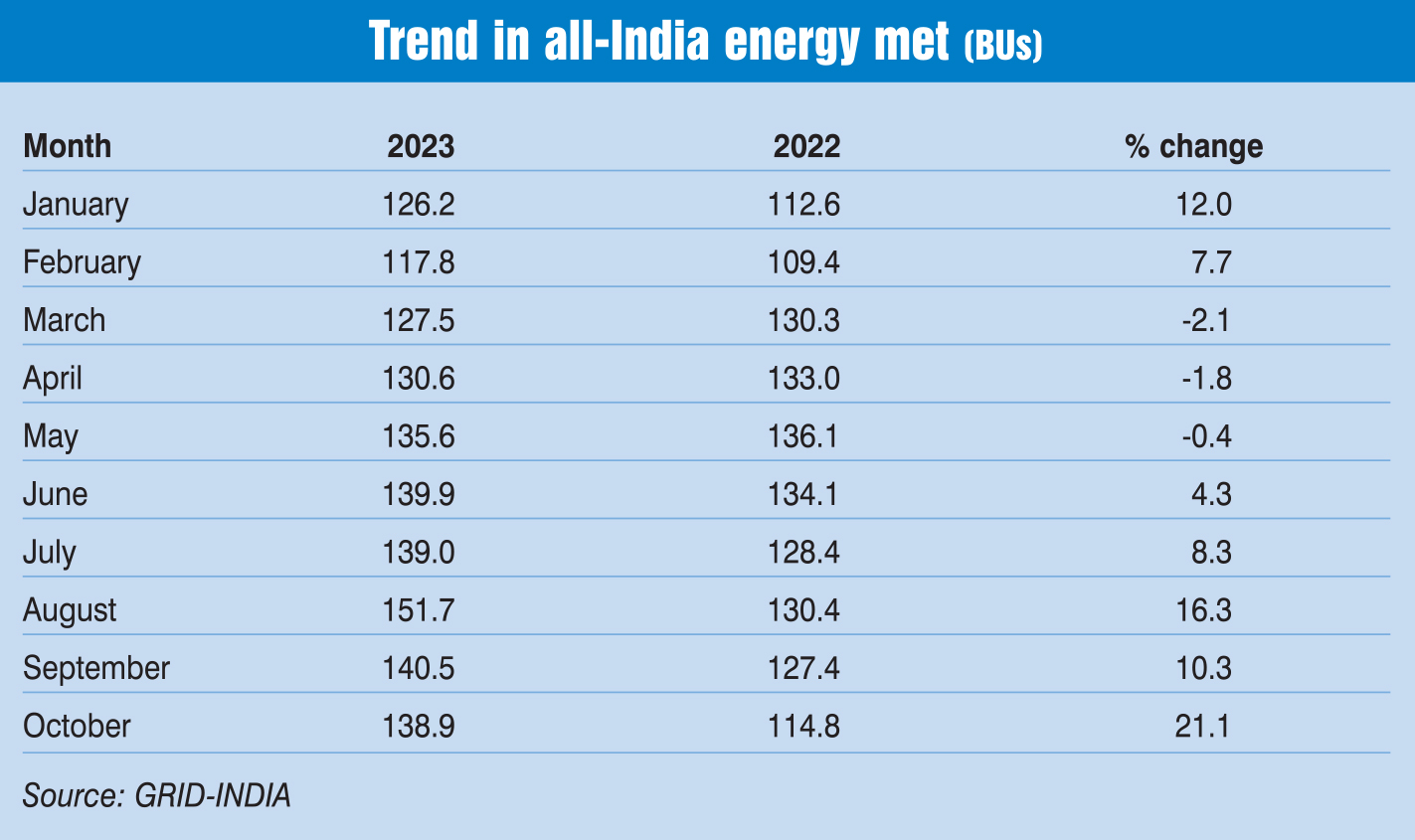
At the power ministry’s recent review meeting with stakeholders to facilitate thermal capacity addition, it was noted that the country needs to add 80 GW of thermal power capacity by 2031-32 to meet its baseload power needs. Currently, 27 GW of capacity is under construction. As such, 55 GW-60 GW of thermal capacity needs to be added, against the planned addition of 25 GW, in order to meet the growing power demand in the country. “Power demand has increased at an unprecedented rate due to rapid growth of the economy. India needs 24×7 availability of power for its economic growth, and we are not going to compromise on this. This cannot be achieved by renewable energy sources alone. Since nuclear capacity cannot be added at a rapid pace, we have to add coal-based thermal capacity for meeting our energy needs. As demand keeps accelerating, we will keep adding this capacity,” stated the power minister at a recent press conference.
 The minister urged the industry to gear up for indigenous development of thermal capacity addition. “Given the power needs, the industry will keep getting orders for thermal capacity addition for the next five to seven years. Thermal energy was written off a few years ago, which was premature. Thermal cannot be written off until energy storage becomes viable. So, thermal is going to stay until energy storage becomes cost-effective for round-the-clock supply of renewable energy. Hence, the industry needs to ramp up thermal capacity,” the minister added. Equipment providers must gear up for the upcoming capacity, vendors should be strengthened, and states and central entities should plan their projects. Meanwhile, EPC vendors raised concerns regarding the bidding process, shortage of credit in the market, bank guarantees, qualifying requirements and technical specifications.
Tendering for new mega-size TPPs is gradually coming to the fore with various project announcements. NTPC is looking to actively award 11.2 GW of thermal capacity by next fiscal. This is in addition to the 10 GW of thermal capacity that is already under construction. Out of the total 11.2 GW planned capacity, 50 per cent will come from NTPC and the remaining would be through its joint venture (JV). Meja Ujra Nigam Private Limited (MUNPL), a JV of Uttar Pradesh Rajya Vidyut Utpadan Nigam and NTPC Limited, has lined up plans to add 5,600 MW of capacity. These comprise two 800 MW units at Sonbhadra’s Obra D TPP (entailing an investment of Rs 179.27 billion), two 800 MW units at Anpara E in Sonbhadra (entailing a cost of Rs 180 billion) and three 800 MW units at the Meja site under Stage II. Some of the big project tenders likely to be issued in the coming months are the 1,600 MW Singrauli TPP (by December 2023), the 800 MW Sipat (by February 2024), the 800 MW Darlipalli (by June 2024), and the 2,400 MW Meja (by September 2024). Some of the projects likely to be awarded in 2024-25 and the first half of 2025-26 are the 2,400 MW Telangana Phase II, the 1,600 MW Obra Expansion and the 1,600 MW Anapara Expansion.
NLC has proposed to set up the 3×800 NLC Talabira Thermal Power Project Phase I in Jharsuguda and Sambalpur districts, Odisha, at an investment of Rs 194.22 billion. Land acquisition has started for the project and is in full swing with the support of the state government. Being a pithead station, the variable cost of electricity from the plant would be less than Re 1 per kWh. The entire capacity of 2,400 MW has been tied up on a long-term basis with Tamil Nadu’s TANGEDCO (1,500 MW), the Puducherry PED (100 MW), Kerala’s KSEBL (400 MW) and Odisha’s Gridco (400 MW). NLC has also announced plans to set up TPS II Second Expansion (2×660 MW). It entails an investment of Rs 111.89 billion.
In another development, CIL has announced plans to set up two thermal power plants. One of these, comprising 660 MW of capacity, will be located at Amarkantak in Madhya Pradesh. The project, entailing an investment of Rs 56 billion, will be set up by the JV of South Eastern Coalfields Limited and Madhya Pradesh Power Generation Company Limited, and is targeted to be commissioned by 2028. In addition, Mahanadi Coalfields Limited, a subsidiary of CIL, is establishing Mahanadi Basin Power Limited, a fully owned subsidiary, to build a 2×800 MW thermal power plant near the Basundhara mines. The project, costing Rs 159.47 billion, has garnered interest from several states for 4,000 MW of power purchase agreements.
Conclusion
Net, net, the multi-pronged approach adopted by the power ministry to meet the growing power demand in the country is expected to support economic growth while ensuring reliable and quality power supply. Meanwhile, on the thermal capacity addition front, with private players unlikely to go back to conventional power generation, especially in light of their renewable energy expansion plans, the onus of setting up new coal-based capacity is expected to rest largely on state-owned entities. Over the course of the next couple of years, how the country will strike a balance between its clean energy goals and the growing demand for power will be crucial.
Priyanka Kwatra