The Ministry of Power (MoP) has recently revised the Guidelines for Import/Export (Cross Border) of Electricity, 2018. The amendments include proposed changes to the rules governing power exports by coal-and gas-based power stations. Further, the ministry has introduced changes to provisions for stations that exclusively supply power to neighbouring countries. A look at the recent amendments…
Key revisions
As per the guidelines, generating companies and distribution companies in India may export electricity generated from coal, renewable energy, or hydropower plants to neighbouring countries, either directly or through Indian trading licensees, subject to approval from the designated authority.
Under the amendments, such exports are allowed only if the electricity is generated using imported coal, spot e-auction coal, coal from commercial mining, or other sources specified by the Government of India. However, these restrictions do not apply to collective transactions on power exchanges in India. For gas-based power plants, exports are allowed only if the electricity is generated using imported gas or other approved sources.
 The guidelines also include provisions for Indian generating stations supplying electricity exclusively to neighbouring countries. These stations may construct dedicated transmission lines to connect with the transmission system of the neighbouring country, taking into account technical and strategic factors. Such construction is subject to approval from the designated authority, in accordance with the provisions of the Electricity Act, 2003, with costs covered in the contract agreement between the entities in India and the neighbouring countries.
In addition, the new guidelines allow these generating stations to connect to the Indian grid (interstate or intra-state) to sell power within India if there is a sustained non-scheduling of full or partial capacity, or if a default notice is issued by the generator for any reason, including delayed payments under the power purchase agreement (PPA).
Current cross-border electricity trade status
Electricity trade between India and neighbouring countries takes place through bilateral agreements, competitive bidding or mutual agreements between entities, all within the framework of agreements signed by the governments of India and these countries, and in accordance with prevailing laws. In cases involving tripartite agreements, the trade will be governed by bilateral agreements between the Government of India and the respective neighbouring countries.
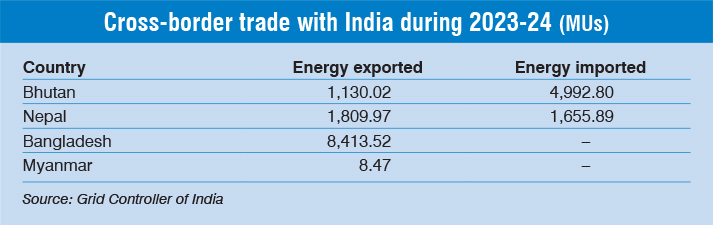
The revised rules come amidst political upheaval in Bangladesh. Currently, Adani Power, which operates the 2×800 MW Godda ultra-supercritical thermal power plant, has a PPA with the Bangladesh Power Development Board, under which 100 per cent of power is exported to the neighbouring country. The plant was operationalised in June 2023.
Cross-border energy trade by India and its neighbouring countries has significantly grown in recent years. Transmission links ranging from 11 kV to 400 kV have been established between border states such as Bihar, Uttar Pradesh, Uttarakhand, Tripura, West Bengal and Assam. Currently, Bhutan and Nepal export hydroelectric power to India, which in turn supplies power to these countries during the lean hydro season. In a key recent development, India has allowed Nepal to export an additional 251 MW of electricity from 12 hydropower projects, which will be supplied to Bihar under a medium-term sales agreement. This brings Nepal’s total hydropower exports to 941 MW from 28 projects.
Besides export of electricity to Bangladesh, there are ongoing discussions for an advanced interconnection between the two countries. Discussions for an interconnection between India and Sri Lanka are also under way.
The import/export guidelines were initially issued by India in December 2018 and revised in July 2019. These guideline aim to facilitate the trade of electricity between India and neighbouring countries, develop a dynamic and robust electricity infrastructure, and ensure transparency, consistency and predictability in the regulatory mechanisms governing such trade. Additionally, they aim to support reliable grid operation and transmission of electricity for cross-border trade. The guidelines, along with recent agreements, are expected to strengthen regional energy cooperation, paving the way for greater energy security, sustainability and resilience across the broader South Asian region.
Aastha Sharma