India’s power distribution segment is on a steady path of reform and modernisation. Supported by schemes such as the Revamped Distribution Sector Scheme (RDSS), growing digitalisation and the large-scale roll-out of smart meters, the segment is undergoing a transformation focused on efficiency, loss reduction and supply reliability. However, continuing financial stress, high aggregate technical and commercial (AT&C) losses in several states and renewable energy integration remain key challenges. As new technologies and consumer-centric reforms take shape, discom leaders share their views on the progress, priorities and the road ahead for the sector…
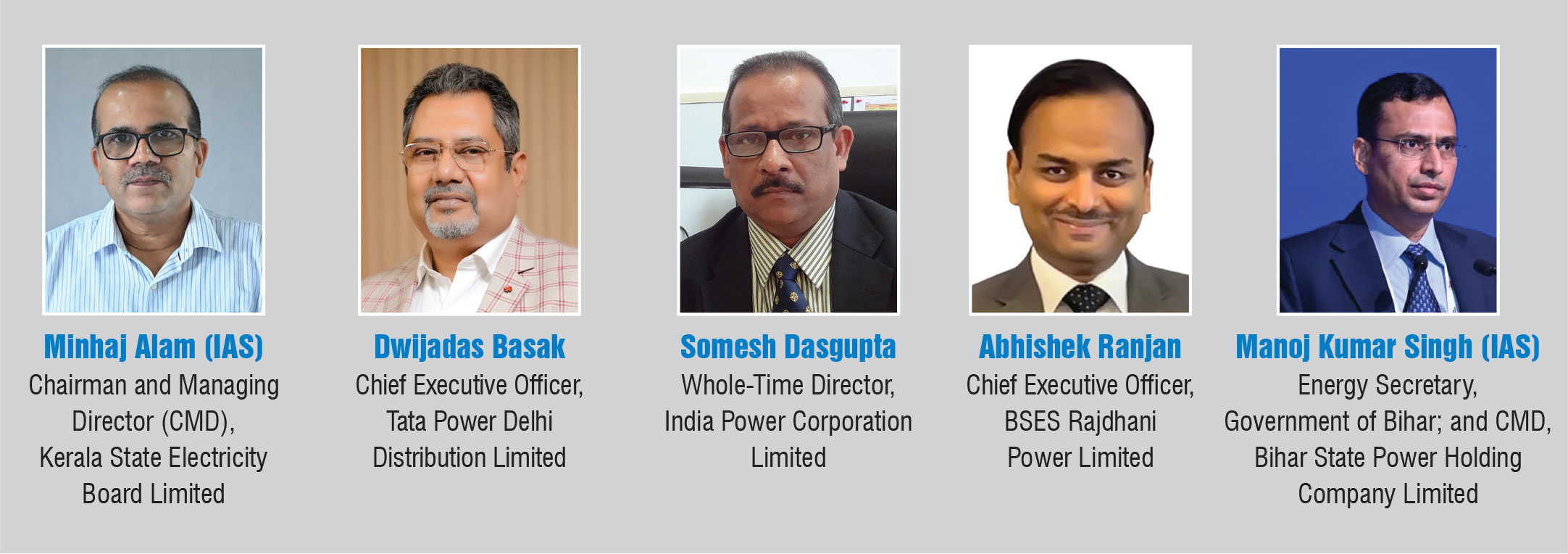
What is your assessment of the current state of the distribution segment? How has it performed over the past year?
Minhaj Alam
Kerala State Electricity Board Limited’s (KSEBL) distribution segment has recorded notable achievements over the past year, positioning Kerala as one of the better-performing states in the power sector. The utility has consistently maintained one of the lowest AT&C losses in the country, a benchmark that demonstrates both operational efficiency and effective consumer engagement. In addition, KSEBL’s system reliability indices have shown steady improvement, with fewer supply interruptions and quicker restoration times compared to earlier years. These efforts have directly translated into higher consumer satisfaction levels, as reflected in service quality surveys and grievance redressal performance.
The successful execution of large-scale initiatives, including network strengthening works, distribution system upgrades and the groundwork for smart metering roll-out, has further enhanced operational credibility. Kerala’s distribution system has also performed strongly in aligning with renewable integration and meeting regulatory compliance requirements without major setbacks.
While these achievements underline KSEBL’s leadership in the distribution segment, further gains can be achieved through system modernisation and augmentation. The wider adoption of smart meters, supervisory control and data acquisition (SCADA)-based automation and resilient infrastructure will allow the utility to maintain its current edge and address emerging challenges.
Dwijadas Basak
India’s power distribution segment has witnessed a remarkable turnaround in the past decade. Once seen as the bottleneck of the power value chain, it is now steadily emerging as an enabler of growth. Reforms such as the RDSS, coupled with digital adoption, have made a measurable difference. AT&C losses, which stood at 22.62 per cent in 2014, have dropped to about 15 per cent in 2025, reflecting improved operational efficiency and better governance. Non-fossil fuel sources, including renewables and nuclear, account for 235.7 GW (49 per cent) of the total capacity of 476 GW as of June 2025. Power shortages have declined significantly from 4.2 per cent in FY 2014 to just 0.1 per cent in FY 2025. Under the PM Surya Ghar: Muft Bijli Yojana, approximately 5,696 MW of solar capacity has been installed nationwide, covering more than 1.9 million households, with Rs 107.68 billion of subsidies released. Additionally, smart metering has been completed for more than 39.9 million connections, further enhancing the efficiency and transparency of the power distribution segment.
At Tata Power-DDL, the discom has installed over 0.6 million smart meters till August 2025, enabling faster outage detection, tamper alerts and improved billing accuracy. Its Behavioural Demand Response Programme, launched in 2021, has crossed 0.13 million enrolments and saved over 1,100 MW till FY 2025, demonstrating how simple behavioural nudges can strengthen grid stability.
On the renewables front, Tata Power-DDL has so far facilitated 5,530 rooftop solar connections across key consumer segments. The domestic segment accounts for the largest share with 3,995 connections, followed by commercial and industrial with 1,497 and others with 38.
All of this demonstrates that the distribution segment is no longer a weak link. It is evolving into the backbone of India’s modern, consumer-centric power sector.
Somesh Dasgupta
In 2024, the power industry as a whole displayed tremendous growth, from meeting record energy demand of 250 GW to reducing energy shortages. The distribution segment showed growing reliance on technological integrations such as smart grids, energy storage systems and artificial intelligence (AI) to optimise power supply and efficiently manage the grid. India is on a journey to achieve net zero emissions by 2070 and become Viksit Bharat by 2047. In this regard, the advancement of renewable energy is a key lever. During the past one year, India added more renewable capacity in the distribution segment than ever before, which is a significant achievement. However, the journey to net zero is extended and demanding. India is still dependent on coal-based thermal power plants (TPPs) for its load requirement. Specifically, the share of the total power generation from thermal sources (coal, oil and gas) is 75-80 per cent, and non-fossil sources (renewable and nuclear) is 20-25 per cent. In simple terms, India still depends on thermal power for about three-quarters of electricity generation. Therefore, capacity building of state-of-the-art TPPs is imperative.
The performance of power discoms has improved; however, I believe billing and collections remain a significant obstacle. We need more smart meter installations to reduce commercial losses and more high tension power lines to improve transmission. As the power distribution segment is a crucial link in the energy supply chain, frequent assessments are extremely important. I am proud to highlight that India Power received an “A” rating in the 13th Annual Integrated Rating and Ranking of Power Distribution Utilities. We are, in fact, the only discom from West Bengal to receive this rating.
Abhishek Ranjan
The distribution segment has shown steady improvement over the past year, driven by sustained regulatory focus and government interventions. The RDSS has been central to this progress, providing budgetary support to distribution utilities (except private discoms) for strengthening infrastructure, reducing losses and rolling out smart meters – a critical element of the reform agenda. Over the years, flagship programmes such as the IPDS, DDUGJY, UDAY and SAUBHAGYA have supplemented these efforts, enabling investments in system strengthening, grid modernisation, infrastructure expansion, feeder segregation and prepaid smart metering. Complementing these, enabling measures such as an additional borrowing space of 0.5 per cent of gross state domestic product, revised prudential norms, and the introduction of a resource adequacy framework have strengthened the sector’s performance framework.
These initiatives, combined with affirmative action by discoms, have delivered measurable improvements:
- AT&C losses declined to 16.28 per cent in 2023-24.
- Power supply availability improved to 22.6 hours in rural areas and 23.4 hours in urban areas as of Q3 FY 2025.
- Per capita electricity consumption surged to 1,395 kWh in FY 2024, a 45.8 per cent increase over the past decade, underscoring both rising demand and the system’s ability to meet it efficiently.
- Billing efficiency has improved alongside rising digital adoption by distribution companies.
- On the financial front, the gap between the average cost of supply (ACS) and the average revenue realised (ARR) narrowed by 20 paise per unit, from Re 0.59 per kWh in 2022-23 to Re 0.39 per kWh in 2023-24, reducing the absolute cash gap to approximately Rs 580 billion.
- Overall, the distribution segment has moved from a position of persistent stress towards greater financial and operational stability, though structural challenges remain.
Manoj Kumar Singh
India’s power distribution sector, comprising 85 utilities (including 13 power departments), serves over 330 million consumers. In 2024-25, these utilities supplied 1,694 BUs of electricity, marking steady growth from 1,622 BUs in the previous year (as per the Central Electricity Authority). Financially, the sector has improved through focused modernisation, reducing losses from Rs 435.28 billion in 2022-23 to Rs 310.37 billion in 2023-24, and narrowing the cost-to-revenue gap from Re 0.55 per kWh to Re 0.39 per kWh (as per PFC Limited). However, AT&C losses rose slightly to 16.12 per cent from 15.37 per cent, underscoring ongoing challenges. Driving transformation, the sector is aggressively adopting smart grid technologies, deploying advanced metering infrastructure, and integrating renewable energy and distributed energy resources. These initiatives enhance reliability, automate outage management and boost operational efficiency. Rising demand, fuelled by electrification trends such as electric vehicles, cooking and heating, is further accelerating growth. Emerging innovations such as microgrids and community energy projects show promise, while increased digitalisation is bringing cybersecurity into sharper focus. Proactive investments in resilience aim to mitigate climate-related risks.
Poised at a critical inflection point, India’s power distribution landscape is set to leverage technology and policy support for sustainable growth, even as it navigates complex economic, regulatory and technological challenges.
What are the unresolved issues in the segment and how can these be addressed?
Minhaj Alam
Despite improvements, several challenges continue to affect the efficiency and reliability of the distribution segment:
Reliability of supply: The sub-transmission backbone, particularly the 33 kV network, lacks redundancy, meaning that a single failure can lead to prolonged outages. This directly affects service reliability and consumer confidence. Immediate strengthening of the network, with redundancy measures, is essential to minimise interruptions and improve the quality of supply.
Automation and control: Although plans for SCADA-based remote distribution control centres exist, the supporting infrastructure is inadequate. The absence of robust communication systems and adequate feeder-level sensors and ring main units limits the scope for real-time monitoring and automated fault management. Without these, system operators are unable to fully leverage digital tools for outage reduction and load management.
Standardisation and workforce capacity: Distribution construction practices are not uniformly aligned with TN-C-S standards, largely due to skill gaps and inconsistent implementation. The lack of trained manpower results in deviations from best practices, creating safety and operational risks. To bridge this, there is a strong need for structured training programmes, hands-on workshops and certification schemes that build capacity for adopting modern construction and maintenance techniques.
Ageing infrastructure and climate resilience: Large portions of the distribution infrastructure are ageing and increasingly vulnerable to Kerala’s diverse climatic conditions, ranging from coastal humidity to heavy monsoon rains and hilly terrain. This raises concerns over safety, reliability and higher maintenance costs. Climate-resilient design standards, coupled with targeted investment support, are necessary to build a robust and future-ready network.
Smart metering and loss reduction: The roll-out of smart meters will be a major step towards improving billing efficiency, reducing AT&C losses and enabling consumer-side load management. However, Kerala, having already achieved relatively low AT&C loss levels, requires policy flexibility. Additional incentives or revised key performance indicators may be considered to recognise states that are already high performing, ensuring they remain motivated to pursue further digitalisation and efficiency improvements.
Integration of renewable power: Kerala is among the states with the highest levels of distributed solar integration, largely in the form of rooftop solar projects. While this has contributed to clean energy adoption, the increasing injection of variable solar power is creating serious challenges in maintaining network stability and voltage parameters. Sudden fluctuations and reverse power flows at the distribution level are affecting feeder performance and power quality. There is an immediate need for network augmentation, strengthening and implementation of advanced control systems to accommodate this growing share of renewables without compromising reliability.
Dwijadas Basak
Despite commendable progress, financial sustainability remains the biggest concern, with the persistent ACS-ARR gap compounded by collection inefficiencies. Without tariff rationalisation and loss reduction, discoms will struggle to invest in infrastructure and innovation.
A key unresolved issue is mounting regulatory assets and often delayed subsidy payments by state governments. Regulatory assets amounting to over Rs 1.5 trillion continue to remain unresolved, largely in Tamil Nadu, Rajasthan, Kerala and Delhi. The recent Supreme Court order for the time-bound liquidation of regulatory assets is expected to provide significant relief to discoms and improve their financial efficiency.
On the technical front, integrating renewable energy presents challenges such as intermittency, which demand better forecasting, smart grids, demand response and energy storage.
Tata Power-DDL is demonstrating leadership in this space. For the past six years, its 10 MW battery energy storage system (BESS) in Rohini has been successfully stabilising the grid, managing peak loads, enabling arbitrage and ensuring reliable supply. The discom is committed to integrating more advanced technologies and it aims to scale up the adoption of storage systems to make the grid future-ready.
Cybersecurity is also becoming critical as discoms digitalise operations, making robust defences essential to protect both infrastructure and consumer data. Addressing these issues calls for a holistic approach – enhancing financial viability, improving governance, embracing advanced technologies and ensuring regulatory accountability across the distribution segment.
Somesh Dasgupta
A major unresolved issue is the intermittent availability of round-the-clock (RTC) renewable power in the grid. India has an abundance of solar and wind energy, but they are variable in nature. In 2025 itself, we experienced heavy monsoons for most of the year. We are on a journey to maximise green power supply, declaring an ambitious target of 500 GW of renewable capacity by 2030. The addition of several small renewable projects and the continuous rise and fall of power supply and demand can make the grid unstable if there is no RTC power. To ensure RTC green power during peak hours or when there is not enough green power generation, we need to rely on robust energy and battery storage systems. India’s energy storage sector is still emerging. Today, pumped hydro storage provides the most bulk storage, while grid-scale batteries are just beginning to roll out. Going ahead, we need a big surge in storage capabilities.
The financial viability of discoms is another issue. Despite decreased operational losses, most discoms have accumulated debt. While higher tariff and government subsidy plans have eased the situation to some extent for state discoms, private companies do not receive subsidised government grants for capex, which is affecting performance efficiency.
Abhishek Ranjan
Despite progress, several structural challenges persist and require focused action:
- High AT&C losses in specific states: While the national average has improved, many discoms continue to report losses exceeding 20-25 per cent. Targeted reforms such as feeder segregation, underground cabling, technology adoption and enhanced accountability are needed to bring these losses under control.
- Tariff rationalisation: The average revenue gap continues to reflect under-recovery due to delays in tariff revisions and high cross-subsidisation. Timely tariff orders, the implementation of direct benefit transfer for subsidies and stricter regulatory compliance can help close the ACS-ARR gap in a sustainable manner.
- Delayed infrastructure upgrades: Distribution infrastructure in several urban and rural areas remains stressed. The RDSS, with an outlay of Rs 3.03 trillion till 2025-26, must be executed in a time-bound manner with an emphasis on smart metering, digitalisation and network strengthening.
- Adoption of renewables and storage: With India targeting 500 GW of non-fossil fuel capacity by 2030, discoms must gear up for much higher renewable penetration. This requires proactive planning for grid integration, development of flexible demand-side mechanisms, and accelerated deployment of BESS to ensure RTC reliability and manage the variability of solar and wind power.
- Bridging the skill gap: The transition towards smart grids, digital twins, AI-driven forecasting and distributed energy resources demands new skillsets. Bridging the gap between existing manpower and emerging technologies through large-scale skilling, reskilling and capacity-building programmes is essential to sustain reform gains.
- Healthy competition and customer-centric reforms: Competition is vital to bring efficiency, innovation and better value to customers. While concepts such as content and carriage separation have been widely discussed, they now need to move to the forefront of reform implementation. A transparent framework for competition in distribution, with strong consumer protection, can anchor sector efficiency while enhancing service quality.
- In sum, addressing these issues with policy consistency, investments in new technology, customer-centric reforms, and workforce readiness will be key to unlocking the next phase of efficiency and sustainability in the distribution segment.
- Manoj Kumar Singh
The power distribution segment stands at a critical crossroads, offering vast growth potential, yet grappling with deep-seated challenges that demand urgent, focused intervention. Tackling these issues is not merely about survival; it is vital for building a vibrant, sustainable future. Key priorities include:
Market-based economic despatch (MBED): MBED represents a transformative shift by centralising power despatch across states, aligning with the government’s “One Nation, One Grid, One Frequency, One Price” vision. This reform promises greater efficiency, competitiveness and substantial cost savings by optimising the use of the cheapest and cleanest electricity in real time.
Accurate voltage-wise cost data: The persistent lack of precise voltage level cost data hampers tariff design that reflects true consumption costs, limiting utilities’ ability to optimise pricing and operational efficiency.
Technology integration: Despite its transformative potential, the adoption of digital solutions remains low. Enhancing IT systems and embracing digital tools are critical to streamline operations, improve data accuracy, reduce losses and elevate customer service.
Regulatory accounting transparency: The widespread absence of transparent regulatory accounting among many state utilities undermines tariff rationalisation and financial sustainability. Without accurate accounting, regulatory oversight weakens, impeding essential sector reforms that ensure fairness and clarity for consumers and stakeholders.
Comprehensive fixed asset registers: Many utilities struggle with outdated systems, fragmented data and limited digital infrastructure, resulting in incomplete asset records. This deficiency leads to frequent outages, operational inefficiencies and distorted financial reporting, and erodes investor confidence.
Human capital development: Bridging knowledge gaps by upskilling engineers, technicians and operational staff in regulatory frameworks, best practices and technology are crucial to empower front line teams driving daily and future sector performance.
Combating power theft: Power theft continues to significantly drain revenues through unauthorised connections and meter tampering. Addressing this demands a multifaceted approach involving advanced metering, strict monitoring, enforcement and consumer engagement.
The path ahead is challenging, but ripe with opportunity. By strengthening data systems, embracing reforms such as MBED, investing decisively in technology and human resources, and rigorously addressing inefficiencies, the power distribution segment can be revitalised. With visionary policies, cutting-edge technology and skilled talent, India is poised to realise its promise of reliable, affordable and sustainable power under the banner of “One Nation, One Grid, One Frequency, One Price”, ushering in a new era of energy excellence.
What is your outlook for the distribution segment in the near-to-medium term?
Minhaj Alam
Kerala is embarking on smart meter implementation, which is expected to be completed by 2030. Under this initiative, more cities will be integrated into the distribution network alongside the existing three.
Network expansion is progressing steadily, with 4 per cent annual growth in high tension lines and 2 per cent in low tension lines, leading to an estimated 20 per cent increase in the overall network by 2030. As part of Kerala’s climate-resilient strategy, nearly 25 per cent of the network will be converted into underground cables or covered conductors, reducing outage risks from climatic events and enhancing safety.
All distribution assets will be mapped in a geographic information system (GIS), and a comprehensive asset management solution is expected to be in place by 2030.
The integration of distributed renewable energy will become more streamlined with enhanced data visibility, rooftop solar forecasting and localised demand prediction. Plans are under way to use automatic weather stations for procuring weather data. These initiatives will optimise power purchase planning, thereby improving economic efficiency.
Innovative projects such as drone-based feeder monitoring in difficult terrain are under consideration, which is expected to improve service and system reliability.
Dwijadas Basak
India’s distribution segment stands at an inflection point, and the outlook seems positive. Continued implementation of the RDSS, targeted reduction in AT&C losses and a near-zero ACS-ARR gap will drive greater financial stability. Tariff normalisation will play a critical role in ensuring sustainable cost recovery while protecting consumer interests.
Digitalisation and smart technologies will shape the next phase of growth. Accelerated deployment of smart meters and the introduction of new use cases will empower consumers with real-time control over consumption and billing, enabling energy conservation. Programmes such as behavioural demand response and automated demand response will also encourage efficient energy usage and help balance supply and demand, reducing peak load stress and enabling better grid management.
The rise of prosumers – consumers who also produce energy, especially through rooftop solar – will transform consumption patterns. Peer-to-peer energy trading platforms will empower prosumers to trade surplus power within communities, fostering decentralised and resilient energy ecosystems.
Grid modernisation through SCADA, advanced distribution management and GIS mapping will improve reliability and transparency. Rooftop solar and EV adoption are set to scale rapidly, with discoms playing a central role. For instance, Tata Power-DDL has partnered with Baaz Bikes to expand EV battery swapping infrastructure across north and northwest Delhi. So far, we have successfully facilitated the installation of over 2,804 EV charging points.
Sector privatisation and improved governance models are expected to boost accountability, encourage investment and drive competitive efficiencies, accelerating the overall transformation of the segment. With these initiatives, India’s distribution segment is poised not only to meet domestic power sector goals but also to emerge as one of the world’s most advanced in the coming decade.
Somesh Dasgupta
The overall development trend is positive, and the momentum of improvement will determine the outcome. Some states are likely to achieve sustainability sooner than others, based on the Ministry of Power’s annual ratings. If decarbonisation is the end goal, it will require the modernisation of ageing grids and tremendous investments in smart grids, predictive maintenance and energy storage systems, as well as the integration of hybrid and clean energy systems. Under the RDSS, I see significant emphasis on smart metering solutions, establishment of new substations, enhancement of last-mile connectivity to power the remotest of areas, and increased deployment of energy storage systems.
Abhishek Ranjan
- DERs, rooftop solar and PMSGY: The PM Surya Ghar: Muft Bijli Yojana targets 10 million households with structured subsidies (scheme outlay Rs 750.21 billion; implementation through 2026-27). This will accelerate rooftop solar adoption in the LT network, requiring utilities to upgrade net metering, settlement and protection practices while using smart meters and analytics for prosumer management.
- BESS to move from pilots to portfolio scale: With cabinet-approved viability gap funding for grid-scale storage and an indicative storage need of around 83 GW by 2032 (47 GW BESS + 36 GW PSP), discoms and load-serving entities will increasingly contract hybrid renewables plus storage projects for peak shaving and RTC supply. State bids are likely to pair time-of-day (ToD) tariffs with storage obligations, improving evening reliability and reducing dependence on expensive short-term power.
- EV charging infrastructure to scale up: However, it needs planning discipline. As of April 1, 2025, BEE-tracked public charging stations are expanding under the FAME/PM E-DRIVE initiatives, yet the EV-to-charger ratio remains stretched in many cities, necessitating distribution-level capacity augmentation, ToD tariffs and connection process service-level agreements. Discoms that standardise connection timelines and cost-sharing frameworks for depots and highway nodes will capture higher quality loads with stable utilisation profiles.
- Private participation to gather pace: Multiple large private utilities have expressed interest in acquiring 51 per cent stakes in two Uttar Pradesh discoms (PUVVNL and DVVNL) under the state’s ongoing process – an inflection point that other states may study and follow for loss-making circles. As bids and transaction structures mature, we expect operational discipline and capex efficiency. Customer service standards are expected to tighten, with clearer accountability mechanisms for reliability and collections.
- Tariff realism and balance sheets: The Supreme Court’s recent ruling directing time-bound liquidation of regulatory assets (generally within four years) will force a shift to more cost-reflective tariffs and discourage deferrals, improving discom liquidity and bankability for new investments. Together with improved ACS-ARR discipline, this positions discoms for sustainable opex/capex cycles and better vendor credit.
- Digitalisation and digital twins will become foundational. With increasing distributed energy resources, BESS and EV penetration, grid observability (AMI, sensors), state estimation and digital twin deployments will shift from pilots to operational tools, enabling faster fault location, volt/VAR optimisation, and scenario-based planning for new connections and rooftop clusters. This aligns with the RDSS thrust on digitalisation.
- Operational and financial metrics on an improving trajectory: If ongoing reforms hold, the metrics will continue improving. With RDSS investments and policy execution, AT&C losses are projected to fall below 12 per cent by FY 2027, and the ACS-ARR gap will narrow further as time-bound regulatory asset liquidation progresses. Smart metering will enable prepaid models, demand response and better collection efficiency. On this pathway, distribution can evolve from being a bottleneck to becoming a growth enabler over the next three to five years.
Manoj Kumar Singh
The near-to-medium-term outlook for India’s power distribution segment is one of cautious optimism, anchored by a strong foundation of ongoing reforms, improved governance, renewable energy integration, technological innovation and better financial management. These pillars collectively support the promise of sustainable growth.
Sustaining this momentum hinges on the effective execution of key initiatives such as the RDSS, Pradhan Mantri Kisan Urja Suraksha evam Utthan Mahabhiyan, and PM Surya Ghar: Muft Bijli Yojana. Coupled with these policy measures, the adoption of advanced technologies – such as energy storage, smart grids, AI and real-time demand forecasting – will revolutionise power delivery, enhancing reliability, efficiency and responsiveness to dynamic consumer needs. Hybrid renewable energy solutions will play a pivotal role, accelerating India’s green energy transition and driving economic growth while advancing ambitious sustainability goals.
However, some challenges persist. Ageing infrastructure, financial pressures, regulatory complexities and skill shortages continue to test the sector’s resilience. Overcoming these obstacles requires steadfast policy support, targeted capital investments and robust capacity-building to foster a culture of modernisation.
Ultimately, through strong collaboration among utilities, regulators, policymakers and investors, the power distribution segment is positioned to evolve into a more agile, resilient and consumer-focused ecosystem, serving as a key driver of India’s energy transition and an enabler of inclusive economic growth in the years ahead.