Asignificant portion of India’s thermal fleet has been in operation for several decades. As these units age, renovation and modernisation (R&M) have become essential to sustain and improve plant performance. Long operating hours lead to equipment wear, material fatigue and ageing control systems, which adversely affect plant efficiency, reliability and availability. In many cases, performance deterioration has occurred even earlier due to sub-optimal operating practices, inadequate maintenance and extended part-load operation. If these issues are not addressed in a timely manner, they result in reduced plant output, higher fuel consumption, frequent outages and increased emissions. R&M addresses these challenges by upgrading or replacing critical systems with improved designs and modern technologies. Compared to setting up new generation capacity, R&M requires lower capital investment, involves shorter execution timelines, and delivers measurable gains in efficiency and output.
India adopted a structured approach to R&M in 1984, with the launch of a centrally sponsored programme during the Seventh Five-Year Plan. During 2017-22, R&M and life extension works were carried out across eight thermal generating units with a combined capacity of 1,197 MW. These included the Ukai thermal power station (TPS) (Unit 4), the Wanakbori TPS (Unit 3), the Kathalguri combined cycle gas turbine (Units 3 and 6), the Koradi TPS (Unit 6), the Obra TPS (Units 12 and 13) and the Barauni TPS (Unit 6).
Growth drivers
Ageing
Ageing is a key driver for R&M and life extension (LE). Thermal power plants (TPPs) are typically designed for a minimum operating life of 25 years. Beyond this period, mechanical wear, material degradation and obsolete equipment lead to reduced efficiency and reliability. This results in higher outage rates, increased fuel consumption and rising operating costs. Older plants also tend to have poorer heat rates compared to newer units.
Refurbishment or replacement of critical systems such as boilers and turbines can extend plant life by 10-15 years while improving overall performance. Recognising the continued role of thermal power in meeting demand, the Central Electricity Authority (CEA) has advised utilities not to retire or repurpose coal-based plants before 2030, and instead maintain unit availability through timely R&M measures.
Flexibilisation
The growing share of renewable energy in the country’s energy mix has increased the need for thermal units to operate at lower loads and ramp up/down output more frequently to support grid stability. In 2023, the CEA notified regulations on the flexible operation of coal-based thermal generating units. Under the regulations, all central, state and private sector units were required to achieve a minimum technical load (MTL) of 55 per cent within one year of notification, along with ramp rates of 2-3 per cent per minute. The regulations also require plant owners to implement phased plans for operation at a 40 per cent MTL, with defined ramp rates across different load bands.
Many older units were originally designed for continuous baseload operation and are therefore not equipped for frequent load cycling. R&M enables flexibility by upgrading control systems, improving firing and combustion arrangements, strengthening boiler components with advanced materials, and implementing other modifications required for stable low-load and high ramp-rate operation. As of September 2025, about 75 per cent of the targeted capacity has achieved operation at 55 per cent MTL.
Digitalisation
Digitalisation is driving R&M in TPPs as utilities seek to improve efficiency, reliability and cost competitiveness. R&M provides an opportunity to replace legacy control systems with modern distributed control systems, deploy smart sensors and adopt advanced digital tools for real-time monitoring and analysis.
The adoption of Industry 4.0 solutions, including industrial internet of things platforms and data analytics, is enabling a shift from reactive maintenance to predictive maintenance. By combining operating data with inspection results, these systems allow early detection of equipment degradation caused by factors such as high-temperature creep, load cycling, corrosion and erosion. Digital tools also support improved boiler operation, inspection planning and automated diagnostics, leading to higher availability, reduced unplanned outages and lower manpower requirements.
Selection of TPPs for R&M
TPPs proposed for R&M or LE are identified through detailed technical and economic assessments. The process includes residual life assessment (RLA), condition assessment (CA), energy audits and review of historical performance data. These evaluations typically cover major plant systems such as boilers, turbines, generators, transformers, motors, pumps, fans, heaters, critical piping, hangers and structural components, providing a comprehensive view of the plant’s health.
RLA and CA are typically carried out after about 100,000 operating hours, or approximately 12 years of boiler operation, and are subsequently repeated at regular intervals, usually every five years. Similar assessments are conducted for turbines. The findings of these studies help determine whether R&M or LE should be undertaken, and whether these can be combined with capacity uprating. Units with an installed capacity of 150 MW or higher and a reheat cycle are preferred. In addition, plants that show significant heat rate deterioration despite regular overhauls, or have completed around 20 years of operation, are also considered suitable candidates.
The final selection depends on a cost-benefit analysis, taking into account technical feasibility, compliance with environmental norms, ash management readiness and the ability to achieve a payback period of seven to eight years.
 Challenges and the way forward
Despite its benefits, R&M implementation faces several challenges. Funding remains a major constraint as refurbishment projects require significant capital and many generating companies operate with limited financial headroom. Planned shutdowns needed for retrofitting also pose difficulties, particularly in power-deficit regions where taking units offline can affect availability. Further, technical challenges arise from the complexity of integrating modern equipment into ageing plants. Procurement presents another hurdle as critical flue gas desulphurisation components and specialised materials are frequently imported, leading to longer lead times, higher costs and exposure to supply-chain disruptions. Rising prices of steel, cement and non-ferrous metals also escalate project costs. These issues are exacerbated by shortages of skilled manpower experienced in CA, detailed engineering and the execution of R&M works.
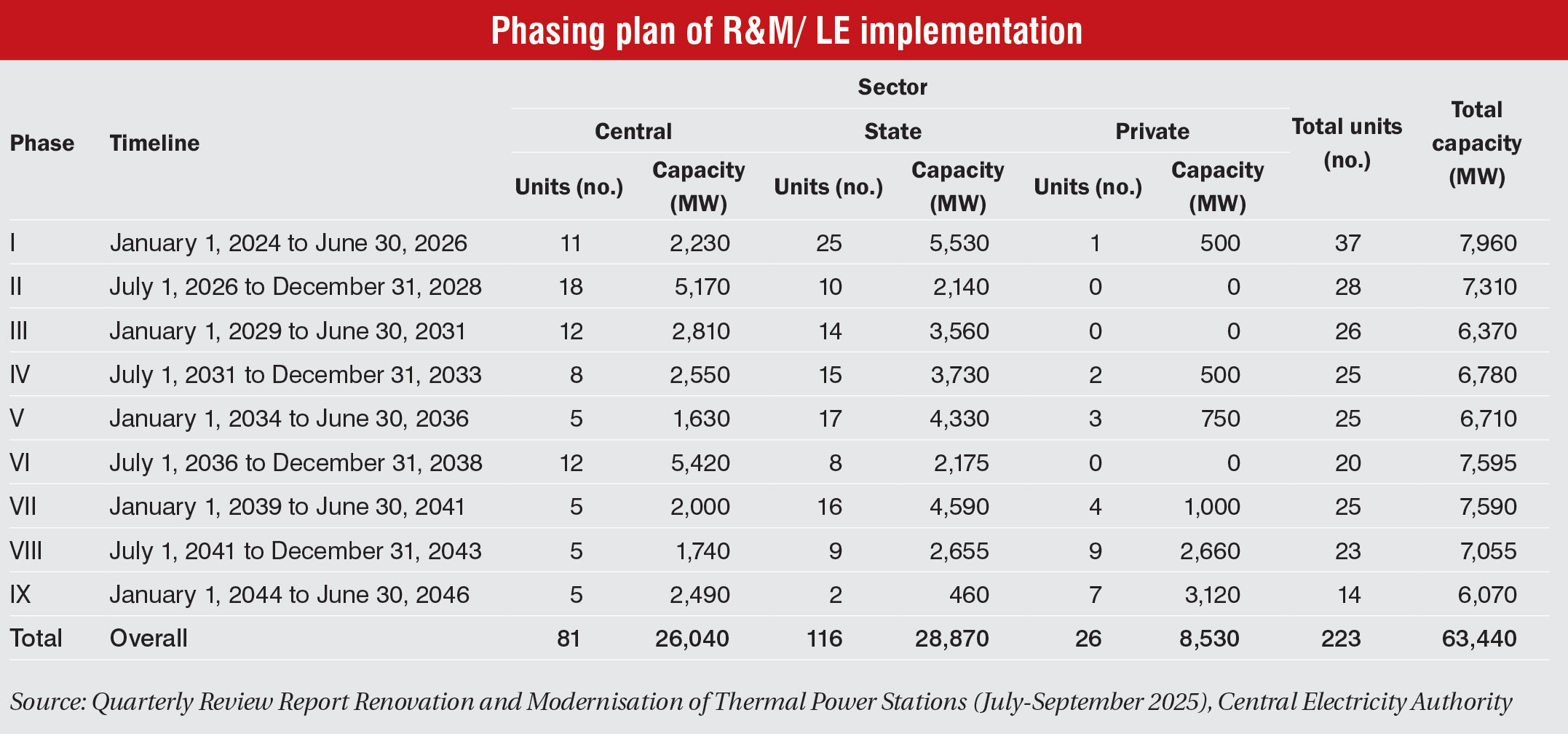
Nevertheless, the scope for R&M and LE across India’s thermal fleet remains substantial. As of December 2022, thermal units that are more than 20 years old, will account for about 63,440 MW across 223 units. The CEA has identified these units as potential candidates for R&M and life extension. To avoid demand-supply imbalances, R&M works will be implemented in a phased manner across nine phases, from January 2024 to June 2046. Under Phase I, 36 units with a total capacity of 7,960 MW are targeted between January 1, 2024 to June 30, 2026.
Going forward, timely R&M will be critical to sustaining dependable thermal capacity as renewable penetration continues to increase.