The flexible operation of thermal power plants (TPPs) has emerged as a key concern amid the rapid transformation of India’s power system. As renewable energy capacity expands at an accelerated pace and variability becomes a defining feature of grid operations, the role of coal-based generation is shifting from baseload supply to providing balancing support. This transition has brought into focus the technical, operational and commercial implications of operating thermal units at lower minimum technical loads and under two-shift regimes.
Concerns have been raised within the sector regarding the impact of sustained low-load operation and cyclic ramping on equipment health, boiler performance, auxiliary systems and overall plant life. In particular, questions have emerged about the feasibility of operating units below 55 per cent load under prevailing coal quality conditions, and the potential increase in boiler tube leakages, flame instability and turbine-related stresses resulting from repeated ramp-ups and ramp-downs.
In this context, the Central Electricity Authority (CEA), in consultation with GRID-INDIA and generating utilities, undertook a comprehensive examination of potential wear and tear, operations and maintenance (O&M) implications and plant life associated with flexible operation, including two-shift functioning. Accordingly, a multi-stakeholder committee was constituted under the CEA to assess these issues in a structured and evidence-based manner.
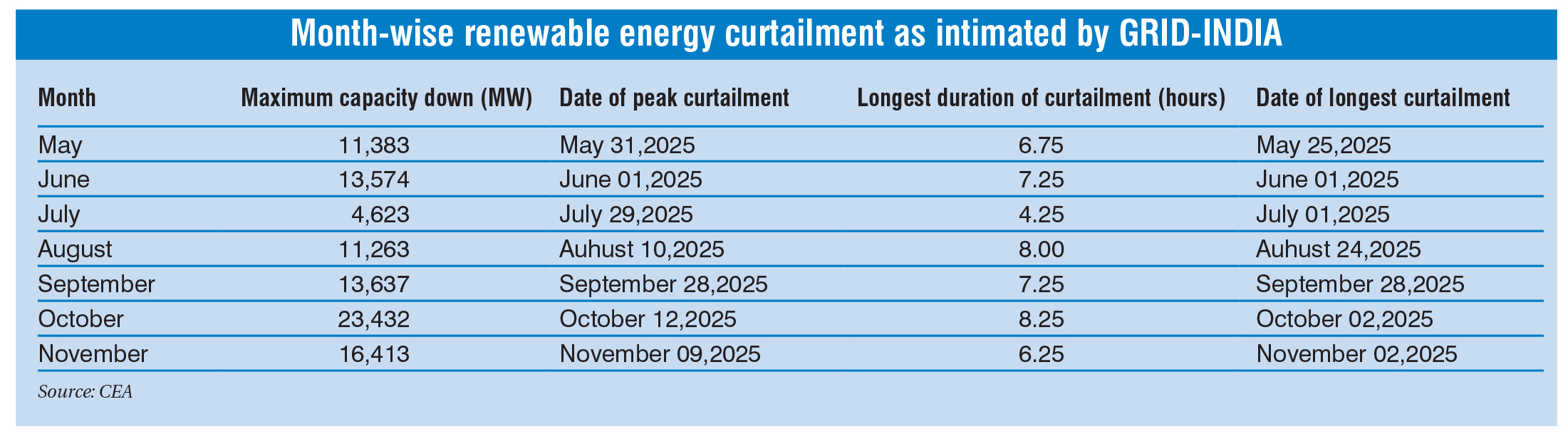
GRID-INDIA has highlighted the increasing incidence of the “duck curve”, marked by surplus renewable generation during mid-day hours and steep evening ramp requirements of around 60 GW. All-India diurnal demand variation stands at about 75 GW, with ramping needs typically in the range of 250-300 MW per minute, rising to 500 MW per minute on certain days. In May 2025, system frequency remained above the Indian Electricity Grid Code band for nearly 20 per cent of the time, with sustained high frequency conditions during solar hours. Even after backing down thermal generation to around 58 per cent and curtailing nearly 10 GW of solar generation, frequency touched 50.48 Hz on May 25, 2025. The inability of several thermal stations to operate below the 55 per cent minimum technical load (MTL) has resulted in renewable curtailment exceeding 23 GW during high solar periods. At the same time, certain units, including Shree Cement, Rajpura, Talwandi Sabo, Adani Raigarh and Mahan, have demonstrated lower-load operation in practice. Therefore, greater thermal flexibility, including 40 per cent MTL and two-shift operations, is increasingly seen as essential for secure grid management and renewable integration.
 CEA’s view
Since 2018, the CEA has undertaken pilot studies in association with international partners and original equipment manufacturers (OEMs) to demonstrate 40 per cent low-load operation capability in coal-based units. After multiple successful trials, and considering the high ash content of Indian coal, the CEA notified flexible operation regulations in 2023, mandating the phased achievement of 40 per cent MTL by 2030.
The CEA’s reports on “Flexible Operation of Thermal Power Plant for Integration of Renewable Generation” (2019) and “Flexibilisation of Coal-based Power Plants” (2023) emphasise the need for plant-specific studies, cost-benefit assessments and consultation with OEMs to identify optimal retrofits. The authority has maintained that continuous low-load operation at 40 per cent is operationally less damaging than repeated reserve shutdown cycles.
From the CEA’s perspective, the key is structured implementation. Flexible operation inevitably increases life consumption relative to baseload operation. However, this impact can be mitigated through appropriate retrofits, advanced control solutions and operator training. Simply complying with the 55 per cent or 40 per cent MTL requirement without technical upgrades does not address the broader implications of cycling and load variation. Accordingly, the CEA has emphasised the need for pilot studies on two-shift operation to generate empirical evidence on wear and tear, determine compensation frameworks and establish operational protocols before large-scale implementation.
CERC’s direction
The regulatory push for two-shift operation gained formal momentum through the Central Electricity Regulatory Commission’s (CERC) order dated March 29, 2025. The CERC directed thermal generating stations to run pilot projects on two-shift operations and tasked the National Load Despatch Centre (NLDC) with identifying suitable candidate units, preferably rail-fed and above 500 MW, covered under Section 62.
The NLDC subsequently identified candidate units and sought confirmation from NTPC regarding readiness and start-up cost data. NTPC, however, sought exemption from participation, citing technical constraints, reliability concerns and the comparatively higher efficiency and environmental performance of its fleet. GRID-INDIA maintained that the pilot project is mandatory as per the CERC order and noted that incentives for the pilot period have been specified. The regulator’s objective is to develop an evidence-based compensation mechanism reflecting actual wear and tear and incremental O&M costs.
So far, no generating utility has formally nominated a unit for pilot two-shift trials. This continued non-availability has delayed the empirical validation of damage mechanisms and hindered the development of a regulatory compensation framework.
 Conclusion
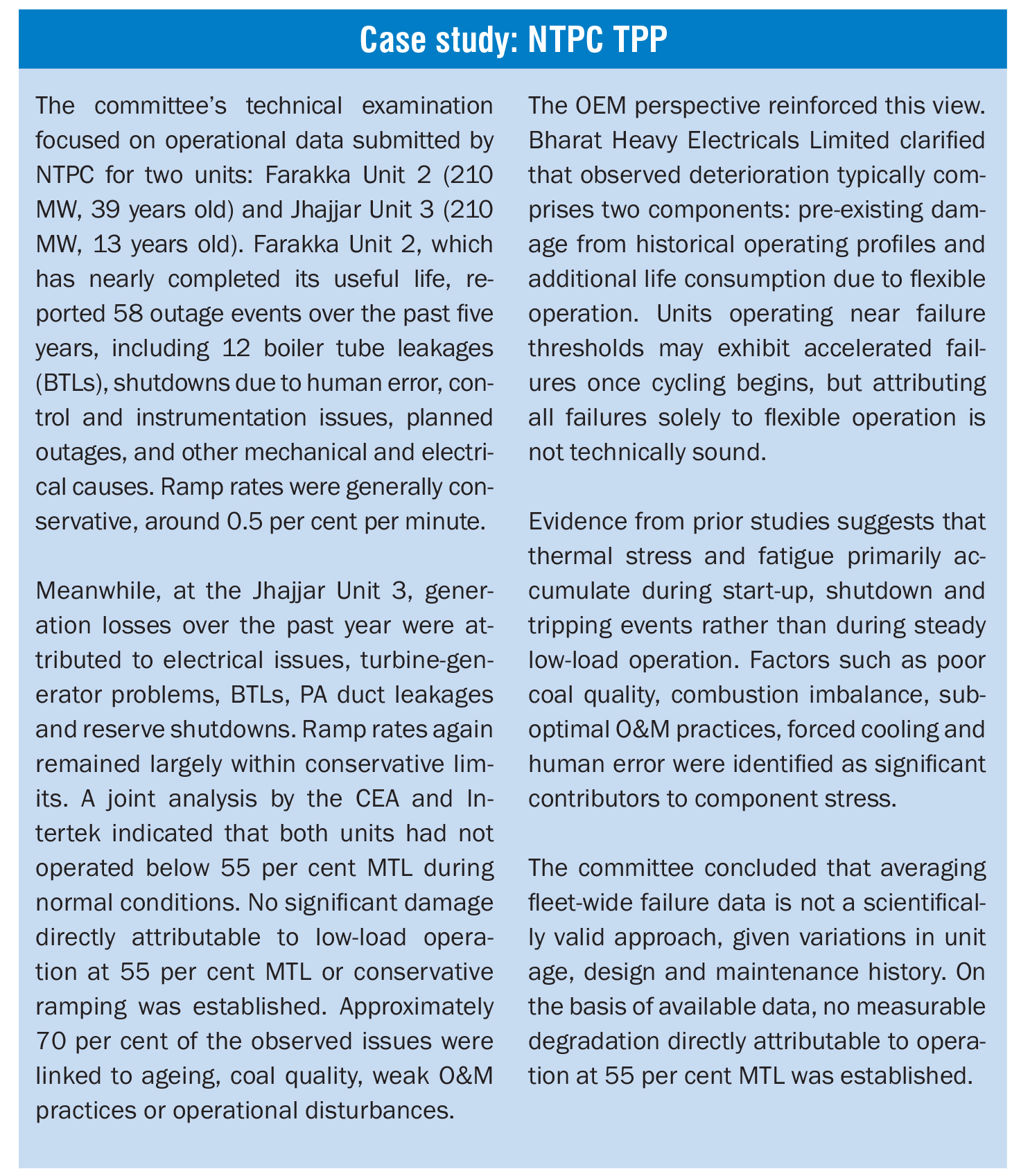
The committee’s findings suggest that while flexible operation introduces incremental thermal stress, conservative operation at 55 per cent MTL has not resulted in significant damage directly attributable to low-load running. The principal drivers of accelerated wear and tear remain start-up and shutdown severity, ageing, poor combustion management and ineffective O&M practices.
Stresses associated with operation below 55 per cent MTL can be mitigated through targeted retrofits, control modifications and structured operator training. Generating utilities are advised to undertake detailed plant-specific studies in consultation with OEMs to achieve 40 per cent MTL safely and sustainably.
At the same time, the evolving grid scenario, marked by rising renewable penetration and significant curtailment, necessitates timely feasibility studies for two-shift operation, particularly in older 210 MW-class units. The continued reluctance to nominate pilot units has slowed progress on empirical validation and compensation design. In effect, the technical debate has moved beyond whether flexibility is required. The grid data already answers that. The outstanding task is to implement flexibilisation in a scientifically structured manner, backed by plant-specific solutions and evidence-based regulatory mechanisms, rather than attributing complex operational outcomes to a single variable.
Aastha Sharma