Uttarakhand is a key region for India’s hydropower generation, supported by steep gradients, perennial river systems and high rainfall. The state’s river basins include Bhagirathi, Alaknanda, Yamuna, Dhauliganga, Goriganga, Saryu and Eastern Ramganga. Uttarakhand’s total hydropower potential is estimated at around 25,000 MW, of which about 17,000 MW is assessed as environmentally sustainable. In addition, the state has a pumped storage potential of about 10,000 MW, which is expected to become increasingly relevant as renewable energy penetration rises. Alongside hydropower, Uttarakhand has also set a solar capacity target of 2,500 MW by 2027 under its Solar Policy, 2023, with 861 MW commissioned so far and the remaining under development.
Current performance
Uttarakhand Jal Vidyut Nigam Limited (UJVNL) continues to anchor the state’s hydropower operations, with 2024-25 performance reflecting both stable plant operations and improving financial outcomes. During the year, the company achieved hydropower generation of 5,175.42 MUs against the board-approved target of 5,306.25 MUs, with generation impacted by the release of ecological flows downstream of dams and barrages in line with orders from the central and state governments. On the financial side, UJVNL reported a total income of Rs 11.32 billion as of March 31, 2025, up from Rs 10.38 billion as of March 31, 2024, while profit improved to Rs 0.57 billion from Rs 0.43 billion over the same period. In parallel, for FY 2024-25, Power Finance Corporation Limited and REC Limited maintained the company’s A++ credit classification, which is the highest rating within the state sector borrowers and central public sector undertaking (CPSUs) and joint venture category, supporting access to low-cost borrowing for its existing loan portfolio.
 Challenges in harnessing the hydropower potential
Hydropower development in Uttarakhand is shaped by the state’s complex geography and ecological sensitivity. With over 65 per cent of its area under forest cover, snow-clad mountain ranges, glacier-fed rivers and fragile slopes, the terrain presents both significant opportunity and considerable execution challenges.
To address environmental concerns, hydro projects incorporate measures such as maintaining free riverine stretches and ecological flows, undertaking compensatory afforestation at twice the forest land acquired, and implementing catchment area treatment plans, environmental impact assessments, cumulative impact assessments and carrying capacity studies.
On the social front, compensation frameworks provide two to four times the land value for acquired land and twice the value for affected buildings. Local area development funds, corporate social responsibility initiatives, employment generation, and structured rehabilitation and resettlement measures are aimed at supporting local communities and improving socio-economic outcomes.
Technical risk mitigation measures include geological investigations by the Geological Survey of India, seismic-resistant designs guided by national committees and technical institutions, incorporation of glacial lake outburst flood parameters in design flood calculations, early warning systems, disaster management plans, emergency action plans and sewage treatment systems. Strengthening and matching the associated power system network is also critical to ensure reliable evacuation and grid integration.
Key initiatives
A key intervention has been the concession framework extended to CPSUs to help reduce tariffs. In addition, the state has provided for the reimbursement of 50 per cent of state GST, applicable to projects of UJVNL as well, and has allowed the allotment of new projects for up to 70 years.
Institutional initiatives have also been taken, including the formation of a joint venture between THDC India Limited (THDCIL) and UJVNL, namely, THDCIL-UJVNL Energy Company Limited. Pumped storage has been prioritised through the Pump Storage Hydropower Policy, 2023. Key provisions include a 50 per cent discount on intra-state transmission charges for five years from the commercial operation date (COD) up to 2033-34. Additionally, in 2024-25, UJVNL also advanced and drafted a comprehensive information and cybersecurity policy framework covering both information technology and operational technology assets, strengthening governance and risk management. It also modernised the training hall at headquarters with upgraded facilities and video conferencing capabilities to support hybrid learning and internal capacity building.
Future plans and outlook
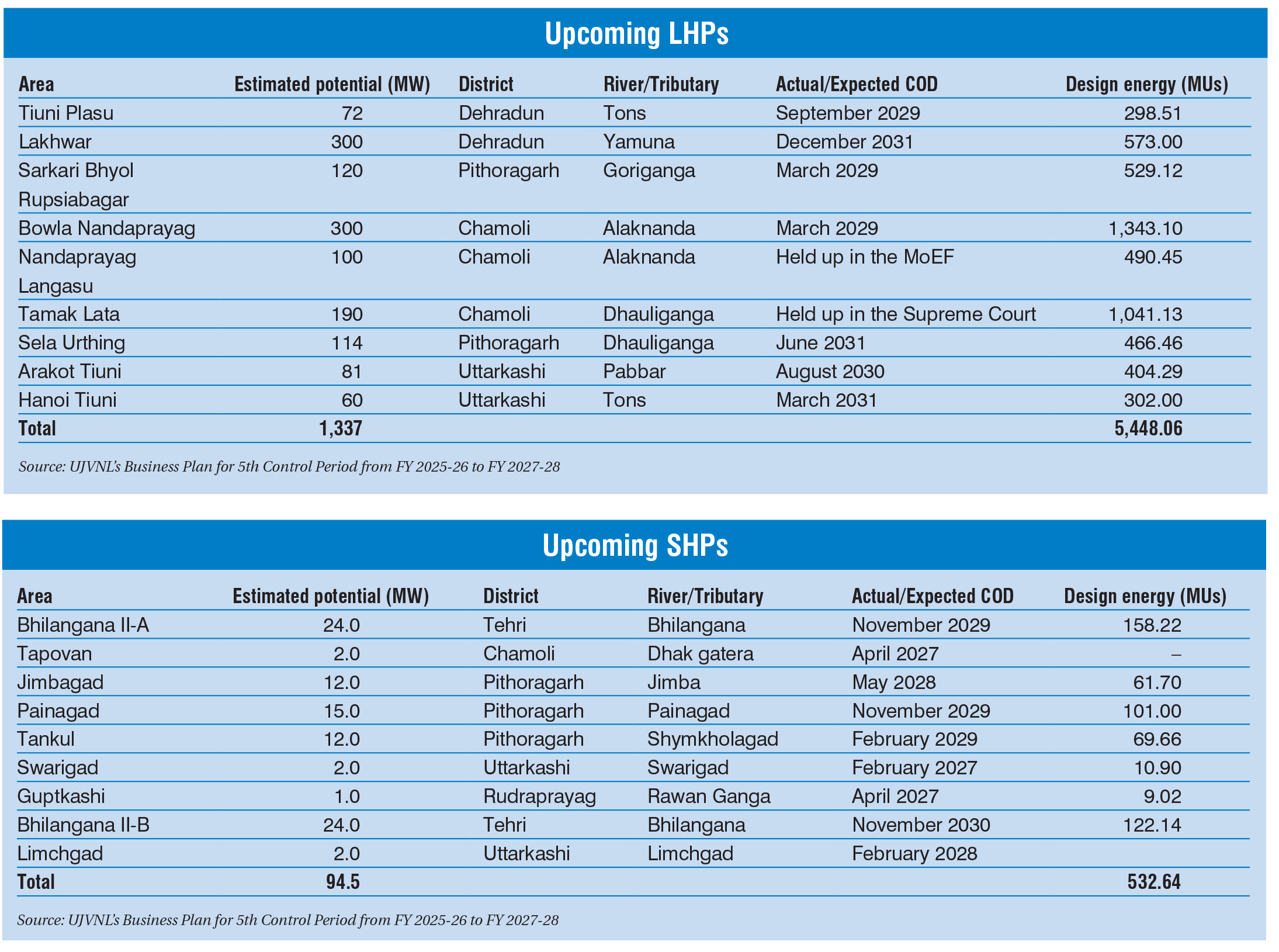
Going forward, hydropower development in Uttarakhand is expected to remain closely linked to the state’s wider development objectives. UJVNL’s future project pipeline includes a substantial large hydropower project (LHP) component of 1,337 MW and a smaller hydro pipeline of 94.5 MW. Among the LHPs, the biggest planned projects are Lakhwar (300 MW) in Dehradun on the Yamuna river and Bowla Nandaprayag (300 MW) in Chamoli on the Alaknanda river. Meanwhile, in the small-hydro power project (SHPs) category, the largest projects are Bhilangana II-A (24 MW) and Bhilangana II-B (24 MW) in Tehri on the Bhilangana river. In terms of timelines, no LHP or SHP is currently slated for commissioning in 2026. The earliest expected commissioning in the small-hydro pipeline begins in 2027, while the large-hydro pipeline is scheduled to start commissioning from 2029 onwards.
Beyond its hydropower mandate, UJVNL is also scaling a parallel renewable and flexibility pipeline to broaden its clean energy portfolio. In solar, the utility is already operating 26.36 MW of solar PV capacity and has approved 117 MW of small-sized solar PV projects on UJVNL land across Uttarakhand, alongside canal bank solar projects of 1.25 MW at Pashulok barrage and 6.25 MW at Dhalipur. Construction is under way for 38.75 MW of solar capacity at multiple locations, targeted for commissioning before June 30, 2026, while additional solar projects on other government land are planned, subject to statutory clearances.
In parallel, UJVNL has outlined a broader diversification road map covering pumped storage and emerging clean energy vectors. It plans to execute a pilot green hydrogen plant in Haridwar district following finalisation of the Uttarakhand Green Hydrogen Policy, with a construction and commissioning period of 24-30 months. The utility is also tracking geothermal opportunities in the state, with the Geological Survey of India identifying around 40 potential sites in Uttarakhand and studies initiated at Tapovan in March 2025. In grid storage, UJVNL is planning phased deployment of battery energy storage system (BESS) projects at strategic locations to support grid stability, renewable energy integration and peak demand management.
The utility has structured its BESS programme in phases, with Stage I anchored by three projects for which detailed project reports have been prepared. The Stage I projects aggregate 60 MW and 150 MWh and are planned at the Dhakrani, Tiloth and Khatima substations. In continuation, UJVNL has initiated detailed project report preparation for Stage II, covering two additional projects aggregating 106 MW and 265 MWh at the Chilla and Pathri substations. With these initiatives, UJVNL is positioned to play a central role in harnessing Uttarakhand’s hydro potential while contributing to India’s long-term low-carbon transition.