

 By S.K. Soonee, Former and Founding Chief Executive Officer, Grid Controller of India Limited (GRID-INDIA); S.S. Barpanda, Former Director (Market Operations), GRID-INDIA; Debasis De, Former Executive Director, National Load Despatch Centre, GRID-INDIA
Modest numbers with large consequences
Transmission losses in power systems are often spoken of in percentages, typically in the range of 3-5 per cent. In routine discourse, such numbers appear modest, almost peripheral. Yet, when placed against the scale of the Indian power system, their significance becomes immediately evident.
India would soon handle around 2,000 BUs per annum of electrical energy, with energy from interstate generating station, handled by the interstate transmission system (ISTS), accounting for 40-45 per cent, or 800 BUs. Even a typical transmission loss of 4 per cent translates into nearly 32 BUs of energy. At a conservative average value of Rs 4 per kWh, this corresponds to an annual economic magnitude of approximately Rs 120 billion. Meanwhile, the sunk annual ISTS transmission charges are at Rs 450 billion.
These numbers are not merely accounting artifacts. They underscore that transmission losses, while expressed as percentages, embody substantial physical energy and economic value. It is therefore worthwhile to revisit how we understand, measure and treat them in an evolving grid.
From approximation to measurement: A quiet evolution
The treatment of transmission losses in India has evolved gradually, almost unobtrusively, alongside the broader transformation of the power sector. In earlier decades, losses were largely implicit, absorbed within regional systems, estimated with limited granularity and seldom subjected to detailed scrutiny. The introduction of scheduling and energy accounting discipline marked a turning point. For the first time, the system began to observe, in a structured manner, the distinction between injection, drawal and the resulting residual loss.
Subsequent developments, including the point of connection framework, sought to align network usage with charges and loss allocation, thereby avoiding pancaking that was in practice earlier. Over time, with improvements in metering, communication and data handling, the system converged towards a more standardised practice.
Today, the Indian grid operates with a uniform all-India transmission loss factor, computed periodically, typically on a weekly basis for each 15-minute time block, using special energy meter (SEM) data. This loss factor is applied consistently across market transactions, including power exchanges and bilateral schedules. While losses remain time-varying and flow-dependent, averaging will continue to provide operational simplicity. Transmission losses in India are applied/paid in kind and not in cash for good reason – to avoid the overly complex system of transmission loss settlement. This evolution reflects a careful balancing of competing objectives: engineering accuracy, operational simplicity and institutional robustness.
 The physics behind the percentage
Behind every percentage point of transmission loss lies a well-understood physical principle: the I²R relationship. Losses in transmission lines are proportional to the square of the current flowing through them and the resistance of conductors.
While this relationship is straightforward in isolation, its manifestation in a large interconnected grid is anything but simple. India’s transmission network is highly meshed, with 200,000 ckt km of 220 kV and above ISTS lines and multiple parallel corridors operating at 400 kV, 765 kV and beyond.
Transmission losses exhibit seasonal variation driven by changes in generation despatch arising from the hydro–thermal mix and diurnal demand variation. During high inflow periods, hydro stations, typically located far from major load centres, operate at elevated output levels, necessitating long-distance bulk power transfers and resulting in higher line loading and I²R losses. This variability is accentuated with solar and wind. Thus, the diurnal and seasonal redistribution of generation plays a key role in shaping network loading patterns and overall loss characteristics.
Power flows as per network impedances and not along contractual paths. It distributes itself across available electrical pathways according to network impedances. This gives rise to an important phenomenon – loop flows. Loop flows occur when power, injected at one location and intended for a particular sink, finds alternate parallel routes through the network. These flows are not explicitly scheduled, yet they are physically real. They can increase loading in certain corridors, alter current distribution and, consequently, influence total system losses.
Thus, transmission losses are not attributable to any single transaction or corridor. They are an emergent property of the entire network, shaped by topology, impedance and the instantaneous pattern of injections and withdrawals.
 What high-resolution data reveals
With the widespread deployment of SEMs and the availability of time-block data (96 blocks per day), transmission losses are observed at a much finer temporal resolution.
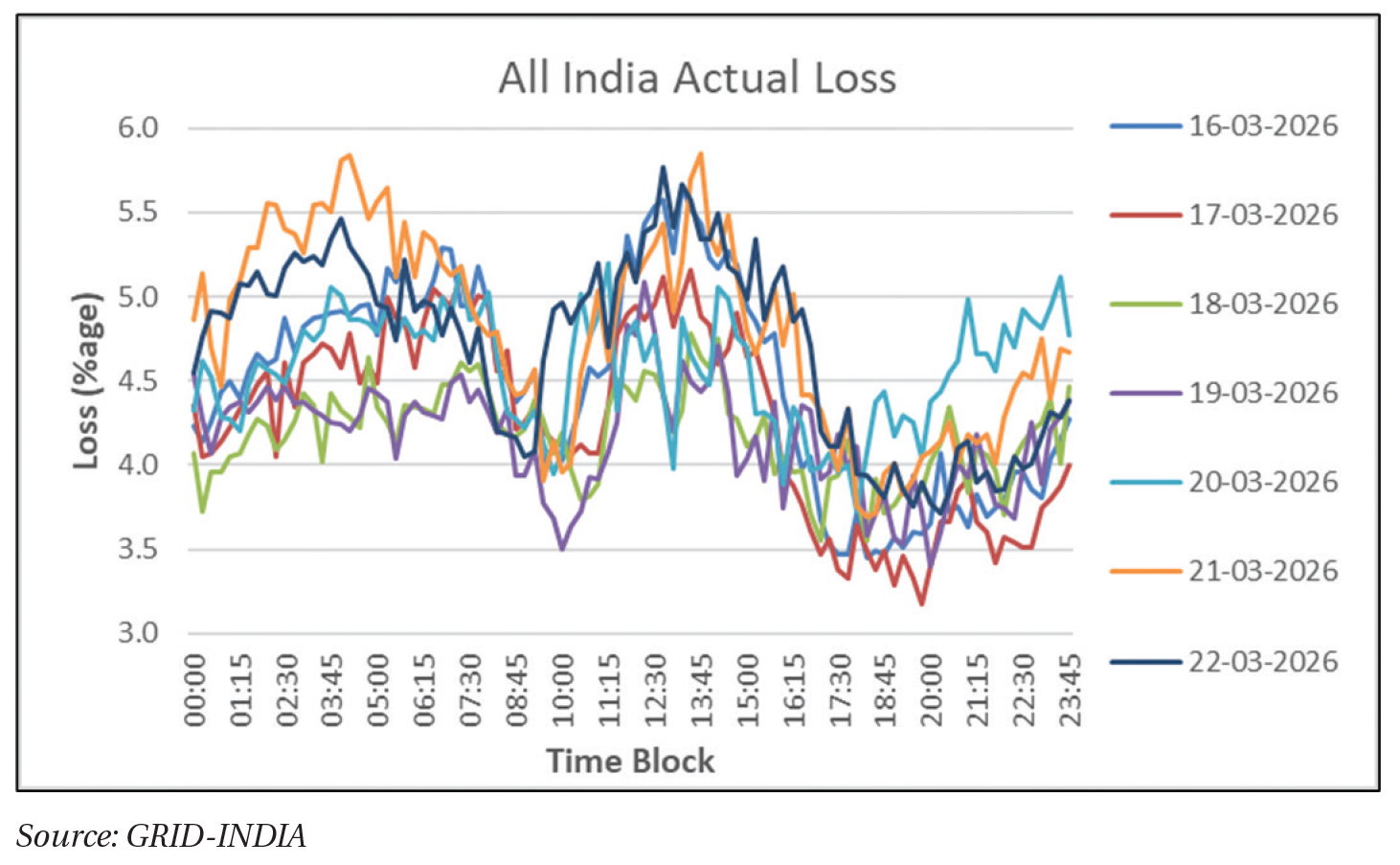
Around 7,000 interface meters have been installed in the ISTS network, covering around 1,000 locations across India. Such data reveals a consistent and instructive pattern. While the weekly average transmission loss may be around 4.4 per cent, the instantaneous value varies within a band, typically from about 3 per cent to 6 per cent seasonal and diurnal. As the system enters the morning ramp, when demand rises and generation is re-despatched, losses increase, sometimes exceeding 5.5 per cent.
During late night hours, when the system demand is low and flows are relatively stable, losses tend to lie at the lower end of this range, often around 4.3–4.6 per cent.
Midday periods, influenced by renewable generation and long-distance transfers, exhibit moderate to high losses, while evening behaviour reflects a combination of peak demand and altered flow patterns.
What is particularly noteworthy is not merely the magnitude of variation, but its repeatability. Across days, the diurnal pattern of losses exhibits a clear structure, suggesting that while instantaneous values are dynamic, their statistical behaviour is predictable.
 Beyond peak demand: The role of ramps and redistribution
A closer examination of time-block data reveals an interesting nuance. Losses do not peak solely at times of maximum demand. Instead, they show pronounced sensitivity showing a distinct ramp.
For instance, losses may rise from around 4.5 per cent at midnight to over 5.5 per cent during the morning ramp, even before the system reaches its absolute peak demand. This indicates that losses are influenced not only by the magnitude of load, but also by the rate of change of system conditions and the associated redistribution of flows.
Such behaviour is consistent with the underlying physics. As generation and load patterns change, power redistributes across the network, activating different corridors and loop paths. This dynamic reconfiguration can lead to transient current increases in certain elements, thereby elevating losses.
Averaging as a deliberate design: Choice by the regulator
Given this inherent variability, one might ask why the current framework adopts a uniform weekly loss factor rather than a time-varying one. The answer lies in the practical requirements of system operation and market design. A uniform loss factor offers several advantages. It is simple to compute, easy to apply, and, perhaps most importantly, minimises disputes in a system involving multiple states, generators and buyers.
By contrast, a fully time-varying or locationally differentiated loss regime, while more reflective of physical reality, would introduce significant complexity in scheduling, settlement and verification.
The present approach therefore represents a conscious and pragmatic compromise. It acknowledges the non-linear, time-varying nature of losses, but chooses to represent them through a stable, averaged parameter for the sake of operational tractability.
Analytical opportunities
While the commercial framework emphasises simplicity, the increasing availability of data and computational tools opens up opportunities for deeper analytical insight.
Few such avenue is the use of power flow simulation studies and optimal power flow (OPF) formulations to compute locational marginal prices (LMPs). Even when not used for market settlement, LMPs provide valuable information to planners and regulators for citing generators. They capture the marginal cost of supplying an additional unit of electricity at a given node, incorporating the effects of congestion and losses.
In particular, the loss component embedded within LMPs reflects marginal loss factors – the incremental losses associated with changes in injection or withdrawal at specific locations. These are inherently sensitive to network topology such as optimal transmission switching.
By examining LMPs and related OPF outputs, system operators and planners can gain a more nuanced understanding of how losses behave under different conditions. Such analysis can complement the existing framework without necessarily altering its commercial simplicity.
Markets, policy and neutrality
Transmission losses today are seamlessly integrated into India’s market architecture. Whether in power exchanges or bilateral contracts, the uniform loss factor ensures consistency and predictability.
At the same time, certain policy-driven provisions, such as exemptions for renewable energy, play an important role in supporting broader system objectives. While such measures may introduce minor distortions in loss allocation, they are best viewed in the context of long-term policy priorities. The overall framework thus strives to remain neutral and facilitative, balancing economic efficiency with developmental goals.
Loss as an indicator of efficiency
Although modest in percentage terms, transmission losses can serve as a useful indicator of system efficiency. Trends in losses over time can reflect changes in network loading, infrastructure adequacy and operational practices.
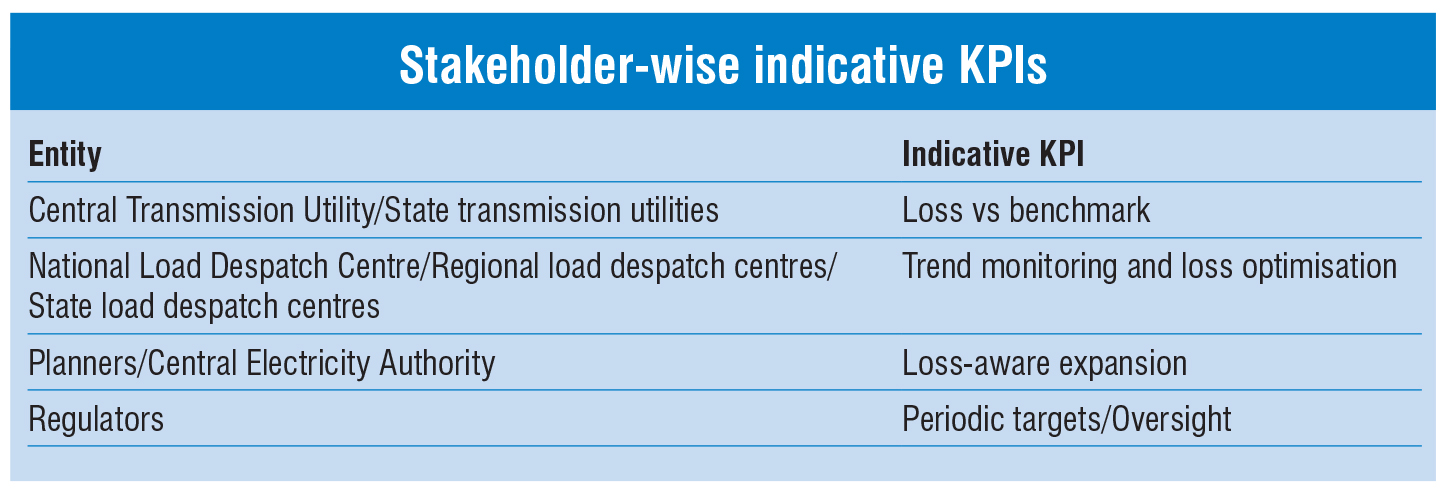
There is merit in viewing losses through a monitoring lens, with indicative benchmarks for different entities, transmission utilities, system operators and planners. Such an approach need not be prescriptive or punitive. Rather, it can support informed decision-making and continuous improvement.
Extending analysis: Intra-state systems
It is important to recognise that most current analysis and reporting pertains to the ISTS. However, a substantial portion of power flows occurs within state networks.
Intra-state transmission systems have their own characteristics:
- Different topology and voltage levels
- Varying load profiles
- Distinct generation mixes
Applying similar analytical techniques, time-block loss assessment, diurnal pattern analysis and possibly OPF-based studies at the intra-state level can yield valuable insights. It can help identify inefficiencies, guide investments and improve overall system performance. This represents a natural and logical extension of the work already undertaken at the interstate level.
Looking ahead: Insights alongside simplicity
India’s power system is entering a phase marked by increasing complexity. Large-scale renewable integration, long-distance bulk transfers and deeper interconnections are reshaping flow patterns.
In this context, transmission losses will remain inherently dynamic and sensitive to system conditions. The current practice of averaging will continue to provide operational simplicity and stability. At the same time, there is growing value in supplementing this simplicity with analytical insight.
High-resolution data analysis using AI/ML tools, power flow simulation studies and OPF-based evaluations can help illuminate the underlying behaviour of losses and detect anomalies. They can support better planning, more informed operation and, ultimately, a more efficient system.
Concluding reflections
Transmission losses may appear as a single number in schedules and settlements. Yet, they encapsulate the interplay of physics, network structure and operational dynamics.
India’s approach to loss treatment reflects a thoughtful balance, between accuracy and simplicity, between detail and usability. As the system evolves, the opportunity lies not necessarily in redesigning this framework, but in deepening our understanding of it.
A 4 per cent loss, when viewed in isolation, may seem modest. But when it represents tens of billions of units of energy and thousands of crores of rupees, it becomes a reminder that even small percentages can carry large realities. Understanding those realities, and acting upon them judiciously, will remain an important part of the journey towards a more efficient and resilient power system.