With global concerns regarding energy security, depleting fossil fuel reserves, increasing pollution levels and the looming threat of climate change, countries are increasingly prioritising the transition towards greener energy sources. As a result, the deployment of renewable energy projects is experiencing exponential growth. India, which has set a goal to install 500 GW of non-fossil-fuel-based energy capacity by 2030, is a front runner in renewable energy installations. The country’s green commitment is evident in the recently published National Electricity Plan (NEP) (Volume I: Generation) by the Central Electricity Authority (CEA). The new plan estimates more than 400 GW of capacity addition in the renewable energy sector, far exceeding the combined capacity addition of less than 70 GW in the thermal and nuclear power sectors.
Background
According to the Electricity Act, 2003, the CEA is required to prepare an NEP every five years. The plan focuses on a short-term period of five years while also providing a broader 15-year perspective. For instance, the recently released NEP, which takes March 2022 as the base year, gives a review of the past five years (2017-22), along with a detailed plan for 2022-27 and a perspective plan for the subsequent five years (2027-32). Thus, the NEP presents a broad overview of power generation planning for the 15-year period from 2017 to 2032.
A review of capacity additions in 2017-22 reveals that the conventional power sector witnessed new installations of 30,668 MW. Meanwhile, the renewable energy sector, including large hydropower, witnessed significant growth with new installations of 54,779 MW. There is a notable gap in the planned capacity additions and the actual deployments – 21,620 MW in the case of non-hydro conventional power and 4,802 MW for hydropower. The NEP attributes the shortfall to the Covid-19 pandemic, although delayed approvals and environmental concerns also played a role in project implementation delays.
In the renewable energy sector, capacity additions slowed down due to the pandemic and supply chain issues. In particular, the wind power segment was significantly impacted by the transition from a feed-in tariff system to a competitive bidding regime. Pandemic-led disruptions in the supply chain and manpower unavailability during the wind season further complicated matters, leading to a substantial decline in capacity additions over the five-year period. Meanwhile, solar power witnessed the highest growth among all power sources. However, many projects faced setbacks due to Covid-led supply chain issues and policy upheavals. Thus, capacity additions could have been even higher if these concerns had been addressed.
Power demand estimations
As the Indian economy continues to grow, the demand for power is also on the rise. Over the past decade, the country’s electricity demand has witnessed a CAGR of 4.1 per cent. According to the 20th Electric Power Supply report released in November 2022, this demand is projected to witness a CAGR of 7.18 per cent for the next five years. This demand assessment is crucial for effective planning of future generation, transmission and distribution capacity additions. It takes into account various factors such as historical electricity demand, the policy and regulatory environment, upcoming interventions, and government programmes and initiatives.
During the year 2021-22, the country’s total electricity consumption was estimated to be 1,138 billion units (BUs). The figure is expected to reach 1,610 BUs by 2026-27 and 2,133 BUs by 2031-32. In contrast, the energy requirement was 1,382 BUs in 2021-22, and this is projected to reach 1,908 BUs in 2026-27 and 2,474 BUs in 2031-32. Similarly, peak power demand is expected to increase from 203 GW in 2021-22 to 277 GW by 2026-27 and 366 GW by 2031-32.
Power generation planning
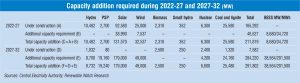
For power generation planning, several factors need to be considered, such as sustainable development, operational flexibility and reliability, efficient resource utilisation, and fuel availability constraints. The NEP considers 398,986 MW of total installed power capacity as of March 2022 as the base for generation planning projections and presents five different scenarios to assess the source-wise power mix by 2026-27 and 2031-32. In all the scenarios, there is a massive increase in renewable energy capacity additions, particularly solar power. Meanwhile, battery energy storage systems (BESSs) are expected to play a critical role in managing the intermittency of renewables and ensuring grid stability in the coming years.
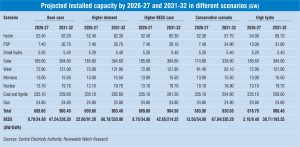
In the base case scenario, the share of coal and lignite is expected to decrease from 53 per cent in 2021-22 to 39 per cent of the total installed power capacity in 2026-27 and eventually to 29 per cent by 2031-32. Meanwhile, the renewable energy capacity is expected to increase from 39 per cent in 2021-22 to 55 per cent in 2026-27 and 66 per cent in 2031-32. While the BESS requirement is expected to be 8.68 GW/34.72 GWh by 2026-27, along with 7.5 GW of pumped storage plant (PSP) capacity, the BESS capacity is estimated to go up to 47.24 GW/236.22 GWh by 2031-32. Meanwhile, a PSP capacity of 26.68 GW is expected by 2031-32. Apart from the base case, the NEP assesses four other scenarios. These are:
Higher-demand scenario: This scenario assumes a 5 per cent increase in both the estimated peak demand as well as the energy requirement for 2026-27 and 2031-32. Interestingly, despite the higher energy demand, there will be no change in the resource mix and the total installed power capacity by 2026-27 compared to the base case. Therefore, no additional capacity additions are expected to meet this higher demand, except for a larger BESS capacity, which is expected to increase to 22.82 GW/91.29 GWh by 2026-27, compared to 8.68 GW/34.72 GWh in the base case. For 2031-32, a modest increase of 3 GW is estimated in the coal-based power capacity in the higher-demand scenario compared to the base scenario. Meanwhile, the BESS requirement would go up to 66.78 GW/ 333.91 GWh in this scenario from 47.24 GW/236.22 GWh in the base case.
Higher BESS cost scenario: In this scenario, the BESS cost is assumed to be 25 per cent higher compared to the base case. No change in capacity installations is expected in 2026-27 owing to this high BESS cost. However, there would be a reduction in the installed BESS capacity by 2031-32 from 47.24 GW/236.22 GWh in the base case to 42.85 GW/214.26 GWh. To compensate for this reduction, the PSP-based installed capacity would increase from 26.7 GW in the base case to 29.1 GW in this scenario and coal-based installations would also increase marginally by 1.6 GW.
Conservative scenario: This scenario takes into account the construction time required for implementing projects across different power sources and the historical delays in completing these projects. As capacity additions are expected to reduce across all segments such as coal, hydro, nuclear, PSP, solar and wind in this scenario compared to the base case, the BESS requirements are expected to increase in both 2026-27 and 2031-32. The BESS capacity is expected to rise to 13.5 GW/54.12 GWh in 2026-27 from 8.68 GW/34.72 GWh in the base case and to 67.04 GW/335.2 GWh in 2031-32 from 47.24 GW/236.22 GWh in the base case.
High-hydro scenario: This scenario assumes accelerated capacity additions across the hydropower and PSP segments, with these projects being completed two to three years before their planned commissioning dates. If hydropower and PSP capacities are increased to 54 GW and 13 GW in 2026-27, compared to 52 GW and 7.4 GW in the base case respectively, the BESS requirement is expected to decrease to 2.12 GW/8.47 GWh against 8.68 GW/34.72 GWh in the base case. Similarly, the BESS capacity would go down to 38.71 GW/193.55 GWh in 2031-32 from 47.24 GW/236.22 GWh in the base case, while hydropower capacity would increase to 65.7 GW and PSP capacity to 31.8 GW.
Except for the conservative scenario, there are no changes in the solar, wind and nuclear power capacities when compared to the base case. It is observed that the coal-based installed capacity remains the same in all the scenarios in 2026-27 and ranges from 259.6 GW to 262.6 GW in 2031-32 across various scenarios. Meanwhile, except for the high-hydro scenario, PSP and hydropower capacities remain the same as the base case in 2026-27. In 2031-32 however, the PSP and hydropower capacities increase in the high-hydro scenario and decrease in the conservative scenario compared to the base case. While the hydropower capacity remains the same as in the base case in the higher BESS scenario in 2031-32, the PSP capacity increases to 29.1 GW in the higher BESS scenario compared to 26.7 GW in the base case. Notably, the BESS capacity deviates the most across all scenarios, highlighting the critical role of BESS in the country’s power sector. The BESS requirement varies from 2.1 GW/8.4 GWh to 22.8 GW/91.2 GWh and from 38.7 GW/193.55 GWh to 67.04 GW/335.2 GWh across different scenarios in 2026-27 and 2031-32 respectively.
Outlook
Renewable energy is expected to dominate India’s future power mix, and thus, a significant portion of the upcoming capacity additions are expected to be focused on the renewable power sector. Energy storage, both PSP and BESS, is required to manage the influx of intermittent renewables into the grid. While BESS and PSP capacities are expected to be similar in the initial years, BESS capacity will be significantly higher in the future as the technology matures and becomes more affordable.
The NEP estimates a total fund requirement of Rs 14,542 billion for the period 2022-27 and Rs 19,064 billion for the period 2027-32. Therefore, substantial capital is needed to realise this planned generation capacity. Going forward, it is important to overcome the key bottlenecks that could dampen investor interest and impact capital inflow. Ensuring payment security for project developers is necessary as delayed payments remain a major issue in the power sector today. Further, the complexities, prolonged approval processes and bureaucratic hurdles must be tackled to ensure timely project implementation. Finally, challenges related to land and transmission availability need to be addressed through better planning and coordination among different agencies.
Overall, the NEP has the potential to serve as a critical guiding document in India’s journey towards net zero emissions, provided that the milestones mentioned in the plan are achieved within the specified time frame, supported by enabling policies and the resolution of power sector challenges.
Khushboo Goyal