India’s pumped storage project (PSP) segment is witnessing growing momentum as storage assumes a larger role in supporting renewable energy integration and grid reliability. According to the Central Electricity Authority’s (CEA) National Generation Adequacy Plan, India’s energy storage requirement is projected to reach 174 GW/888 GWh by 2035-36, including around 94 GW/567 GWh of PSP capacity. As the power system transitions towards higher shares of variable renewable energy, PSPs are expected to play a central role in delivering reliable, despatchable and round-the-clock clean power.
Power Line Research’s “Pumped Storage Monitor” report tracks key developments in India’s storage market, including project pipeline, state-wise distribution, developer participation and recent developments. This article presents a snapshot of the market from April-May 2026.
Market overview
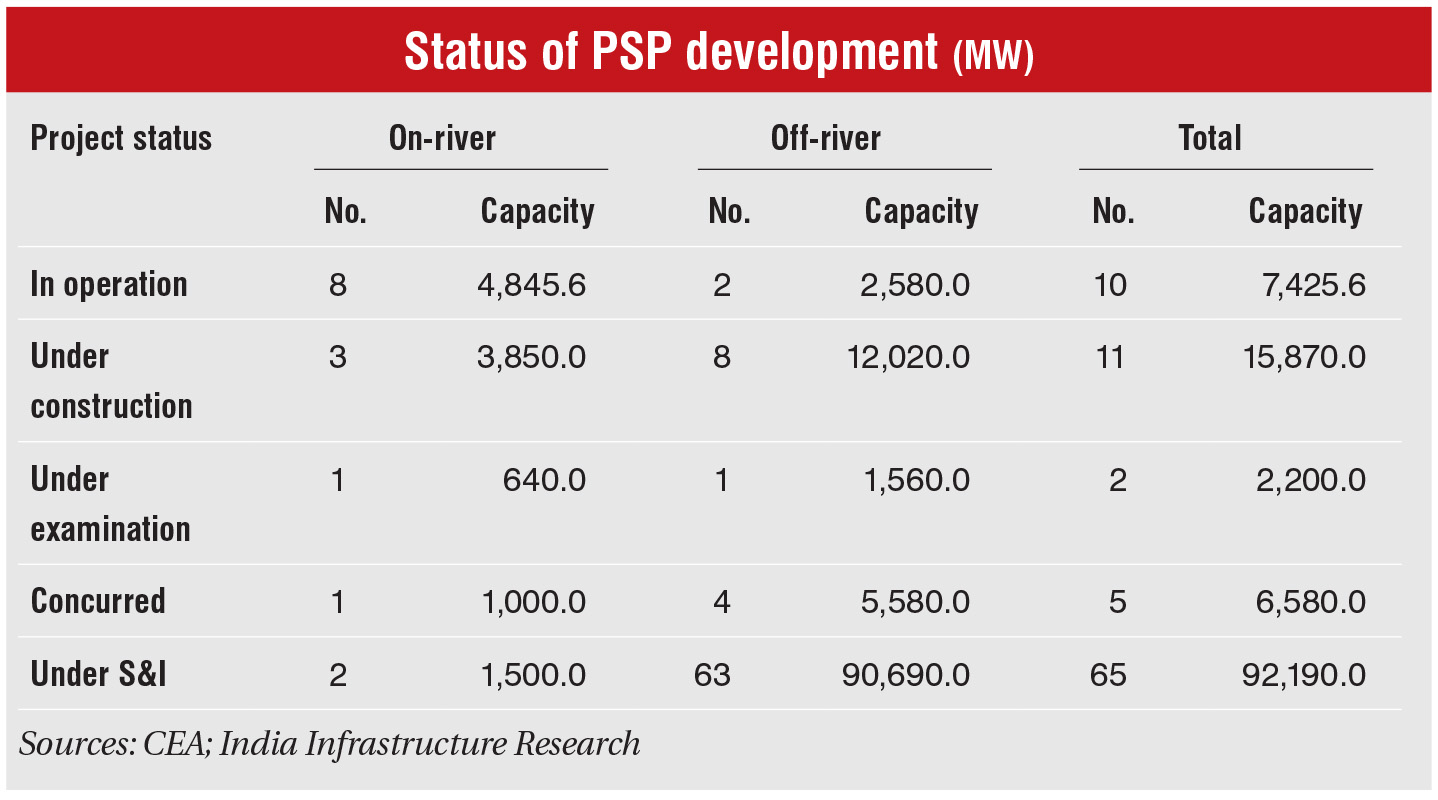
India has a total PSP potential of 290,435.6 MW as of May 2026 across onstream and offstream sites. Of this, only 10 PSPs with a combined capacity of 7,425.60 MW are currently operational. Meanwhile, 15,870 MW is under construction, and 92,190 MW is at the survey and investigation (S&I) stage. The number of projects and capacities in the CEA-concurred detailed project report and under-examination categories remained unchanged between April 2026 and May 2026, at five projects (6,580 MW) and two projects (2,200 MW) respectively.
The operational PSPs include Pinnapuram (1,680 MW, Andhra Pradesh), the Sardar Sarovar project (1,200 MW, Gujarat), Tehri (1,000 MW, Uttarakhand), Srisailam Left Bank Power House (900 MW, Telangana), Purulia (900 MW, West Bengal), Nagarjunasagar (705.6 MW, Telangana), Kadamparai (400 MW, Tamil Nadu), Ghatghar (250 MW, Maharashtra), Kadana (240 MW, Gujarat) and Bhira (150 MW, Maharashtra). Maharashtra has the highest number of operational PSPs with two commissioned projects, while Andhra Pradesh has the highest operational capacity, driven by the 1,680 MW Pinnapuram project.
Under-construction projects
The under-construction PSP pipeline comprises 11 projects with a total capacity of 15,870 MW. The projects are spread across six states. Maharashtra has the largest under-construction pipeline with four projects, namely, Saidongar-1 (Karjat) (3,000 MW), Bhavali (1,500 MW), Tarali (1,500 MW) and Bhivpuri (1,000 MW), aggregating 7,000 MW, accounting for around 44 per cent of the total under-construction capacity. Andhra Pradesh follows with three projects – Upper Sileru pumped storage hydroelectric project (1,350 MW), Gandikota (1,000 MW) and Chitravathi (500 MW), totalling 2,850 MW. Karnataka has two projects – Sharavathy (2,000 MW) and Saundatti (1,600 MW), with a combined capacity of 3,600 MW, while Madhya Pradesh has the MP 30 Gandhi Sagar standalone project (1,920 MW) and Tamil Nadu has the Kundah (Stages I, II and III) project (500 MW). These projects are scheduled for commissioning between December 2026 and May 2032.
Development pipeline
India’s PSP development pipeline comprises projects across multiple stages of development, including under S&I (92,190 MW), permitting (56,005 MW), announced (35,810 MW), under construction (15,870 MW), concurred (6,580 MW), under examination (2,200 MW) and operational (7,425.6 MW). The S&I category consists of 65 projects. Of these, 63 are off-river projects that account for 90,690 MW, while two on-river projects contribute 1,500 MW. Meanwhile, five projects with a cumulative capacity of 6,580 MW have received CEA concurrence, comprising one on-river project (1,000 MW) and four off-river projects (5,580 MW). In addition, two projects aggregating 2,200 MW are currently under examination by the CEA– one on-river project (640 MW) and one off-river project (1,560 MW).
 State-wise PSP portfolio
The cumulative PSP capacity is concentrated in a few key states, with Maharashtra leading by a significant margin. The state has a cumulative pipeline of 62,625 MW, accounting for nearly 25 per cent of the total identified capacity across all stages of development. Andhra Pradesh follows with 34,550 MW, while Tamil Nadu ranks third with 21,300 MW. Together, these three states account for 118,475 MW, representing around 47 per cent of the cumulative PSP capacity, highlighting the concentration of project development in a few regions. Among the remaining states, Uttar Pradesh (18,160 MW), Rajasthan (14,200 MW), Odisha (12,515 MW), Chhattisgarh (11,525 MW), Gujarat (11,430 MW) and Telangana (11,105.6 MW) each have pipelines exceeding 11 GW, reflecting strong project activity. Madhya Pradesh (9,760 MW), Himachal Pradesh (9,550 MW) and Karnataka (7,600 MW) also have sizeable pipelines. In the Northeast, Mizoram and Assam account for the majority of the region’s identified PSP pipeline, with cumulative capacities of 5,550 MW and 3,920 MW, respectively. Together, they contribute 9,470 MW, representing the bulk of the region’s cumulative PSP capacity. The remaining states have relatively smaller pipelines, with West Bengal (4,600 MW), Jharkhand (1,500 MW), Bihar (1,320 MW), Kerala (1,230 MW), Uttarakhand (1,000 MW), Tripura (800 MW) and Arunachal Pradesh (660 MW) accounting for a modest share of the overall development pipeline.
Industry activity
The cumulative PSP development pipeline is dominated by private developers, with the Adani Group leading the portfolio at 29,550 MW, followed by the Greenko Group with 24,970 MW and JSW Energy with 14,110 MW. Together, these three developers account for 68,630 MW of PSP capacity across projects at various stages of development, including announced, permitting, S&I, under-examination, concurred, under-construction, stalled and operational projects. Torrent Power (13,860 MW), NHPC Limited (13,450 MW) and NTPC Limited (12,600 MW) also have sizeable pipelines exceeding 12 GW.
Among public sector developers, NHPC Limited has the largest cumulative PSP portfolio at 13,450 MW, followed by NTPC Limited with 12,600 MW and THDC India Limited with 11,040 MW. Tamil Nadu Generation and Distribution Corporation Limited (11,400 MW) and Chhattisgarh Power Generation Company Limited (7,300 MW) are also among the leading state utilities with significant PSP portfolios.
Overall, the top 15 developers account for around 68 per cent of the total identified PSP pipeline, highlighting the concentration of project development among a relatively small group of public and private sector players.
Anticipated PSP commissioning timelines
According to Renewable Watch Research, over 88 GW of PSP capacity is planned for commissioning between 2026-27 and 2035-36, indicating a strong project pipeline over the next decade. Capacity additions are expected to accelerate from 2028-29 onwards, with the bulk of planned commissioning concentrated between 2028-29 and 2033-34. The commissioning pipeline is expected to peak in 2030-31, with 20,890 MW scheduled for addition, followed by 14,640 MW in 2029-30, 12,130 MW in 2032-33 and 11,880 MW in 2033-34. Thereafter, annual additions are expected to moderate, with 6,800 MW planned for 2031-32, 5,700 MW in 2034-35 and 7,500 MW in 2035-36. The commissioning schedule indicates that PSP capacity is expected to increase rapidly to support renewable energy integration and improve grid flexibility.
Outlook
India’s PSP sector has significant long-term growth potential, but project execution remains the key challenge. While a large development pipeline is emerging, less than 3 per cent of the identified potential is currently operational. As the power system becomes increasingly complex with the growth of electric vehicles, green hydrogen and data centres, the need for integrated planning and real-time grid operations will become more critical. Going forward, the pace of PSP deployment will depend not only on resource availability, but also on the ability to convert identified opportunities into bankable and executable projects.