India’s transmission sector is expanding significantly. The sector has played an important role in meeting the country’s rising energy demand while also allowing the incorporation of renewable energy. As electrical grids evolve to accommodate new energy sources, transmission towers and structures evolve to suit shifting demands.
Power Line takes a look at the key trends, growth drivers, and issues and challenges in this segment…
Size and growth
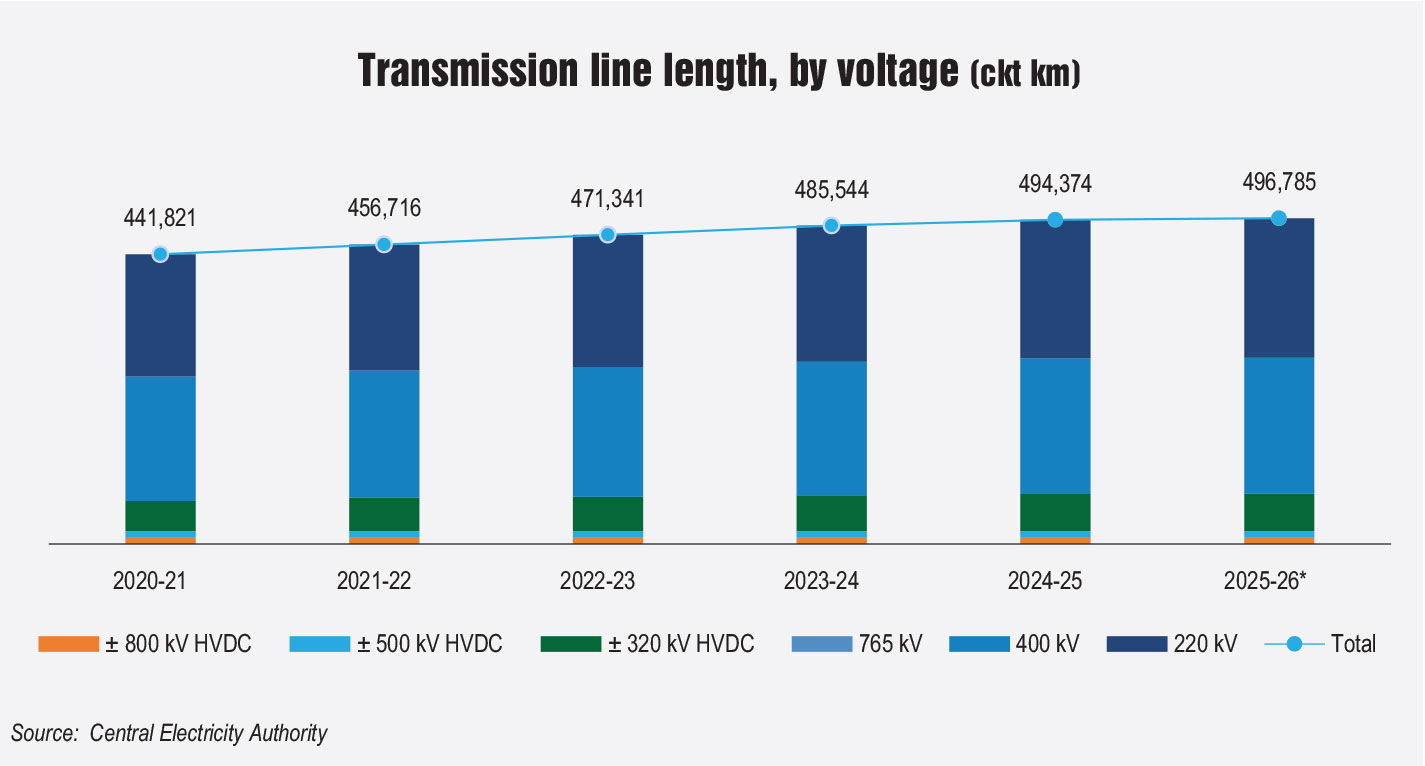
As of September 2025, the total length of transmission lines at the 220 kV level and above stood at 496,785 ckt km, comprising 57,255 ckt km (11.52 per cent) at the 765 kV level, 207,358 ckt km (41.73 per cent) at the 400 kV level and 212,797 ckt km (42.83 per cent) at the 230/220 kV level. At the high voltage direct current (HVDC) level, line length stood at 9,655 ckt km at the ±800 kV level, 9,432 ckt km at the ±500 kV level and 288 ckt km at the ±320 kV level. In 2025-26 (up to September 2025), the total transmission line addition was 2,411 ckt km. Between 2019-20 and 2024-25, the length of transmission lines grew at a CAGR of 2.63 per cent.
The transformation capacity across AC voltage levels stood at 1,348,658 MVA as of September 2025, which comprised 341,200 MVA at the 765 kV level, 507,873 MVA at the 400 kV level and 499,585 MVA at the 230/220 kV level. Likewise, the aggregate HVDC capacity stood at 33,500 MW, constituting 18,000 MW at the ±800 kV level, 13,500 MW at the ±500 kV level and 2,000 MW at the ±320 kV level. Between 2019-20 and 2024-25, AC transformation capacity grew at a CAGR of 6.7 per cent. Voltage-wise, the highest CAGR has been accorded for 765 kV and 400 kV at around 6.4 per cent and 8 per cent, respectively. Similarly, the HVDC transformation capacity grew at a CAGR of 5.6 per cent. The highest growth rate has been witnessed for ±800 kV at a CAGR of 8.4 per cent.
During 2024-25, the total added AC transformation capacity was 86,433 MVA, while in 2025-26 (till September 2025), the total transformation capacity addition was 44,645 MVA.
 Growth drivers
Renewable energy
As India moves faster toward its ambitious goals of having 500 GW of renewable energy capacity by 2030 and a net-zero carbon footprint by 2070, the availability of a robust power transmission infrastructure will be crucial in determining how effectively the generated power reaches the last mile.
The government has initiated essential measures to have well-established transmission system infrastructure to cater to renewable energy integration. For instance, the concept of green energy corridors (GECs) has been emphasised to evacuate green energy from renewable energy projects. In this regard, the utilisation of transmission towers and structures has gained traction to efficiently evacuate and transfer renewable energy from remote generation locations to major demand centres. The GEC scheme is being implemented in a phased manner, where GEC-I envisages the execution of 9,767 ckt km of transmission lines and 22,689 MVA of substation capacity, while GEC-II envisages the implementation of 7,919 ckt km of transmission lines and 24,488 MVA of substations. There are also plans to roll out the third phase of GEC with a budgetary outlay of around Rs 560 billion, with the central government contributing Rs 224 billion or 40 per cent of the total budget. The remaining share will be contributed by state governments and stakeholders.
Likewise, another regulatory intervention known as the general network access (GNA) was implemented by the Central Electricity Regulatory Commission in 2022, which permits power generators to utilise the transmission network without prior identification of buyers. GNA is likely to enhance grid equity and efficiency, facilitate open market trading and aid in integrating additional renewable energy into the national system.
A primary advantage of GNA is its contribution to the enhancement of transmission system planning. The previous paradigm excluded medium-term and short-term contracts from network strengthening assessments, resulting in disjointed planning and inadequately prepared infrastructure. GNA resolves this by including all contracted capacities, encompassing medium- and short-term, in the planning process. This facilitates enhanced demand forecasting and the prompt development of transmission assets in accordance with actual market requirements. As per Central Transmission Utility of India Limited (CTUIL), as of March 2025, the total deemed GNA allocation was 108.65 GW, while the additional GNA allocation was 19.31 GW, where states such as Gujarat, Rajasthan and Tamil Nadu obtained high GNA allocations owing to their high renewable energy generation status. Similarly, states such as Maharashtra and Uttar Pradesh have received high GNA allocations due to high power consumption and system-strengthening requirements.
These initiatives aimed at clean energy evacuation are expected to accelerate the deployment of towers and structures for transmission corridors in the near future.
Infrastructure augmentation
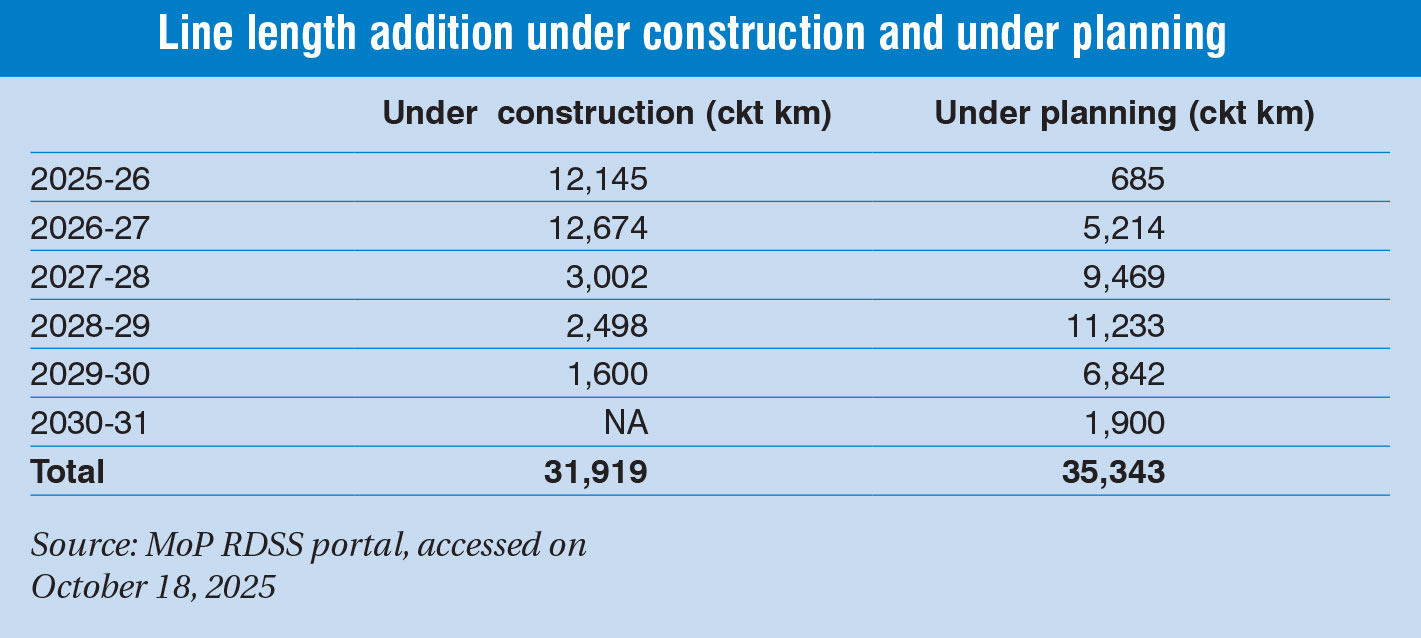
As per CTUIL’s Interstate Transmission System (ISTS) Rolling Plan 2030-31 (interim report September 2025), by 2030-31, transmission schemes comprising 67,263 ckt km of transmission lines and a transformation capacity of 6,29,597 MVA, at an estimated cost of Rs. 4,855.93 billion, are expected to be added. Likewise, interregional capacity is expected to reach 161,540 MW by 2030-31. The all-India installed generation capacity is likely to reach 917 GW, while the peak demand is anticipated to reach 351 GW by 2030-31. Given the anticipated growth in electricity transmission infrastructure in the coming five years, the requirement for towers and structures is likely to accelerate.
In addition, as per the Central Electricity Authority’s (CEA) Manual on Transmission Planning Criteria (Amendment-1), released in January 2025, a provision for planning electric power transmission systems has been introduced. It entails transmission infrastructure planning by different institutions in India. For instance, the CEA has been entrusted with the responsibility of formulating a short-term plan annually on a rolling basis for up to a five-year period and a perspective plan for every alternate year on a rolling basis for the next 10-year period. Similarly, CTUIL will plan for the execution of ISTS for the next five-year period on a rolling basis every year, and the state transmission utility will chart the plan to implement the intra-state transmission system. Accordingly, future augmentation plans for the transmission system, as envisaged by planning and coordination entities, are expected to drive the establishment of towers and structures.
 Design features
Transmission towers and structures support massive transmission conductors at an adequate elevation above the ground. Moreover, as all transmission towers are exposed to various unforeseen weather events, their design aspect becomes crucial. The design indicators for a transmission tower include the length of the insulator strings, ground clearance between the conductors and the tower, location of ground wires, etc.
The right of way (RoW) for transmission towers is another critical aspect for guaranteeing both safety and the effective operation of the transmission system. RoW in transmission tower design denotes the allocated strip of property necessary for a utility to construct, maintain and operate transmission lines and towers. The RoW for a transmission line must be established and maintained in accordance with a number of legal frameworks, such as environmental protection legislation, zoning laws and electrical safety codes.
Transmission tower designs have evolved to reduce RoW restrictions, hasten project completion, withstand various environmental conditions, speed up approvals, and lessen the effects on the community and environment, as obtaining vast land strips for transmission lines has become increasingly difficult, particularly in urban, forested and highly inhabited areas. Over the years, large, lattice-style transmission towers have given way to monopoles and thin base towers, which take up far less space than conventional designs.
 Material features
Climate change mitigation is currently one of the most important challenges globally, which is necessitating tower manufacturing firms to reduce their carbon footprint. This is being achieved by utilising sustainable materials and energy-efficient manufacturing processes in tower manufacturing.
Material selection is a major innovation area for transmission line tower makers. Manufacturers are switching to eco-friendly materials for tower manufacturing, offering performance comparable to that of traditional towers. High-strength, lightweight steel grades and composites are paving the way for a greener future in transmission tower manufacturing. Further, in transmission and distribution projects, tower manufacturing companies are adopting environmentally friendly building materials, such as recycled materials, low-carbon steel and cutting-edge engineering techniques that utilise fewer resources.
Tower failure
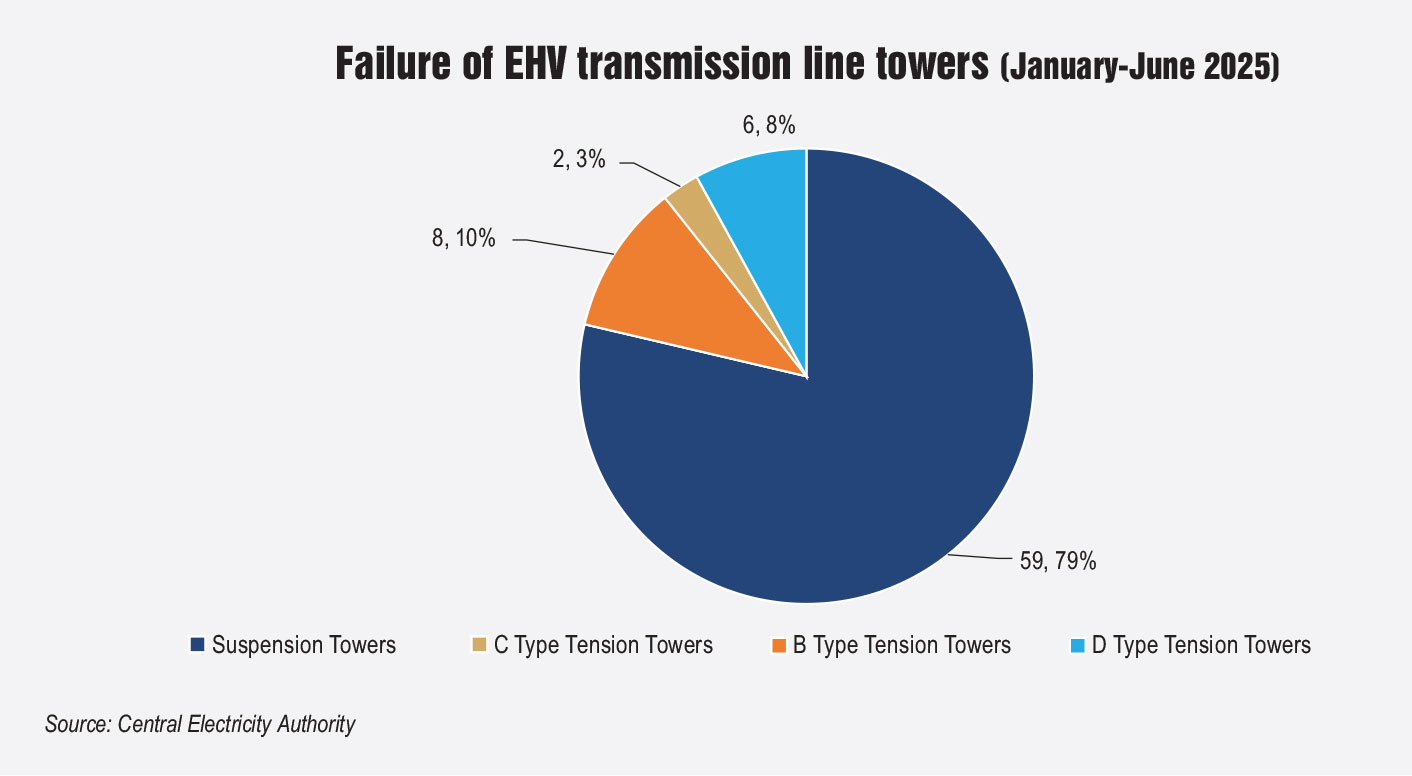
As per the CEA’s standing committee of experts on extra-high voltage (EHV) transmission tower failure between January 2025 to June 2025, it has been noted that the failure rate of a suspension-type tower was significantly higher than that of a tension-type tower. A possible reason is that, in regular terrain, the number of suspension towers in any given line is typically substantially higher than the number of tension towers. Moreover, the failure of one suspension-type tower produces secondary failure of nearby suspension towers due to the pulling force of conductors. Furthermore, suspension-type towers are not built to take horizontal forces in the longitudinal direction.
Many factors impact the structural integrity of transmission towers, including technical standards/code requirements considered for design, quality of material used to manufacture towers, construction methodology, artisanship and tower erection practices, transmission utility operations, and maintenance practices.
To minimise tower failures, transmission utilities must emphasise line patrolling and replace missing members/bolts immediately. Towers located in rivers or creek beds, on river banks with scourable strata, or in areas where river flow or change in river course is anticipated, must have pile-type foundations based on indicators such as detailed soil investigation and previous years’ maximum flood discharge, maximum velocity, highest flood level, scour depth and anticipated river course change based on river morphology data of at least 20 years to ensure availability and resiliency.
The way forward
India’s transmission sector requires tower and structure management technology for reliable electricity delivery, data-driven grid optimisation, and safe, sustainable infrastructure growth.
The transmission industry is gradually leading the way in embracing cutting-edge technology. Transmission utilities are deploying emergency restoration towers in the aftermath of natural disasters. Project developers are using light detection and ranging technology, drones and air cranes to build transmission lines, as well as thermovision cameras and Android-based applications for operations and maintenance.
Asset management in transmission towers is likely to help overcome tough terrain, isolated sites, intense weather and specific soil conditions. Asset management focuses on technology, specialist design and proactive maintenance to safely deploy and reliably and cost-effectively operate transmission towers in complicated geographies. This includes real-time asset monitoring using IoT sensors, drones and satellite-based systems, which allows continuous surveillance in inaccessible or hazardous areas, allowing for early detection of tilts, corrosion or structural hazards.